
Free · Printable · Current syllabus
PSLE Maths Cheat Sheet
The short version
The formulas and rules from P3 to P6 that your child must know by heart for the PSLE: 77 of them across 18 topics, on 11 A4 pages to print free. The PSLE paper gives no formula list, and recalling formulae is the first thing it assesses.
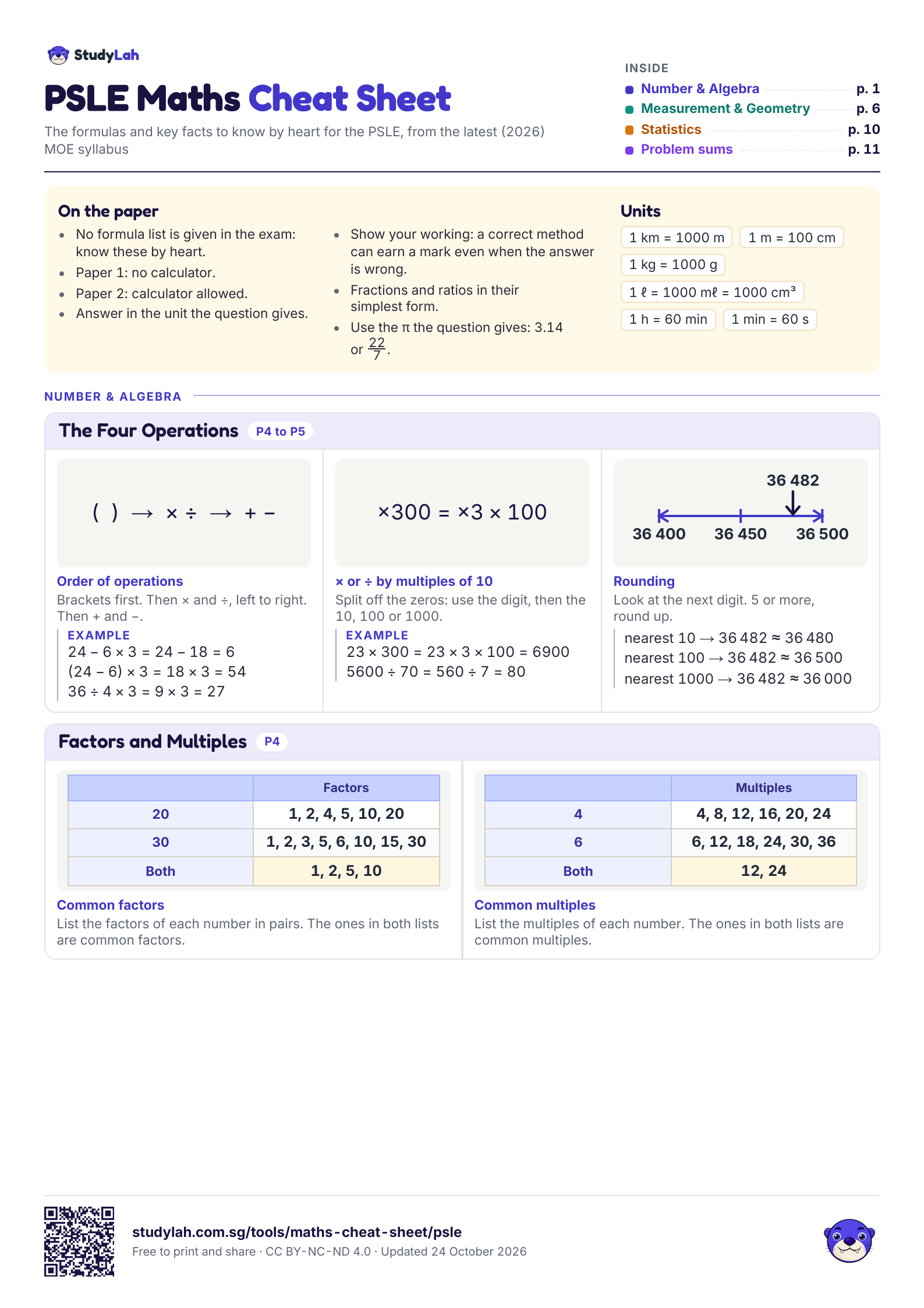
From SEAB's PSLE Maths syllabus
PSLE Maths: the formula list, calculators, units and working
No formula list
SEAB's syllabus for the paper lists no formula sheet: recalling formulae is the first thing it assesses.
A calculator in Paper 2 only
Paper 1, Booklets A and B, is done without one.
The unit is given
Each answer's unit is printed, and the answer must be in that unit.
Working earns marks
A wrong answer with the correct method can still score a mark, and long questions ask for every step.
The PSLE maths formulas to know by heart, by topic
| Rule | Example |
|---|---|
| Order of operationsBrackets first. Then × and ÷, left to right. Then + and −. | |
| × or ÷ by multiples of 10Split off the zeros: use the digit, then the 10, 100 or 1000. | |
| RoundingLook at the next digit. 5 or more, round up. | nearest 10 → nearest 100 → nearest 1000 → See it drawn |
| Rule | Example |
|---|---|
| Common factorsList the factors of each number in pairs. The ones in both lists are common factors. | See it drawn |
| Common multiplesList the multiples of each number. The ones in both lists are common multiples. | See it drawn |
| Rule | Example |
|---|---|
| Simplest formDivide the numerator and the denominator by the same number, until no number divides both. | See it drawn |
| Mixed number to improper fractionEach whole is 5 fifths. Count all the fifths. | fifths → See it drawn |
| Add or subtract fractionsSame denominators first. Then add or take away the numerators. | See it drawn |
| Division as a fractionA whole number ÷ a whole number is a fraction. | See it drawn |
| Fraction of a quantity"Of" means ×. Or find 1 unit first. | 1 unit → 3 units → See it drawn |
| Fraction × fractionNumerator × numerator, denominator × denominator, then simplify. A mixed number: make it improper first. | See it drawn |
| Fraction ÷ whole number: share it out | See it drawn |
| Whole ÷ fraction: how many fit? | See it drawn |
| ÷ a fraction: Keep, Change, Flip |
| Rule | Example |
|---|---|
| Decimals and fractionsDecimal to fraction: over 10, 100 or 1000, then simplify. Fraction to decimal: divide. | See it drawn |
| Rounding decimalsLook at the next digit. 5 or more, round up. | nearest whole number → 1 decimal place → 2 decimal places → See it drawn |
| × or ÷ by 10, 100, 1000× moves every digit 1, 2 or 3 places left. ÷ moves them right. | See it drawn |
| Changing unitsTo a bigger unit, ÷. To a smaller unit, ×. | 4500 cm → See it drawn |
| Rule | Example |
|---|---|
| Part as a percentage | 18 out of 24 → See it drawn |
| Percentage of a quantity | 15% of $60 → See it drawn |
| 30% is $45: find 10%, then 100% | 10% → 100% → See it drawn |
| Percentage change | $40 to $50 → $50 to $40 → See it drawn |
| DiscountPrice after discount = usual price − discount | 20% off $45 → pay → See it drawn |
| GSTPrice with GST = price + GST. Use the rate the question gives. | 9% GST on $200 → pay → See it drawn |
| Annual interestA percentage of the money saved, paid each year. | 3% a year on $2500 → after 1 year → See it drawn |
| Rule | Example |
|---|---|
| RateThe amount for 1 unit. Number of units = total ÷ rate. | $42 for 6 kg → See it drawn |
| Total amount | 9 kg → See it drawn |
| Rule | Example |
|---|---|
| Share $84 in the ratio 3 : 4. Find 1 unit first.3 + 4 = 7 units in all. | 1 unit → A → B → See it drawn |
| Boys : girls = 3 : 5 | boys as a fraction of girls → boys as a fraction of all → See it drawn |
| Simplest form: ÷ every term by the same number | |
| Equivalent ratios: × or ÷ every term by the same number | 3 : 4 = ? : 20 → |
| Rule | Example |
|---|---|
| A letter stands for an unknown number | See it drawn |
| Add or take away like terms only | |
| Substitute a = 4 into 3a + 6 | |
| Solve 2x + 5 = 17: undo each step, then check | 2x → x → check → See it drawn |
| Rule | Example |
|---|---|
| Number pattern: the nth termThe 20th term is 19 jumps after the first. | 20th term → See it drawn |
| Repeating patternDivide by the length of the repeat. The remainder is the place in the repeat. | 50th, repeat of 4 → See it drawn |
| Rule | Example |
|---|---|
| 24-hour clockAfter 12 noon, add 12 to the hour. Midnight is 00 00. | See it drawn |
| How long it takesCount on to the next hour, then whole hours, then the minutes left. | 9.45 a.m. to 11.15 a.m. → See it drawn |
| Rule | Example |
|---|---|
| Angles in a right angleThey add up to 90°. Every corner of a rectangle is 90°. | ∠y → See it drawn |
| Angles on a straight line | See it drawn |
| Angles at a point | See it drawn |
| Vertically opposite angles are equal | See it drawn |
| Angles in a triangle | See it drawn |
| Isosceles triangle: 2 equal sides, 2 equal base angles | See it drawn |
| Equilateral triangle: every angle is 60° | See it drawn |
| Angles in a quadrilateral | See it drawn |
| Parallelogram, rhombus: opposite angles are equal | See it drawn |
| Trapezium: the angles between parallel sides | See it drawn |
| Cube6 equal square faces. A dotted line is a hidden edge. | See it drawn |
| Cuboid6 rectangle faces, in 3 matching pairs. | See it drawn |
| Rule | Example |
|---|---|
| Rectangle: area A, perimeter Pl = length, b = breadth. Breadth from the area: A ÷ l. | breadth → See it drawn |
| Square: area A, perimeter Ps = side. The side from the perimeter: P ÷ 4. | side → See it drawn |
| Area of a triangleb = base, h = height. | See it drawn |
| The height can be outsideIt is always at right angles to the base. | See it drawn |
| Composite figuresArea: split into rectangles, then add. Perimeter: the outside edge only. | area → perimeter → See it drawn |
| Rule | Example |
|---|---|
| Volume of a cuboida cube: edge × edge × edge | See it drawn |
| Height of a cuboid | 360 cm³, base 40 cm² → See it drawn |
| Area of a face | 480 cm³, h = 6 cm → See it drawn |
| Edge of a cube | 343 cm³ → See it drawn |
| Water added or taken outWater added or taken out = l × b × the change in height. | See it drawn |
| Litres and cm³1 mℓ = 1 cm³ |
| Rule | Example |
|---|---|
| Diameter and radius | See it drawn |
| Circumference: the distance around | See it drawn |
| Area of a circle | See it drawn |
| Half circle: perimeter | See it drawn |
| Quarter circle: perimeter | See it drawn |
| Half or quarter circle: area | See it drawn |
| Composite figuresArea: add or take away. Perimeter: the outside edge only. | square − quarter circle → See it drawn |
| Rule | Example |
|---|---|
| Count cubes layer by layerCount each layer, from the bottom up. | bottom to top → See it drawn |
| Front and side viewsLook straight at one face. Draw only the squares you see. | See it drawn |
| Rule | Example |
|---|---|
| Read the scale firstFind what one step on the scale is worth first. | half of a step of 10 → Tuesday → See it drawn |
| Read a line graphRead each point against the scale. The steepest rise is the biggest change. | Wed to Thu → See it drawn |
| Rule | Example |
|---|---|
| A sector is a fraction of the wholeA right-angle mark is a quarter of the circle. A straight line across the centre cuts it in half. | See it drawn |
| A part from the totalPart = fraction × total. Total = part ÷ fraction. | a quarter of 120 → total → See it drawn |
| Rule | Example |
|---|---|
| Average | See it drawn |
| Total from the average | 3 numbers, average 14 → See it drawn |
PSLE maths revision notes, topic by topic
The Four Operations
P4 to P5- Order of operationsBrackets first. Then × and ÷, left to right. Then + and −.Example
- × or ÷ by multiples of 10Split off the zeros: use the digit, then the 10, 100 or 1000.Example
- RoundingLook at the next digit. 5 or more, round up.nearest 10 → nearest 100 → nearest 1000 →
Point Value 36 482 36482
- Common factorsList the factors of each number in pairs. The ones in both lists are common factors.
Factors 20 1, 2, 4, 5, 10, 20 30 1, 2, 3, 5, 6, 10, 15, 30 Both 1, 2, 5, 10 - Common multiplesList the multiples of each number. The ones in both lists are common multiples.
Multiples 4 4, 8, 12, 16, 20, 24 6 6, 12, 18, 24, 30, 36 Both 12, 24
Fractions
P3 to P6- Simplest formDivide the numerator and the denominator by the same number, until no number divides both.
- Mixed number to improper fractionEach whole is 5 fifths. Count all the fifths.fifths →
- Add or subtract fractionsSame denominators first. Then add or take away the numerators.
- Division as a fractionA whole number ÷ a whole number is a fraction.
- Fraction of a quantity"Of" means ×. Or find 1 unit first. 1 unit → 3 units →
- Fraction × fractionNumerator × numerator, denominator × denominator, then simplify. A mixed number: make it improper first.
- Fraction ÷ whole number: share it out
- Whole ÷ fraction: how many fit?
- ÷ a fraction: Keep, Change, Flip
Decimals
P4 to P5- Decimals and fractionsDecimal to fraction: over 10, 100 or 1000, then simplify. Fraction to decimal: divide.
- Rounding decimalsLook at the next digit. 5 or more, round up.nearest whole number → 1 decimal place → 2 decimal places →
Point Value 5.374 5.374 - × or ÷ by 10, 100, 1000× moves every digit 1, 2 or 3 places left. ÷ moves them right.
Hundreds Tens Ones . Tenths Hundredths Thousandths 2.375 2 . 3 7 5 × 100 2 3 7 . 5 - Changing unitsTo a bigger unit, ÷. To a smaller unit, ×.4500 cm →cm4500÷ 100m45÷ 1000km0.045
Percentage
P5 to P6- Part as a percentageExample18 out of 24 →
- Percentage of a quantity15% of $60 →
- 30% is $45: find 10%, then 100%10% → 100% →
- Percentage changeExample$40 to $50 → $50 to $40 →
- DiscountPrice after discount = usual price − discount20% off $45 → pay →
- GSTPrice with GST = price + GST. Use the rate the question gives.9% GST on $200 → pay →
- Annual interestA percentage of the money saved, paid each year.3% a year on $2500 → after 1 year →
Rate
P5- RateThe amount for 1 unit. Number of units = total ÷ rate.Example$42 for 6 kg →
- Total amountExample9 kg →
Ratio
P6- Boys : girls = 3 : 5boys as a fraction of girls → boys as a fraction of all →
- Simplest form: ÷ every term by the same number
- Equivalent ratios: × or ÷ every term by the same number 3 : 4 = ? : 20 →
Algebra
P6- A letter stands for an unknown number
- Add or take away like terms only
- Substitute a = 4 into 3a + 6
- Solve 2x + 5 = 17: undo each step, then check2x → x → check →
- Number pattern: the nth termThe 20th term is 19 jumps after the first.Example20th term →
- Repeating patternDivide by the length of the repeat. The remainder is the place in the repeat.50th, repeat of 4 →
Time
P3- 24-hour clockAfter 12 noon, add 12 to the hour. Midnight is 00 00.
12-hour 24-hour 9.05 a.m. 09 05 12 noon 12 00 3.15 p.m. 15 15 midnight 00 00 - How long it takesCount on to the next hour, then whole hours, then the minutes left.9.45 a.m. to 11.15 a.m. →
Span Gap 9.45 a.m. → 10 a.m. 15 min 10 a.m. → 11 a.m. 1 h 11 a.m. → 11.15 a.m. 15 min
Geometry
P4 to P6- Angles in a right angleThey add up to 90°. Every corner of a rectangle is 90°.∠y →
- Angles on a straight line
- Angles at a point
- Vertically opposite angles are equal
- Angles in a triangle
- Isosceles triangle: 2 equal sides, 2 equal base angles
- Equilateral triangle: every angle is 60°
- Angles in a quadrilateral
- Parallelogram, rhombus: opposite angles are equal
- Trapezium: the angles between parallel sides
- Cube6 equal square faces. A dotted line is a hidden edge.
- Cuboid6 rectangle faces, in 3 matching pairs.
Area & Perimeter
P3 to P5- Rectangle: area A, perimeter Pl = length, b = breadth. Breadth from the area: A ÷ l.Example breadth →
- Square: area A, perimeter Ps = side. The side from the perimeter: P ÷ 4.Example side →
- Area of a triangleb = base, h = height.Example
- The height can be outsideIt is always at right angles to the base.
- Composite figuresArea: split into rectangles, then add. Perimeter: the outside edge only.area → perimeter →
Volume
P5 to P6- Volume of a cuboida cube: edge × edge × edge
- Height of a cuboidExample360 cm³, base 40 cm² →
- Area of a faceExample480 cm³, h = 6 cm →
- Edge of a cubeExample343 cm³ →
- Water added or taken outWater added or taken out = l × b × the change in height.
- Litres and cm³1 mℓ = 1 cm³Example
- Diameter and radius
- Circumference: the distance aroundExample
- Area of a circleExample
- Half circle: perimeterExample
- Quarter circle: perimeterExample
- Half or quarter circle: areaExample
- Composite figuresArea: add or take away. Perimeter: the outside edge only.square − quarter circle →
- Count cubes layer by layerCount each layer, from the bottom up.bottom to top →
- Front and side viewsLook straight at one face. Draw only the squares you see.
Graphs & Tables
P3 to P4- Read the scale firstFind what one step on the scale is worth first.half of a step of 10 → Tuesday →
Category Number of cups Mon 30 Tue 25 Wed 40 - Read a line graphRead each point against the scale. The steepest rise is the biggest change.Wed to Thu →
Series 1 Mon 20 Tue 30 Wed 40 Thu 70 Fri 60
- A sector is a fraction of the wholeA right-angle mark is a quarter of the circle. A straight line across the centre cuts it in half.
Category Share Value half ? ? quarter ? ? quarter ? ? - A part from the totalPart = fraction × total. Total = part ÷ fraction.a quarter of 120 → total →
Category Share Value ? ? ? half ? ? quarter ? ?
Average
P6- AverageExample
- Total from the averageExample3 numbers, average 14 →
Every formula, level by level
This sheet keeps what to know by heart. The level sheets hold all 253 formulas and rules, one level at a time.
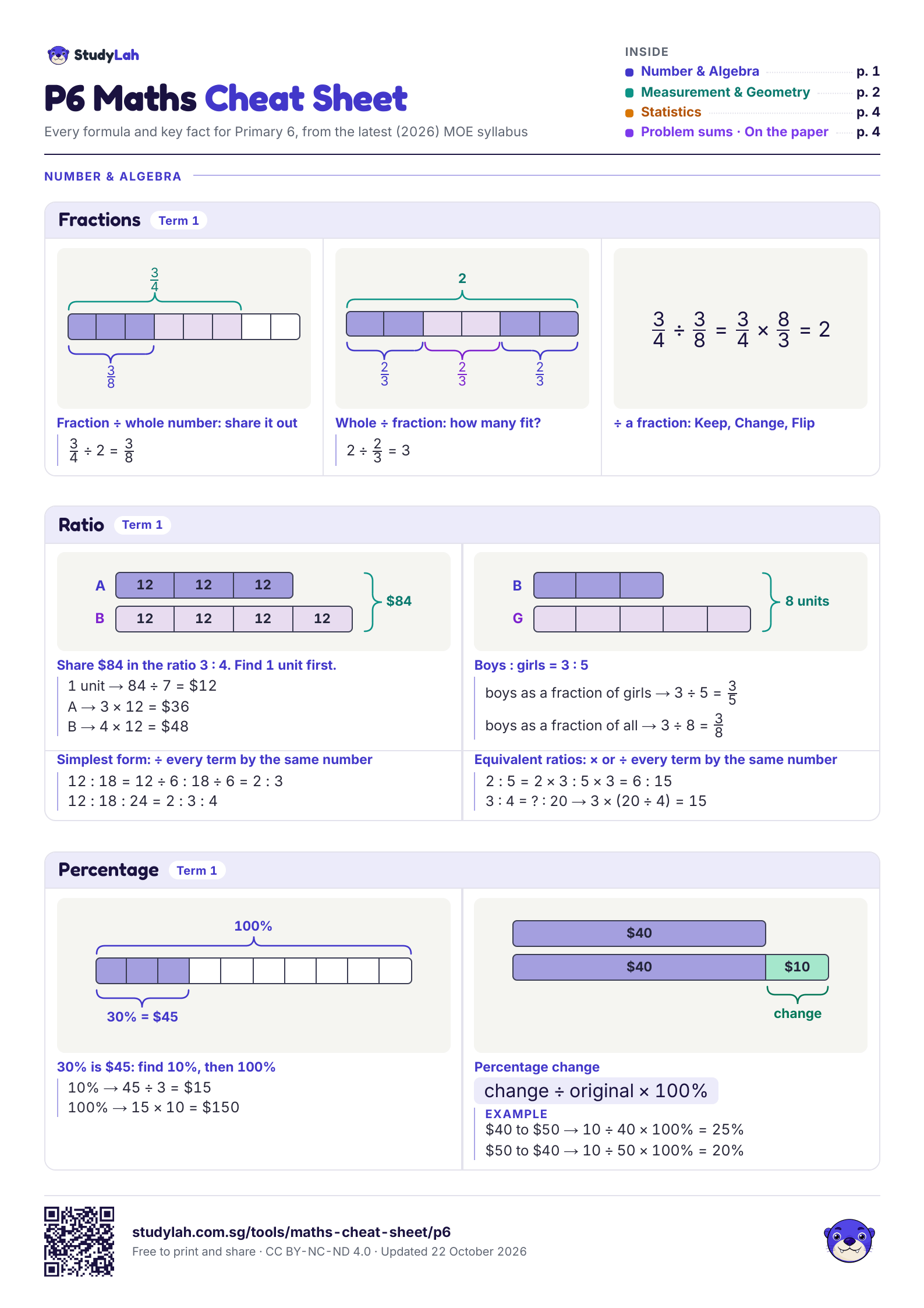
P6 Maths Cheat Sheet
36 formulas and rules · 8 topics · 6 problem-sum methods · 4 A4 pages
- Fractions
- Ratio
- Percentage
- Algebra
- Angles in Geometrical Figures
- Circles
- Volume of Cube and Cuboid
- Average
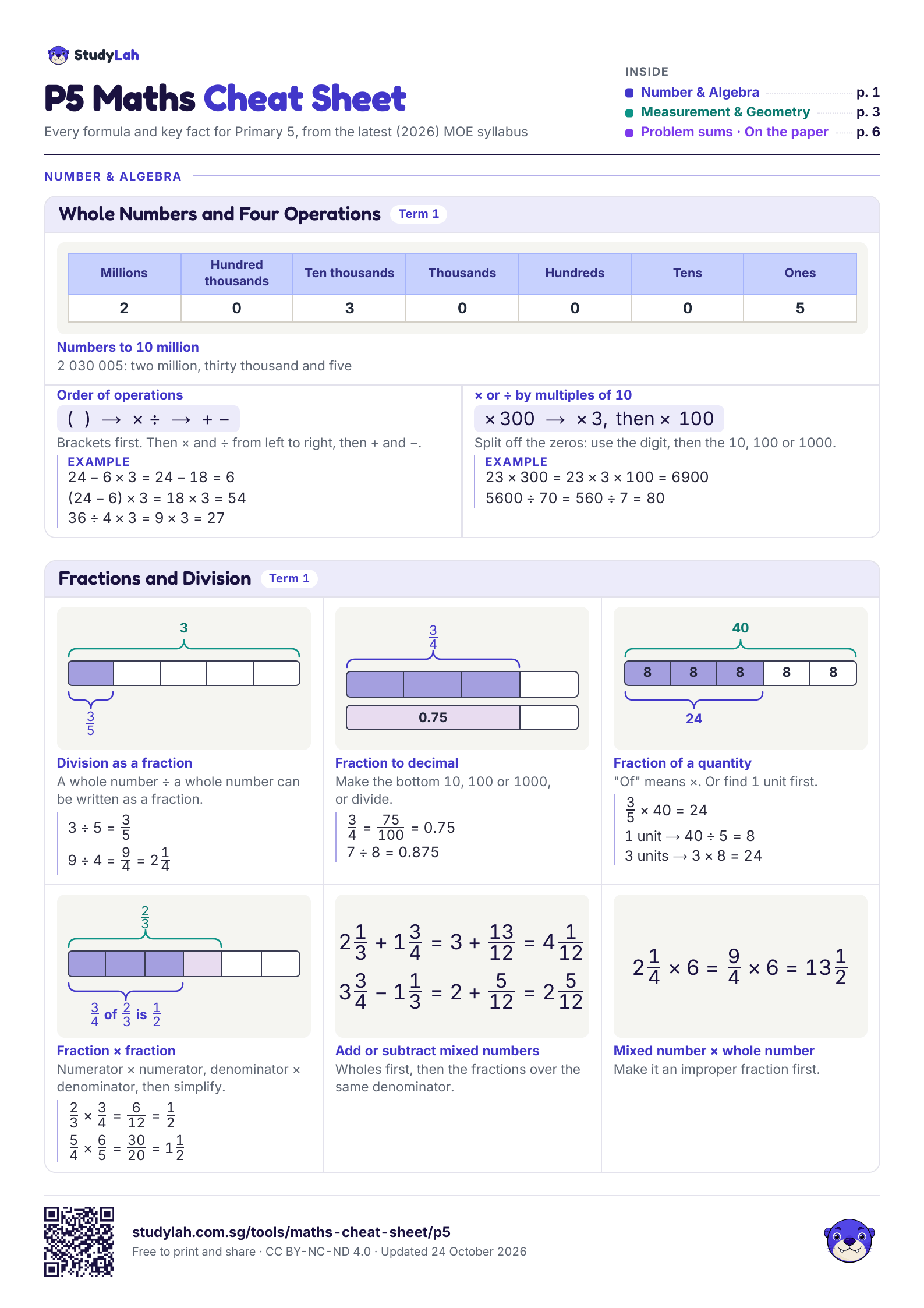
P5 Maths Cheat Sheet
48 formulas and rules · 12 topics · 6 problem-sum methods · 6 A4 pages
- Whole Numbers and Four Operations
- Fractions and Division
- Decimals
- Percentage
- Rate
- Number and Shape Patterns
- Area of Triangle
- Volume of Cube and Cuboid
- Shapes and Spatial Reasoning
- Angles
- Properties of Triangles
- Parallelogram, Rhombus and Trapezium
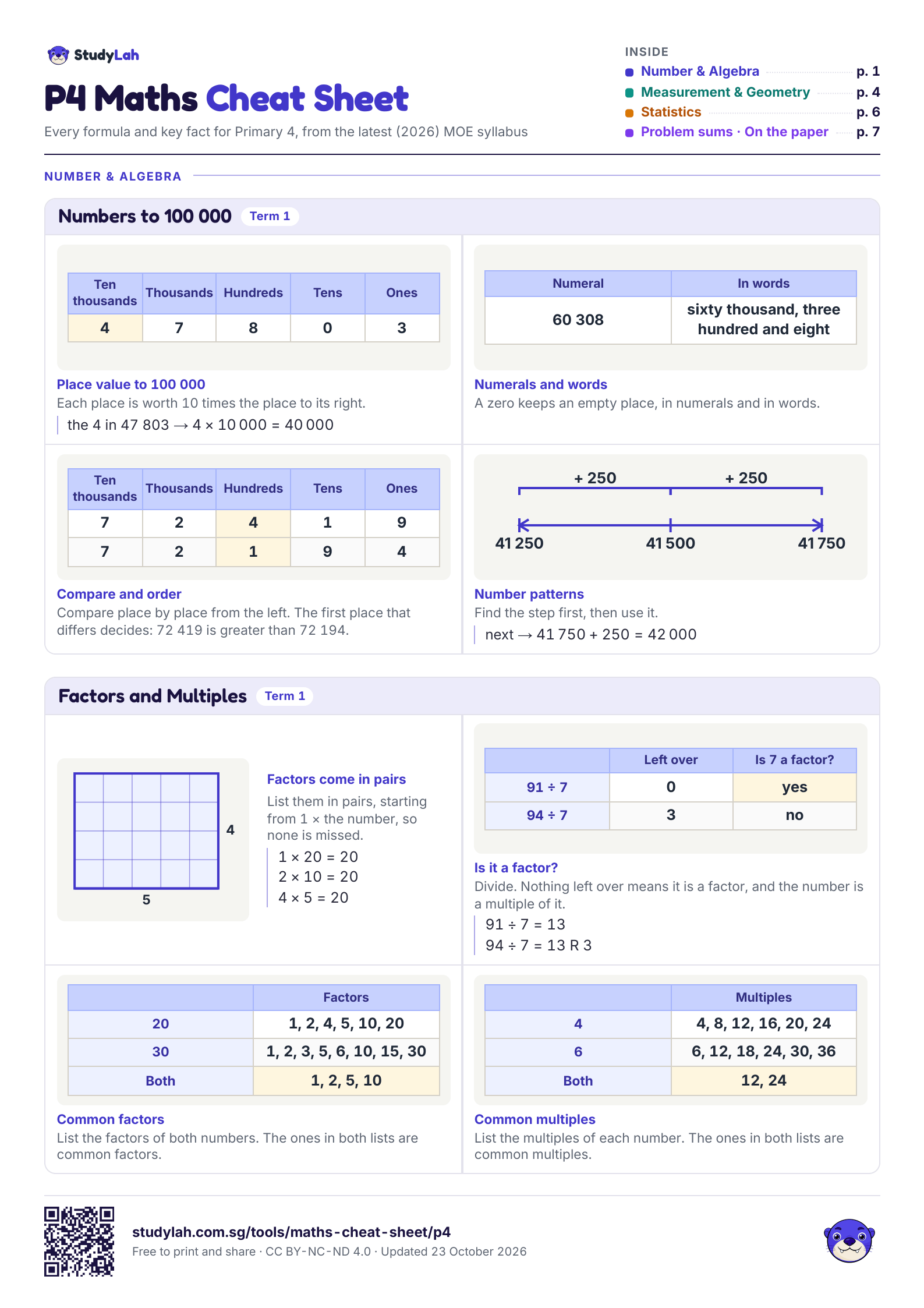
P4 Maths Cheat Sheet
48 formulas and rules · 12 topics · 5 problem-sum methods · 7 A4 pages
- Numbers to 100 000
- Factors and Multiples
- Four Operations of Whole Numbers
- Fractions
- Decimals
- Angles
- Rectangles and Squares
- Area and Perimeter
- Nets
- Symmetry
- Tables and Line Graphs
- Pie Charts
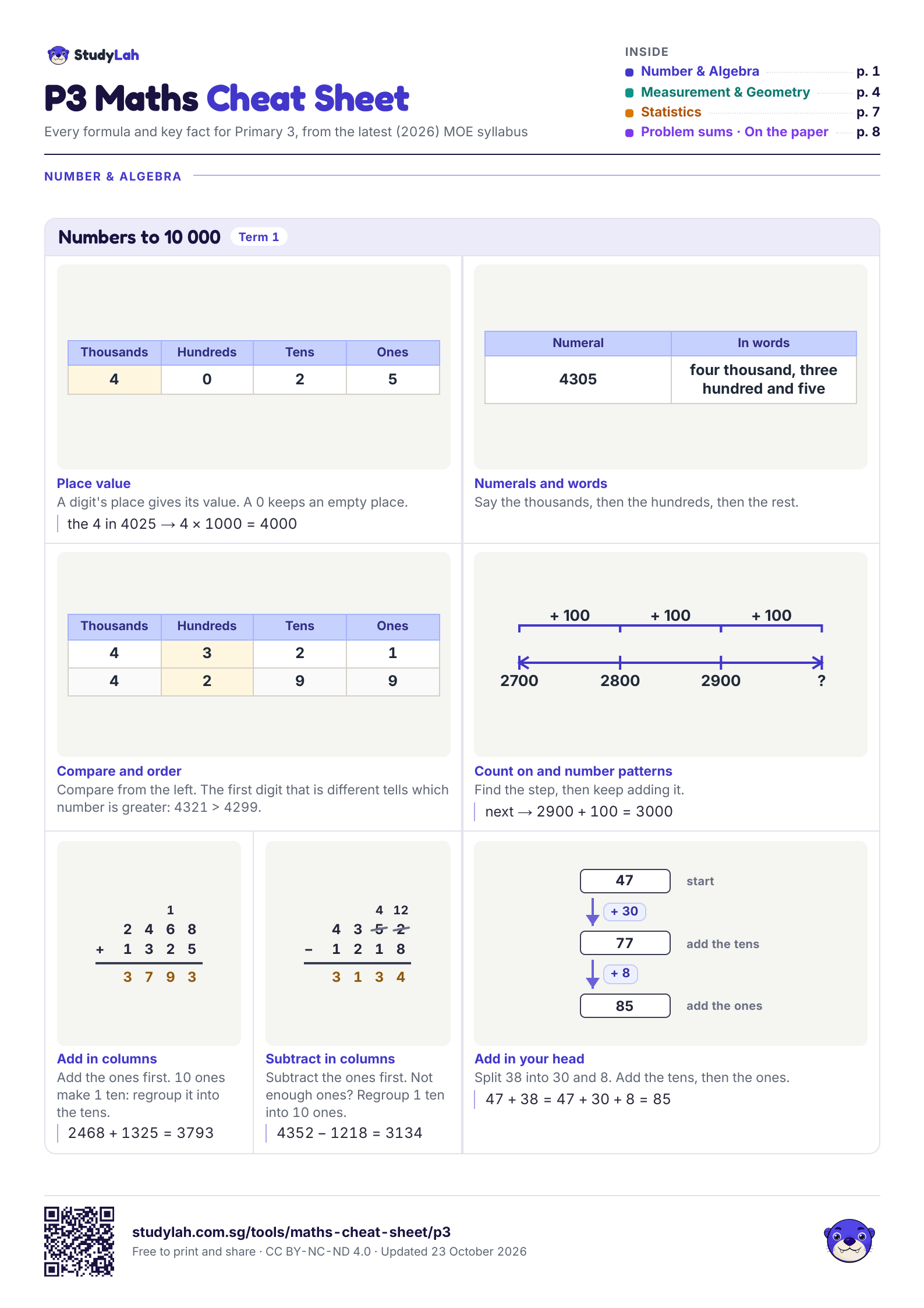
P3 Maths Cheat Sheet
45 formulas and rules · 10 topics · 5 problem-sum methods · 8 A4 pages
- Numbers to 10 000
- Money
- Multiplication and Division
- Fractions
- Angles
- Perpendicular and Parallel Lines
- Length, Mass and Volume
- Area and Perimeter
- Time
- Bar Graphs
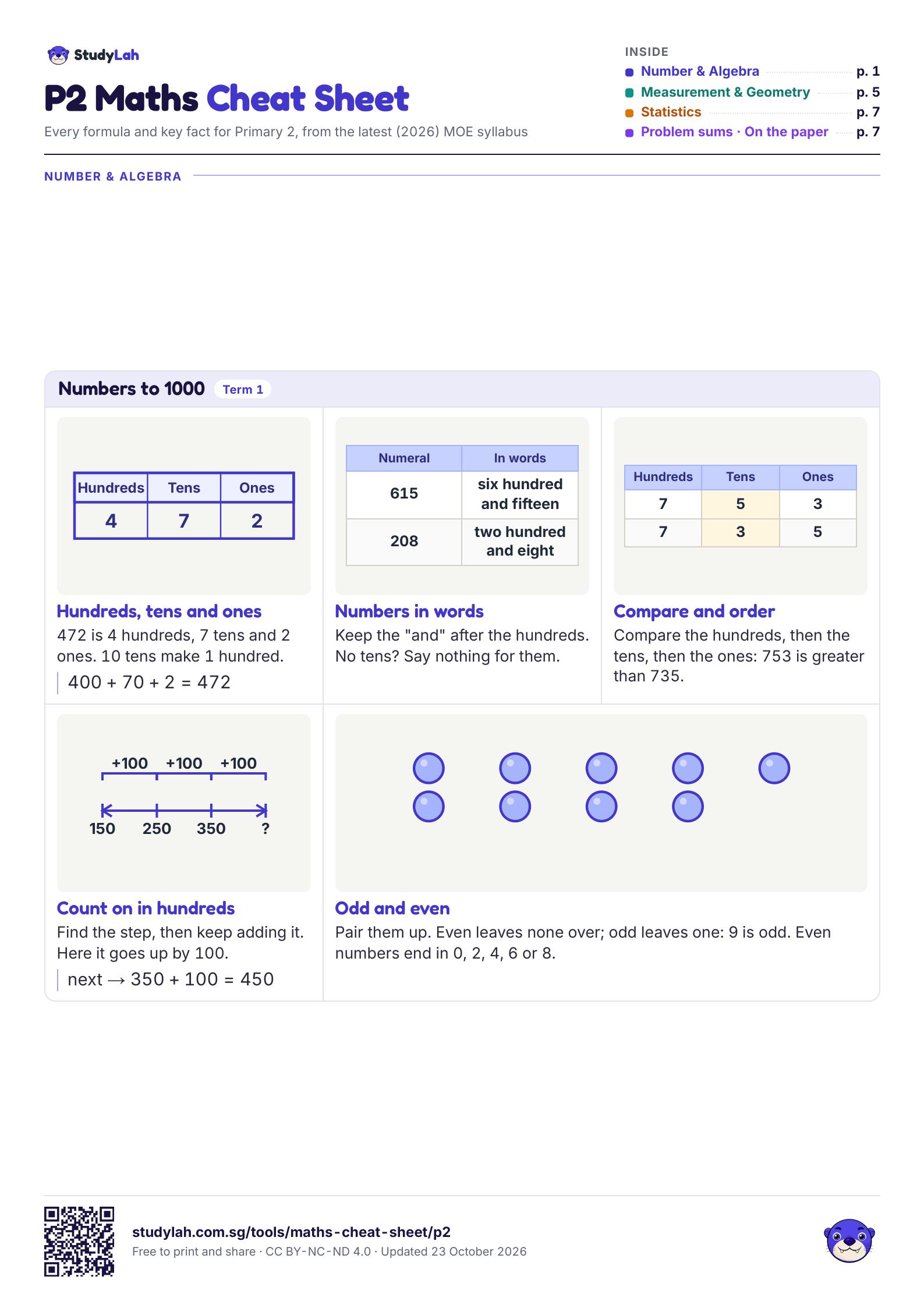
P2 Maths Cheat Sheet
35 formulas and rules · 12 topics · 2 problem-sum methods · 7 A4 pages
- Numbers to 1000
- Addition and Subtraction within 1000
- Multiplication and Division
- Multiplication Tables of 3 and 4
- Fractions
- Money
- Length
- Mass
- Time
- Volume
- Shapes and Patterns
- Picture Graphs
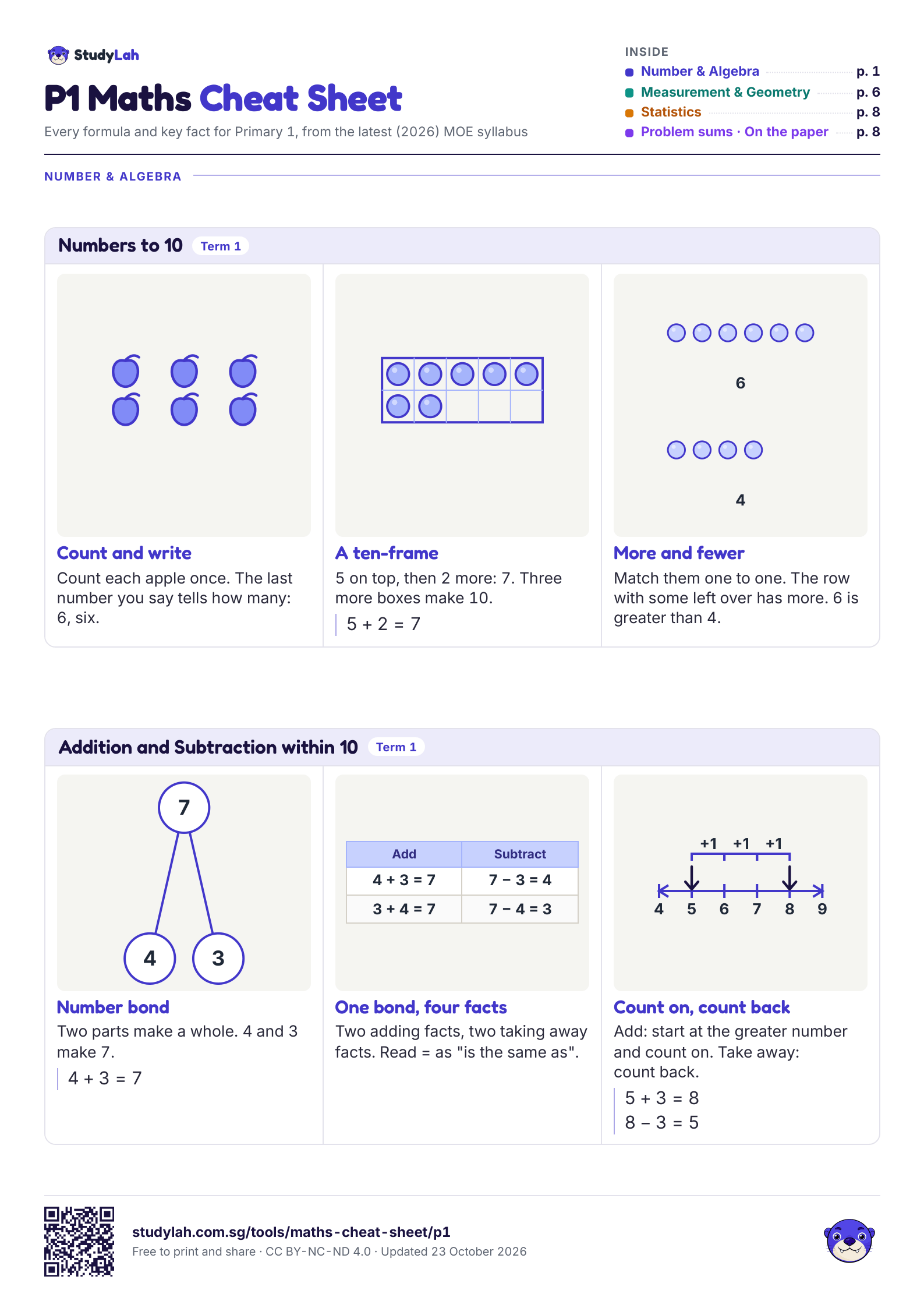
P1 Maths Cheat Sheet
41 formulas and rules · 13 topics · 2 problem-sum methods · 8 A4 pages
- Numbers to 10
- Addition and Subtraction within 10
- Ordinal Numbers and Position
- Numbers to 20
- Addition and Subtraction within 20
- Numbers to 100
- Addition and Subtraction within 100
- Multiplication and Division
- Money
- Shapes
- Length
- Time
- Picture Graphs
The sheet
All 11 pages, full size
The PDF prints sharp on A4. Each page is also an image you can save or send.
PSLE Maths Cheat Sheet, page 1 of 11: formulas for the four operations; and factors and multiples, exam rules and units 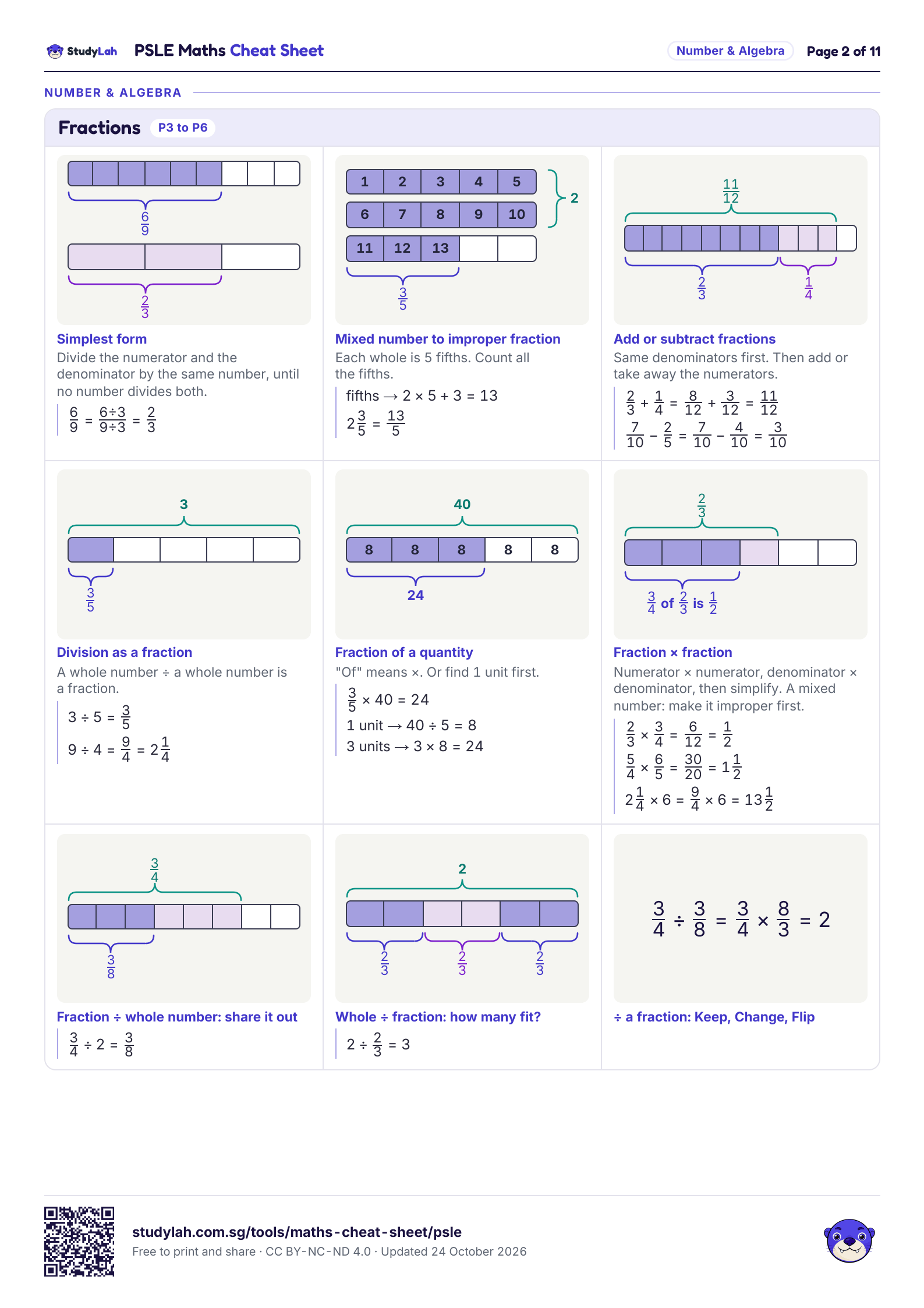
PSLE Maths Cheat Sheet, page 2 of 11: formulas for fractions 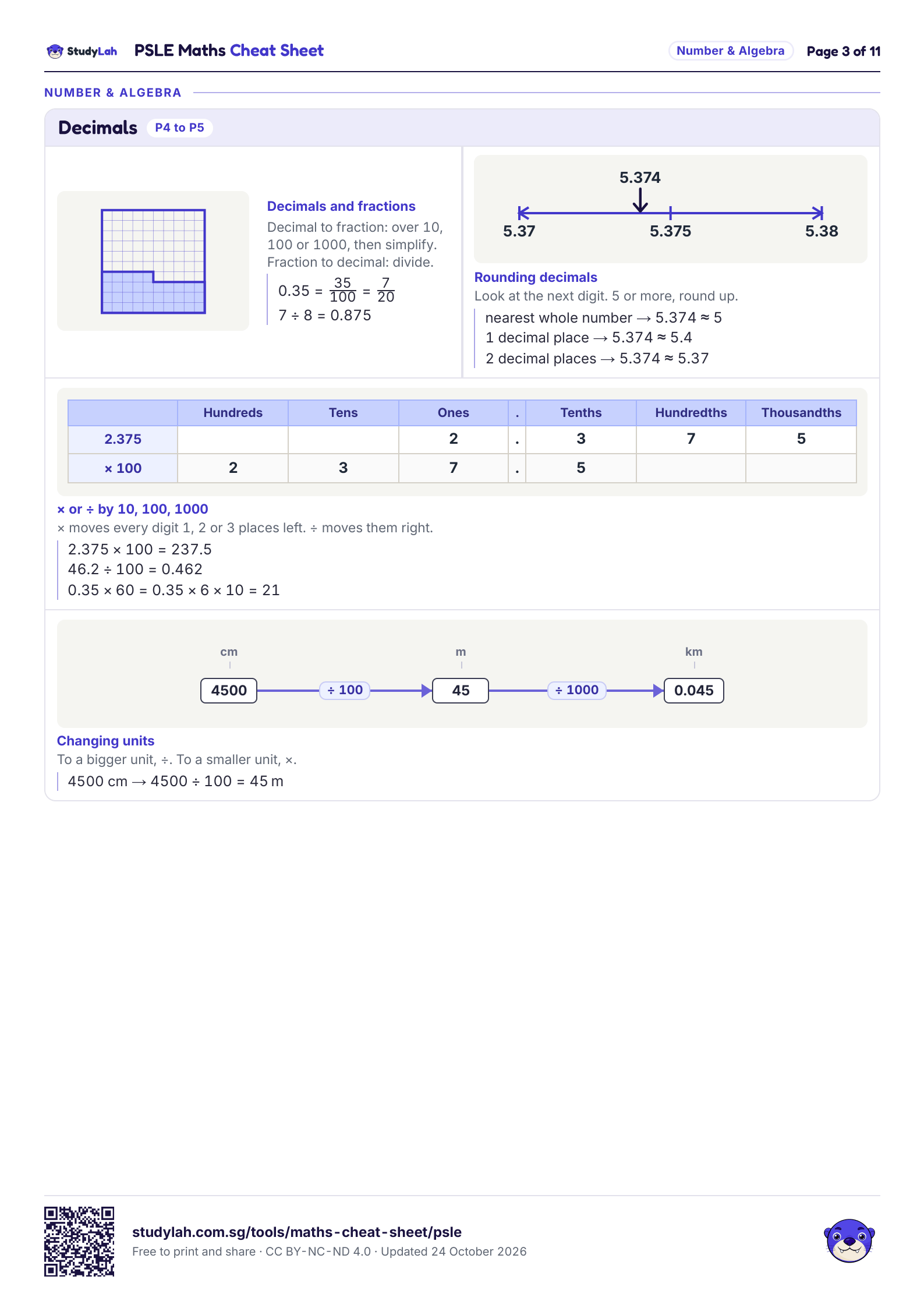
PSLE Maths Cheat Sheet, page 3 of 11: formulas for decimals 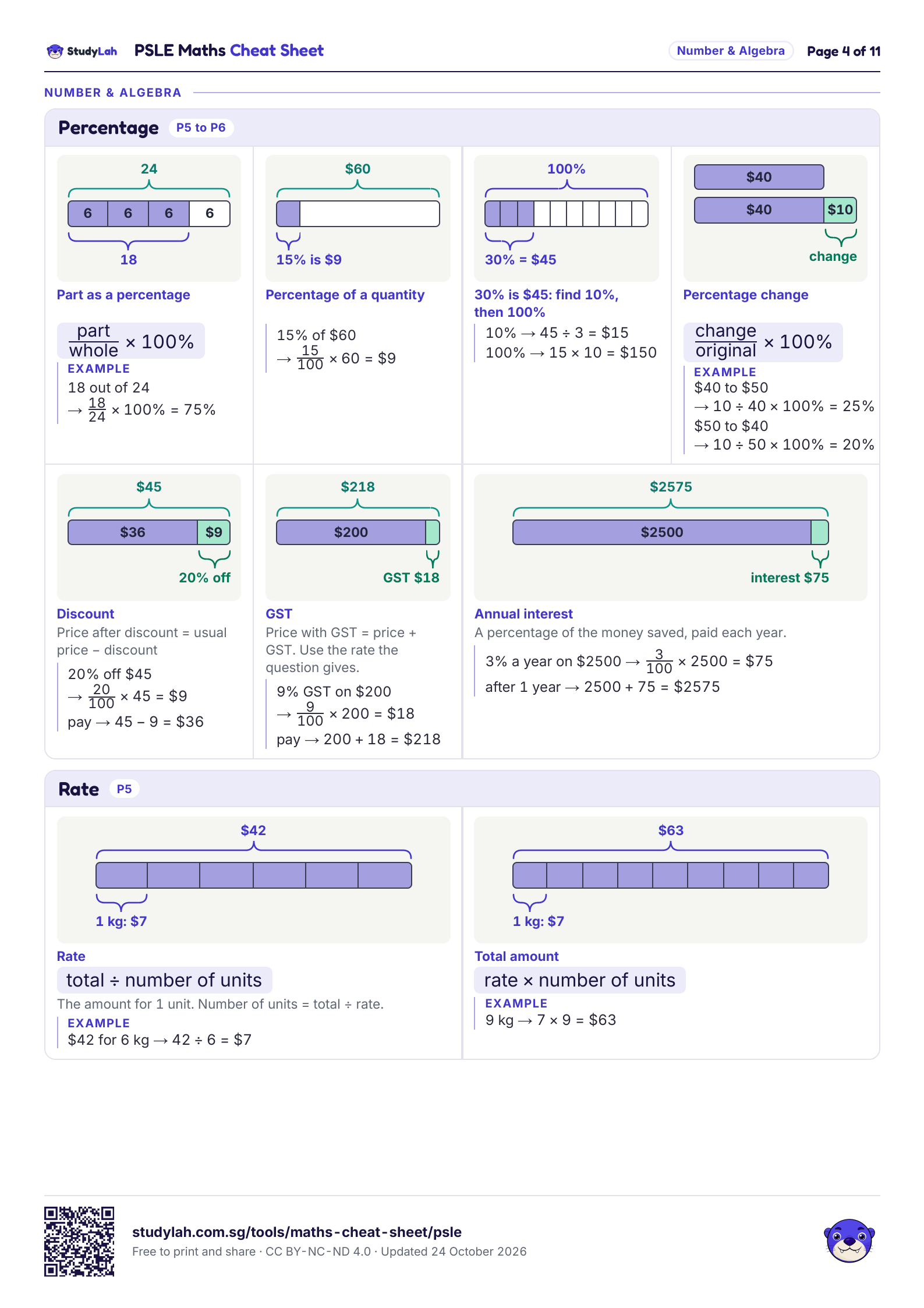
PSLE Maths Cheat Sheet, page 4 of 11: formulas for percentage and rate 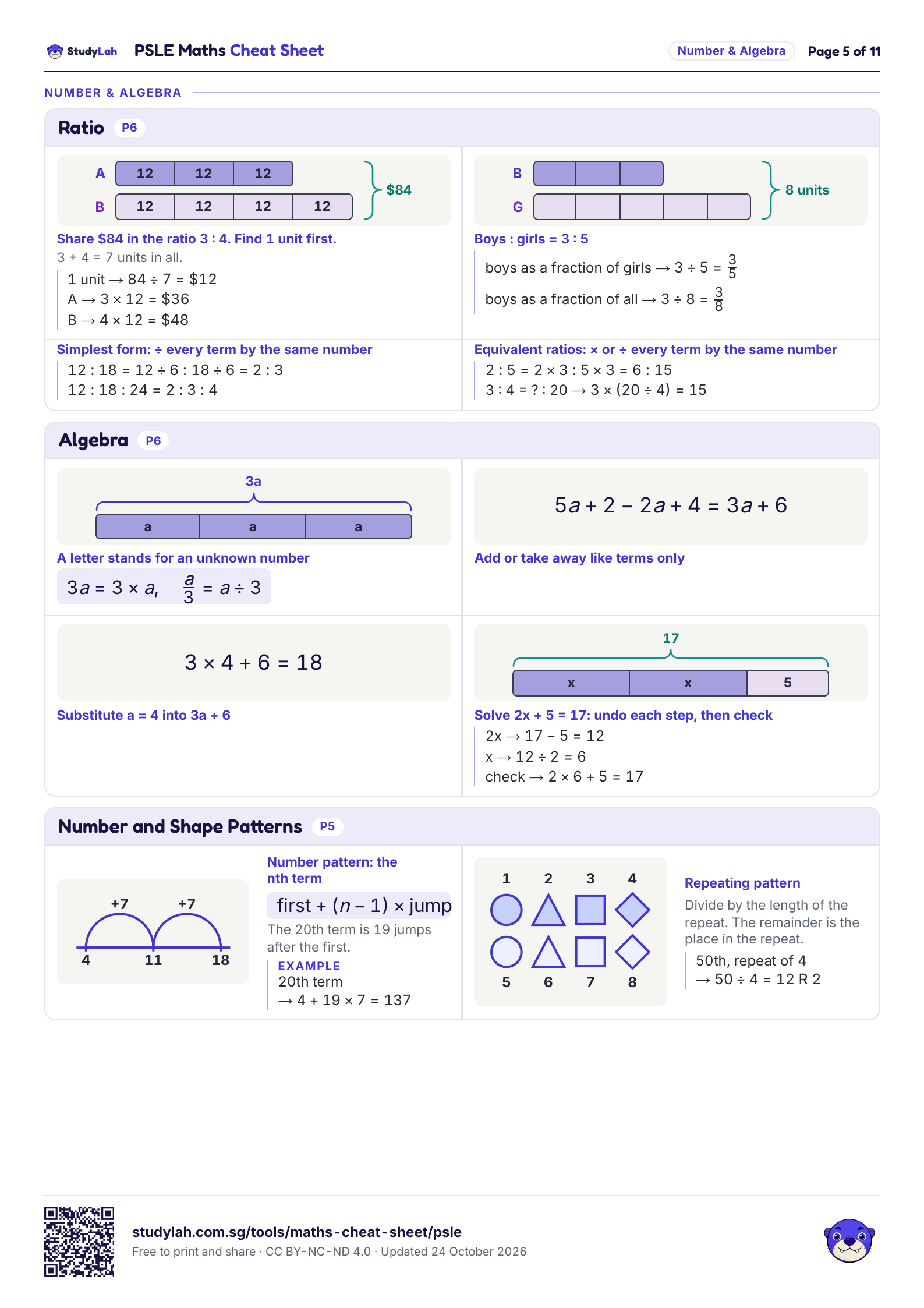
PSLE Maths Cheat Sheet, page 5 of 11: formulas for ratio; algebra; and number and shape patterns 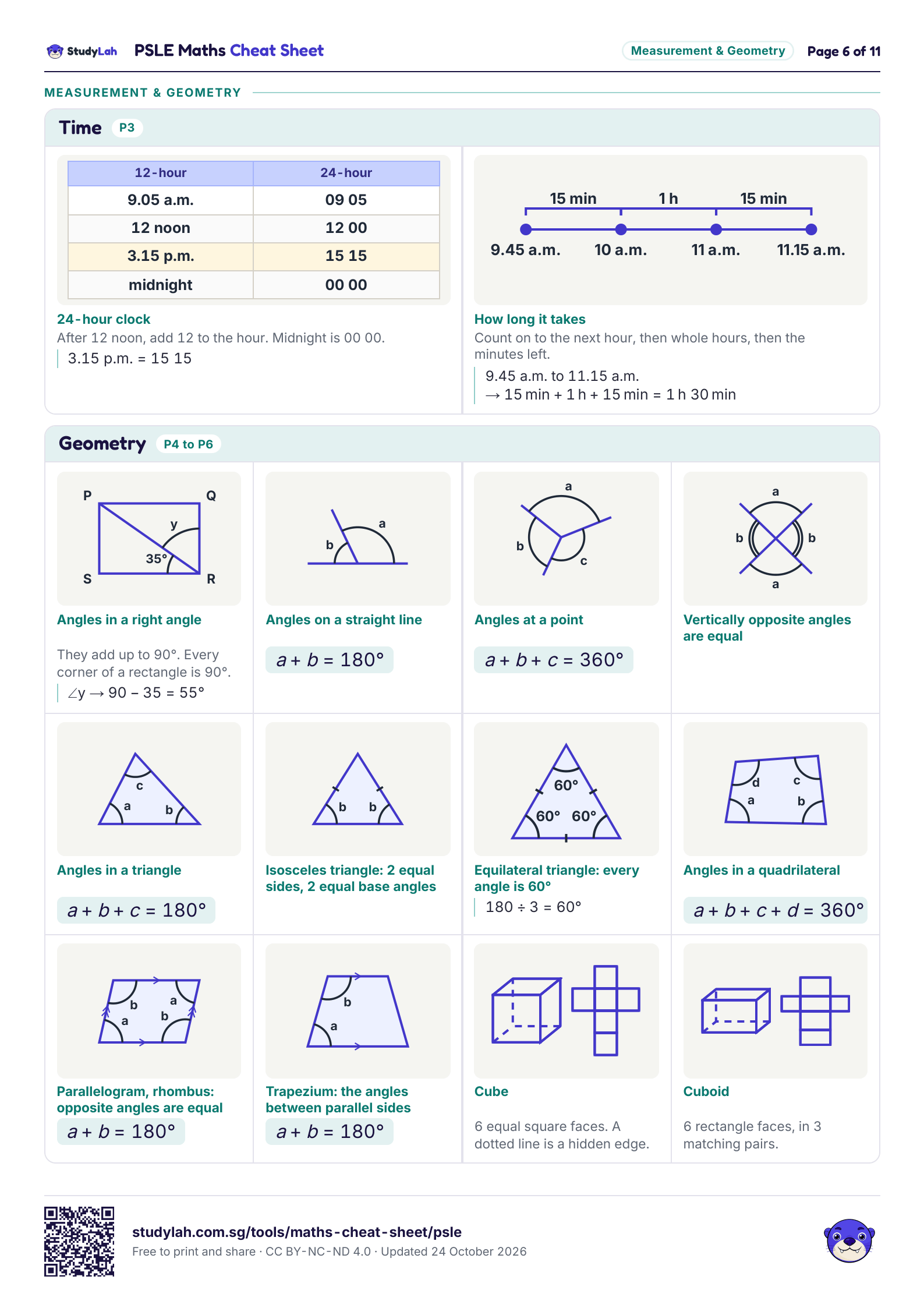
PSLE Maths Cheat Sheet, page 6 of 11: formulas for time and geometry 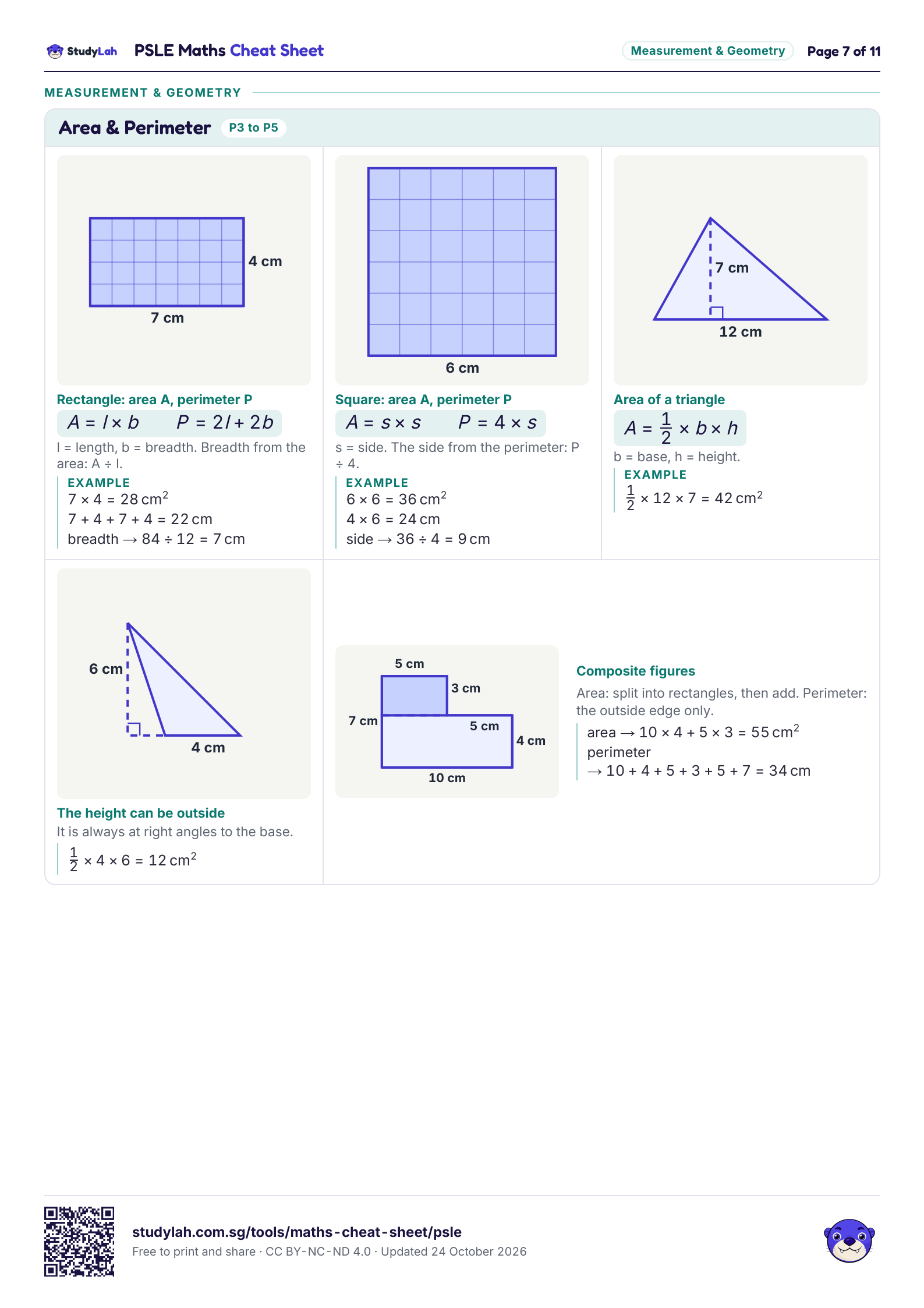
PSLE Maths Cheat Sheet, page 7 of 11: formulas for area & perimeter 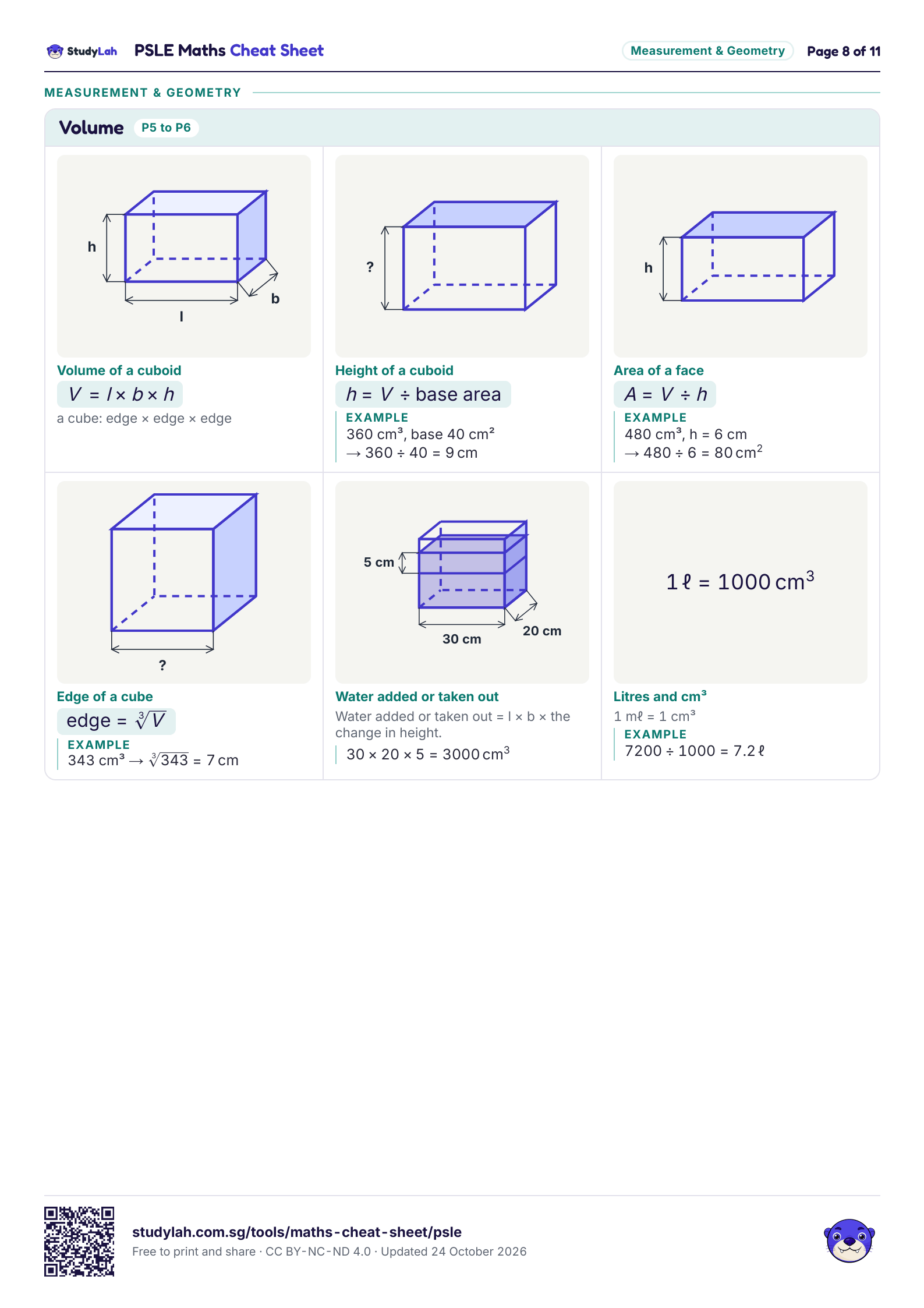
PSLE Maths Cheat Sheet, page 8 of 11: formulas for volume 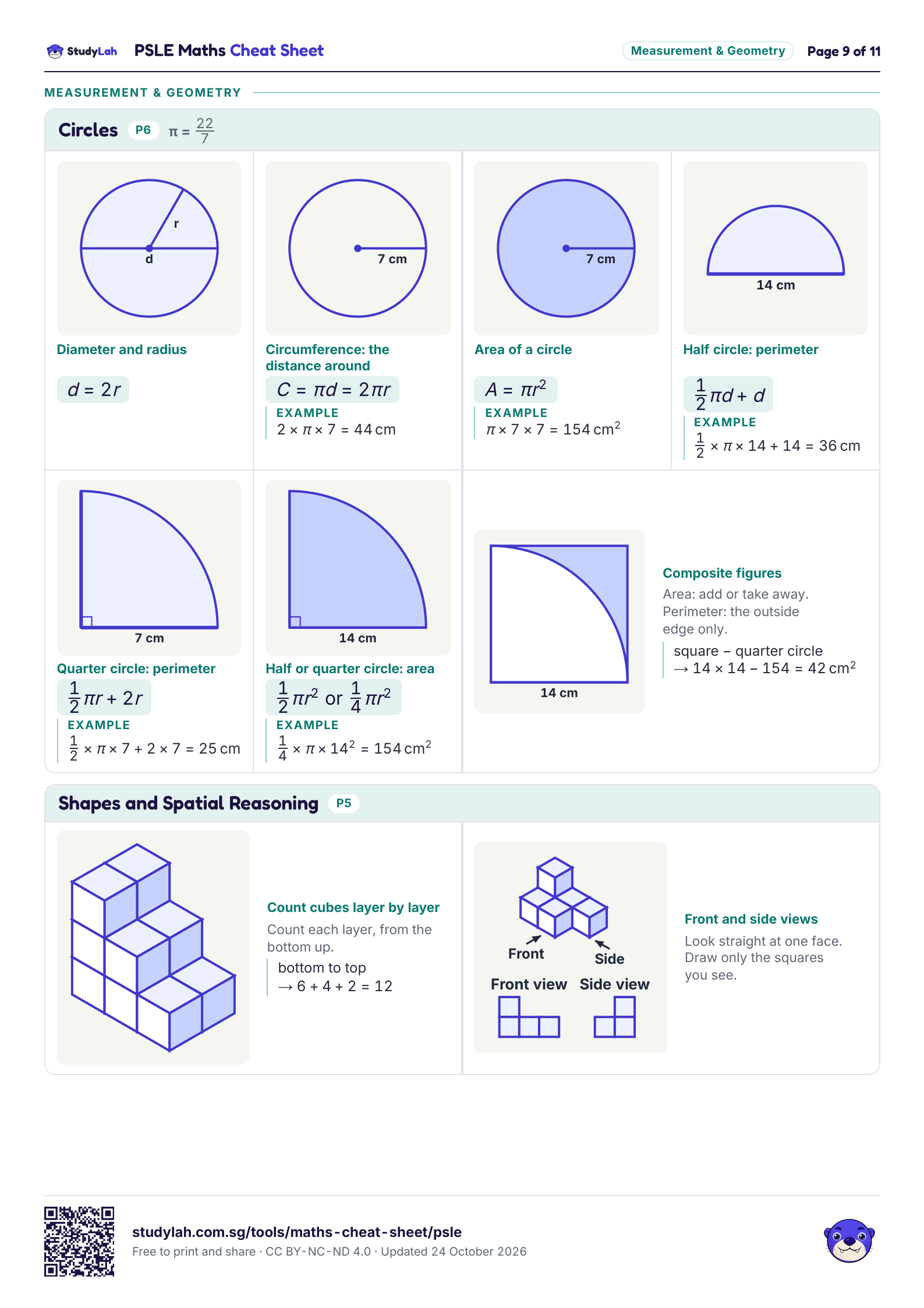
PSLE Maths Cheat Sheet, page 9 of 11: formulas for circles; and shapes and spatial reasoning 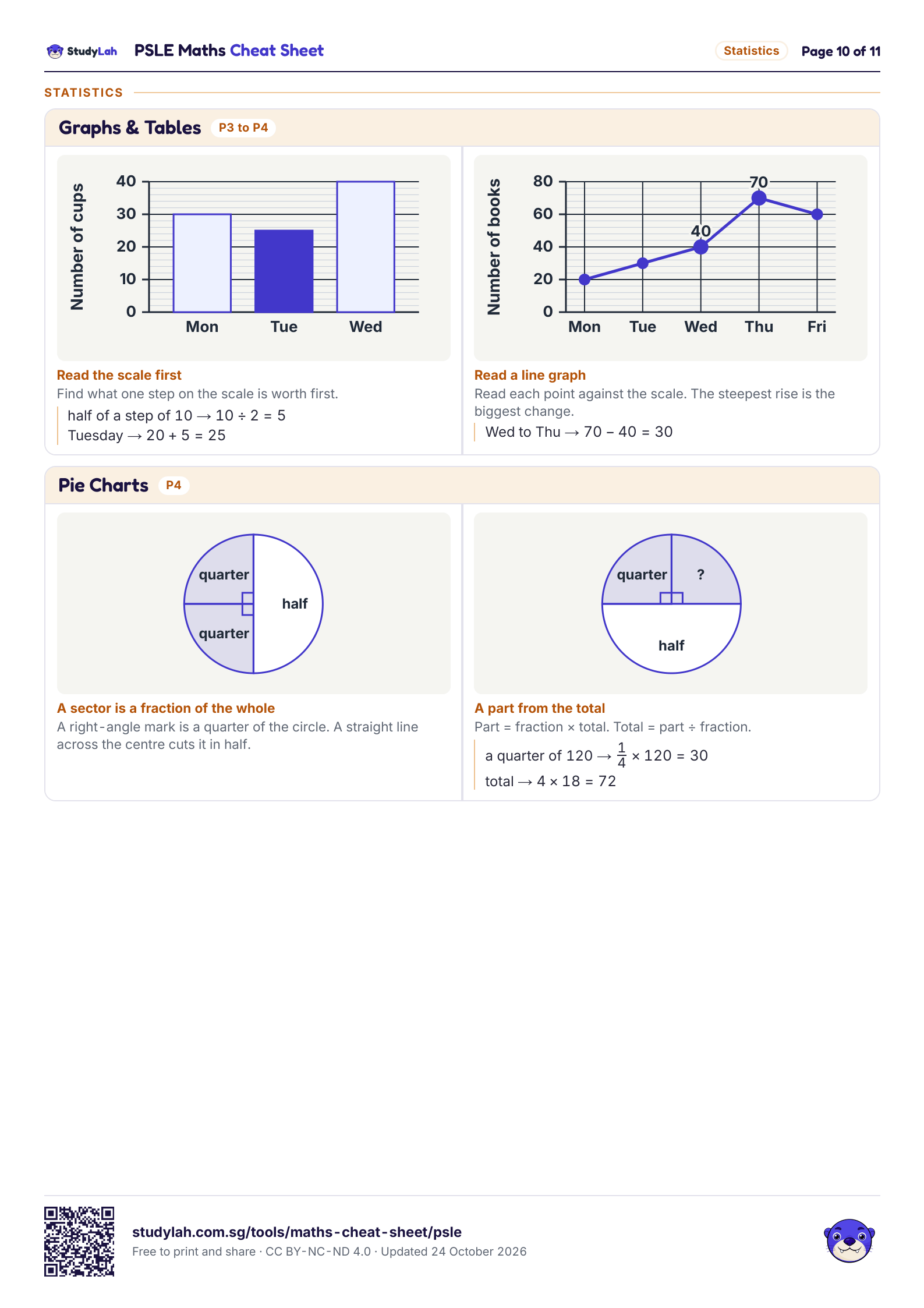
PSLE Maths Cheat Sheet, page 10 of 11: formulas for graphs & tables and pie charts 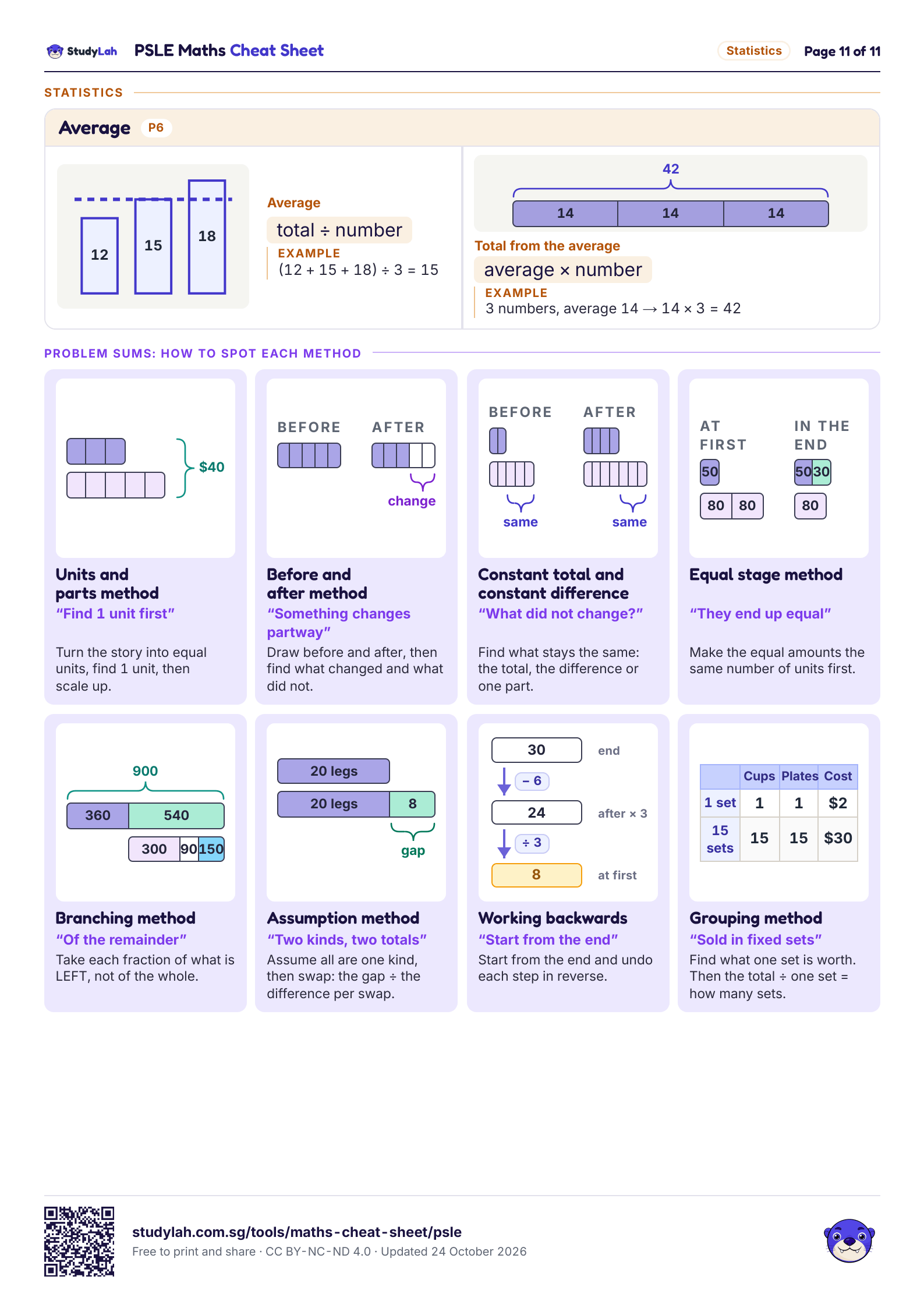
PSLE Maths Cheat Sheet, page 11 of 11: formulas for average, problem-sum methods
Knowing the formula is half of it
The other half is spotting which one a question needs. StudyLah gives your child questions on these topics, and Lah walks through each one step by step. Free: one Daily Practice and one Topic Drill every day, and one exam paper a month.
Try it freeQuestions
PSLE Maths formulas: questions parents ask
Does the PSLE Maths paper give a formula list?
No. SEAB's syllabus for the paper lists no formula sheet, and recalling facts, rules and formulae is the first thing the paper assesses. It prints the unit each answer needs, never the formula.
Which formulas does my child need for the PSLE?
Every formula in the primary syllabus, because the PSLE assesses all of it. This sheet gathers the 77 to know by heart, from P3 to P6, and the level sheets hold all 253, one level at a time.
What topics are tested in PSLE Maths?
Every topic of the primary Maths syllabus, from P1 to P6, in its three strands: Number and Algebra; Measurement and Geometry; and Statistics. This sheet's 18 topics are the ones with a formula or rule to know by heart.
Are P5 Maths topics tested in the PSLE?
Yes. The PSLE assesses the whole primary Maths syllabus, so P5 topics such as whole numbers and four operations; fractions and division; area of triangle; and volume of cube and cuboid are in it.
Can my child use a calculator in PSLE Maths?
In Paper 2 only. Paper 1, Booklets A and B, is done without one.
Which value of π should my child use?
The one the question gives: 3.14 or 22/7. Each circle example on this sheet says which it uses.
Is speed still in the PSLE Maths syllabus?
No. Speed, distance and time are not in the current primary syllabus. Rate, taught in P5, is.
Does my child need to show the working?
Yes. On a short question, a wrong answer with the correct method can still score a mark, and long questions ask for every step.
Which unit conversions does my child need to know?
The answer has to be in the unit the question gives, so these have to be known: 1 km = 1000 m, 1 m = 100 cm, 1 kg = 1000 g, 1 ℓ = 1000 mℓ = 1000 cm³, 1 h = 60 min, 1 min = 60 s.
Does my child need the volume of a cylinder or a cone?
No. Primary Maths asks for the volume of cubes and cuboids only. Cylinders and cones appear only as shapes and nets.
Keep going
- Primary Maths cheat sheets
- Whole Numbers and Four Operations: the full guide
- Factors and Multiples: the full guide
- Fractions: the full guide
- Decimals: the full guide
- Percentage: the full guide
- Rate: the full guide
- Ratio: the full guide
- Algebra: the full guide
- Number and Shape Patterns: the full guide
- Time: the full guide
- Angles in Geometrical Figures: the full guide
- Area of Triangle: the full guide
- Volume of Cube and Cuboid: the full guide
- Circles: the full guide
- Shapes and Spatial Reasoning: the full guide
- Tables and Line Graphs: the full guide
- Pie Charts: the full guide
- Average: the full guide
- What's changing in 2026 PSLE Maths
Sources: Ministry of Education, Singapore, Primary Mathematics Syllabus (Standard), updated October 2025. Singapore Examinations and Assessment Board, PSLE Mathematics (0008), for examination from 2026.
Practise every topic on the PSLE sheet
Free for every child from P1 to P6. Lah walks through each question.