
Free · Printable · Current syllabus
P3 Maths Cheat Sheet
The short version
Every formula and rule a P3 child needs: 45 of them across 10 topics, on 8 A4 pages to print free. The PSLE tests the whole primary syllabus, so these formulas are in it too.
Every P3 maths formula, by topic
| Rule | Example |
|---|---|
| Place valueA digit's place gives its value. A 0 keeps an empty place. | the 4 in 4025 → See it drawn |
| Numerals and wordsSay the thousands, then the hundreds, then the rest. | See it drawn |
| Compare and orderCompare from the left. The first digit that is different tells which number is greater: 4321 > 4299. | See it drawn |
| Count on and number patternsFind the step, then keep adding it. | next → See it drawn |
| Add in columnsAdd the ones first. 10 ones make 1 ten: regroup it into the tens. | See it drawn |
| Subtract in columnsSubtract the ones first. Not enough ones? Regroup 1 ten into 10 ones. | See it drawn |
| Add in your headSplit 38 into 30 and 8. Add the tens, then the ones. | See it drawn |
| Rule | Example |
|---|---|
| Dollars and cents100 cents make $1. In $4.05, the dot comes between the dollars and the cents. | See it drawn |
| Add moneyAdd the cents first. 100 cents make $1: add it to the dollars. | See it drawn |
| Subtract moneyNot enough cents? Change $1 into 100 cents first. | See it drawn |
| Rule | Example |
|---|---|
| Times tables of 6, 7, 8 and 9Learn them by heart. 7 × 8 is the same as 8 × 7. | See it drawn |
| Multiply and divide are a pairOne times fact gives two division facts. | See it drawn |
| Division with remainderThe number left over is the remainder. It is always smaller than the number you divide by. | check → See it drawn |
| Multiply in columnsMultiply the ones, then the tens, then the hundreds. Regroup when you get 10 or more. | See it drawn |
| Long divisionStart from the hundreds. Divide, multiply, subtract, then bring down the next digit. | See it drawn |
| Rule | Example |
|---|---|
| Equivalent fractionsMultiply the numerator and the denominator by the same number. The fraction stays the same size. | See it drawn |
| Simplest formDivide the numerator and the denominator by the same number. Stop when no number divides both. | See it drawn |
| The missing numberWhat was the denominator multiplied by? Do the same to the numerator. | denominator → See it drawn |
| Compare fractionsMake the denominators the same. The bigger numerator is the bigger fraction. | See it drawn |
| Add related fractionsMake the denominators the same, then add the numerators. | See it drawn |
| Subtract related fractionsMake the denominators the same, then subtract the numerators. Simplify if you can. | See it drawn |
| Rule | Example |
|---|---|
| An angleTwo lines that meet make an angle. The bigger the turn, the bigger the angle. Longer lines do not make it bigger. | See it drawn |
| Right angleA right angle is a square corner, like the corner of a book. | See it drawn |
| Acute angleSmaller than a right angle. | See it drawn |
| Obtuse angleGreater than a right angle. | See it drawn |
| Rule | Example |
|---|---|
| Perpendicular linesTwo lines that meet at a right angle are perpendicular. | See it drawn |
| Parallel linesParallel lines stay the same distance apart. They never meet. | See it drawn |
| Lines in a rectangleAB is parallel to DC. AB is perpendicular to BC. | See it drawn |
| Drawing themHold a ruler still. Slide a set square along it for a parallel line. Use its square corner for a perpendicular line. | See it drawn |
| Rule | Example |
|---|---|
| Length1 m = 100 cm. Read the metres, then the centimetres. | See it drawn |
| Mass1 kg = 1000 g. Read the kilograms, then count the small marks: each is 100 g. | See it drawn |
| Volume of liquid1 ℓ = 1000 mℓ. Read the scale where the water is level. | See it drawn |
| Changing unitsTo one unit: change the bigger unit, then add. To two units: take out the thousands. | See it drawn |
| Rule | Example |
|---|---|
| PerimeterPerimeter is the distance all the way around. Add all the sides. | See it drawn |
| Perimeter of a rectangle | See it drawn |
| Perimeter of a square | See it drawn |
| AreaArea is the space inside. Count the squares: each small square is 1 cm². | See it drawn |
| Area of a rectangle | See it drawn |
| Area of a square | See it drawn |
| Rule | Example |
|---|---|
| Seconds60 seconds make 1 minute. | |
| 24-hour clockAfter 12 noon, add 12 to the hour. Midnight is 00 00. | See it drawn |
| How long it takesCount on to the next hour, then the whole hours, then the minutes left. | 9.45 a.m. to 11.15 a.m. → See it drawn |
| Start time and end timeEnd time = start time + how long. Start time = end time − how long. | See it drawn |
| Rule | Example |
|---|---|
| Read a bar graphRead where each bar ends on the scale. "How many more" means subtract. | how many more on Monday than Tuesday → See it drawn |
| Read the scale firstFind what one step on the scale is worth. Tuesday's bar ends halfway between 20 and 30. | half of a step of 10 → Tuesday → See it drawn |
P3 maths revision notes, topic by topic
Numbers to 10 000
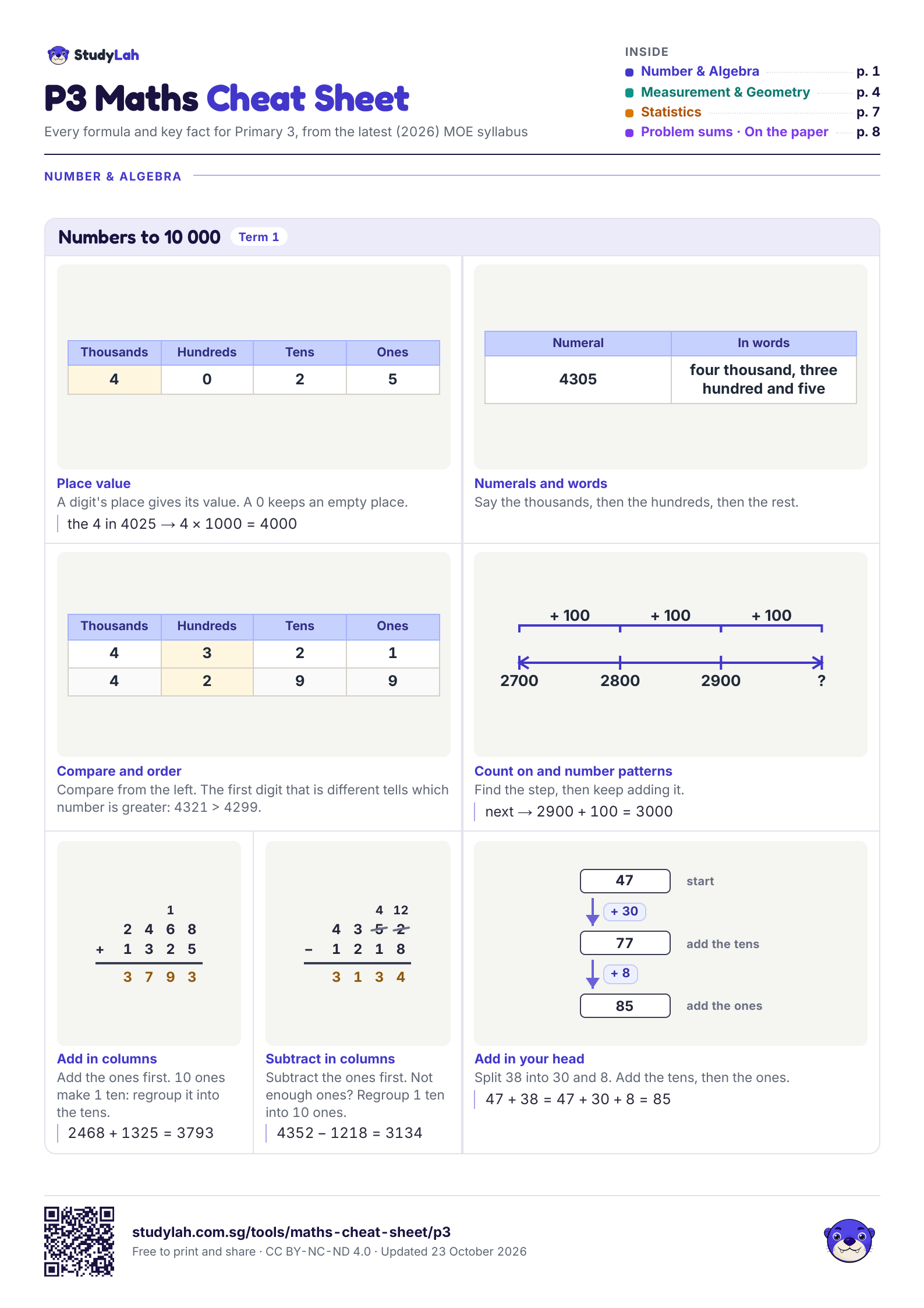
Term 1- Place valueA digit's place gives its value. A 0 keeps an empty place.the 4 in 4025 →
Thousands Hundreds Tens Ones 4 0 2 5 - Numerals and wordsSay the thousands, then the hundreds, then the rest.
Numeral In words 4305 four thousand, three hundred and five - Compare and orderCompare from the left. The first digit that is different tells which number is greater: 4321 > 4299.
Thousands Hundreds Tens Ones 4 3 2 1 4 2 9 9 - Count on and number patternsFind the step, then keep adding it.next →
Point Value 2700 2700 2800 2800 2900 2900 ? 3000 - Add in columnsAdd the ones first. 10 ones make 1 ten: regroup it into the tens.
- Subtract in columnsSubtract the ones first. Not enough ones? Regroup 1 ten into 10 ones.
- Add in your headSplit 38 into 30 and 8. Add the tens, then the ones.start47+ 30add the tens77+ 8add the ones85
Money
Term 1 · revision- Dollars and cents100 cents make $1. In $4.05, the dot comes between the dollars and the cents.
Dollars Cents 4 05 - Add moneyAdd the cents first. 100 cents make $1: add it to the dollars.
Dollars Cents 3 60 + 2 75 6 35 - Subtract moneyNot enough cents? Change $1 into 100 cents first.
Dollars Cents 10 00 − 3 45 6 55
- Times tables of 6, 7, 8 and 9Learn them by heart. 7 × 8 is the same as 8 × 7.
× 6 × 7 × 8 × 9 1 6 7 8 9 2 12 14 16 18 3 18 21 24 27 4 24 28 32 36 5 30 35 40 45 6 36 42 48 54 7 42 49 56 63 8 48 56 64 72 9 54 63 72 81 10 60 70 80 90 - Multiply and divide are a pairOne times fact gives two division facts.
- Division with remainderThe number left over is the remainder. It is always smaller than the number you divide by. check →
- Multiply in columnsMultiply the ones, then the tens, then the hundreds. Regroup when you get 10 or more.
- Long divisionStart from the hundreds. Divide, multiply, subtract, then bring down the next digit.
Fractions
Term 3- Equivalent fractionsMultiply the numerator and the denominator by the same number. The fraction stays the same size.
- Simplest formDivide the numerator and the denominator by the same number. Stop when no number divides both.
- The missing numberWhat was the denominator multiplied by? Do the same to the numerator.denominator →
- Compare fractionsMake the denominators the same. The bigger numerator is the bigger fraction.
- Add related fractionsMake the denominators the same, then add the numerators.
- Subtract related fractionsMake the denominators the same, then subtract the numerators. Simplify if you can.
Angles
Term 3- An angleTwo lines that meet make an angle. The bigger the turn, the bigger the angle. Longer lines do not make it bigger.
- Right angleA right angle is a square corner, like the corner of a book.
- Acute angleSmaller than a right angle.
- Obtuse angleGreater than a right angle.
- Perpendicular linesTwo lines that meet at a right angle are perpendicular.
- Parallel linesParallel lines stay the same distance apart. They never meet.
- Lines in a rectangleAB is parallel to DC. AB is perpendicular to BC.
- Drawing themHold a ruler still. Slide a set square along it for a parallel line. Use its square corner for a perpendicular line.
Length, Mass and Volume
Term 3- Length1 m = 100 cm. Read the metres, then the centimetres.
Object Left (cm) Right (cm) 1 m 35 cm 0 135 - Mass1 kg = 1000 g. Read the kilograms, then count the small marks: each is 100 g.
Figure Reading bag on a kitchen scale read the mass off the scale - Volume of liquid1 ℓ = 1000 mℓ. Read the scale where the water is level.
Reading mℓ Level 1250 - Changing unitsTo one unit: change the bigger unit, then add. To two units: take out the thousands.
In two units In one unit 2 km 480 m 2480 m 5 m 8 cm 508 cm 2 kg 75 g 2075 g 1 ℓ 50 mℓ 1050 mℓ
Area and Perimeter
Term 4- PerimeterPerimeter is the distance all the way around. Add all the sides.
- Perimeter of a rectangleExample
- Perimeter of a squareExample
- AreaArea is the space inside. Count the squares: each small square is 1 cm².
- Area of a rectangleExample
- Area of a squareExample
Time
Term 4- Seconds60 seconds make 1 minute.
- 24-hour clockAfter 12 noon, add 12 to the hour. Midnight is 00 00.
12-hour 24-hour 9.05 a.m. 09 05 12 noon 12 00 3.15 p.m. 15 15 midnight 00 00 - How long it takesCount on to the next hour, then the whole hours, then the minutes left.9.45 a.m. to 11.15 a.m. →
Span Gap 9.45 a.m. → 10 a.m. 15 min 10 a.m. → 11 a.m. 1 h 11 a.m. → 11.15 a.m. 15 min - Start time and end timeEnd time = start time + how long. Start time = end time − how long.
Clock Time start read from the hands Clock Time end read from the hands
Bar Graphs
Term 2- Read a bar graphRead where each bar ends on the scale. "How many more" means subtract.how many more on Monday than Tuesday →
Category Number of books Mon 20 Tue 10 Wed 15 - Read the scale firstFind what one step on the scale is worth. Tuesday's bar ends halfway between 20 and 30.half of a step of 10 → Tuesday →
Category Number of cups Mon 30 Tue 25 Wed 40
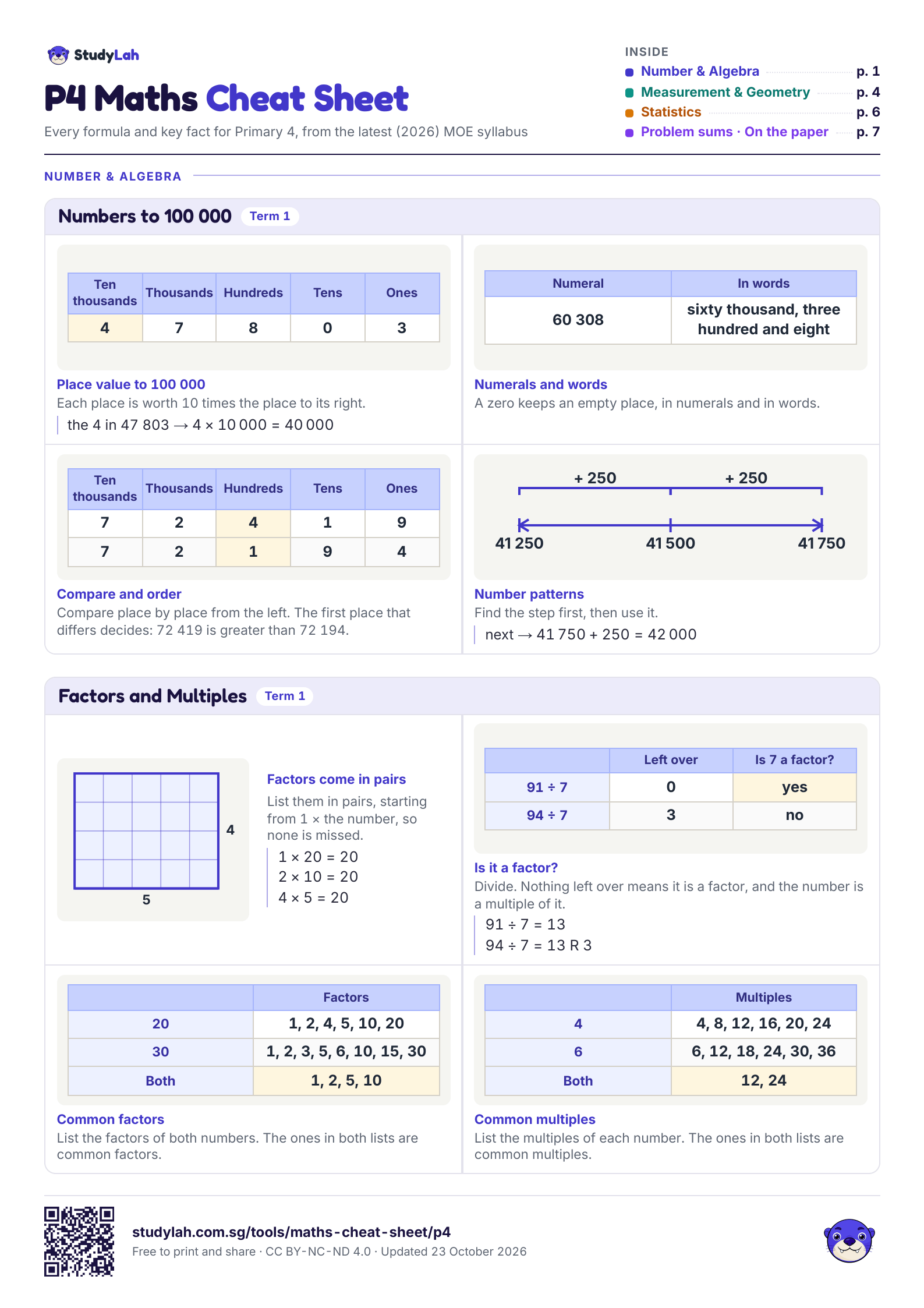
The P4 Maths Cheat Sheet
The P4 sheet holds 48 more formulas and rules, across its 12 topics, on 7 A4 pages.
P4 Maths Cheat Sheet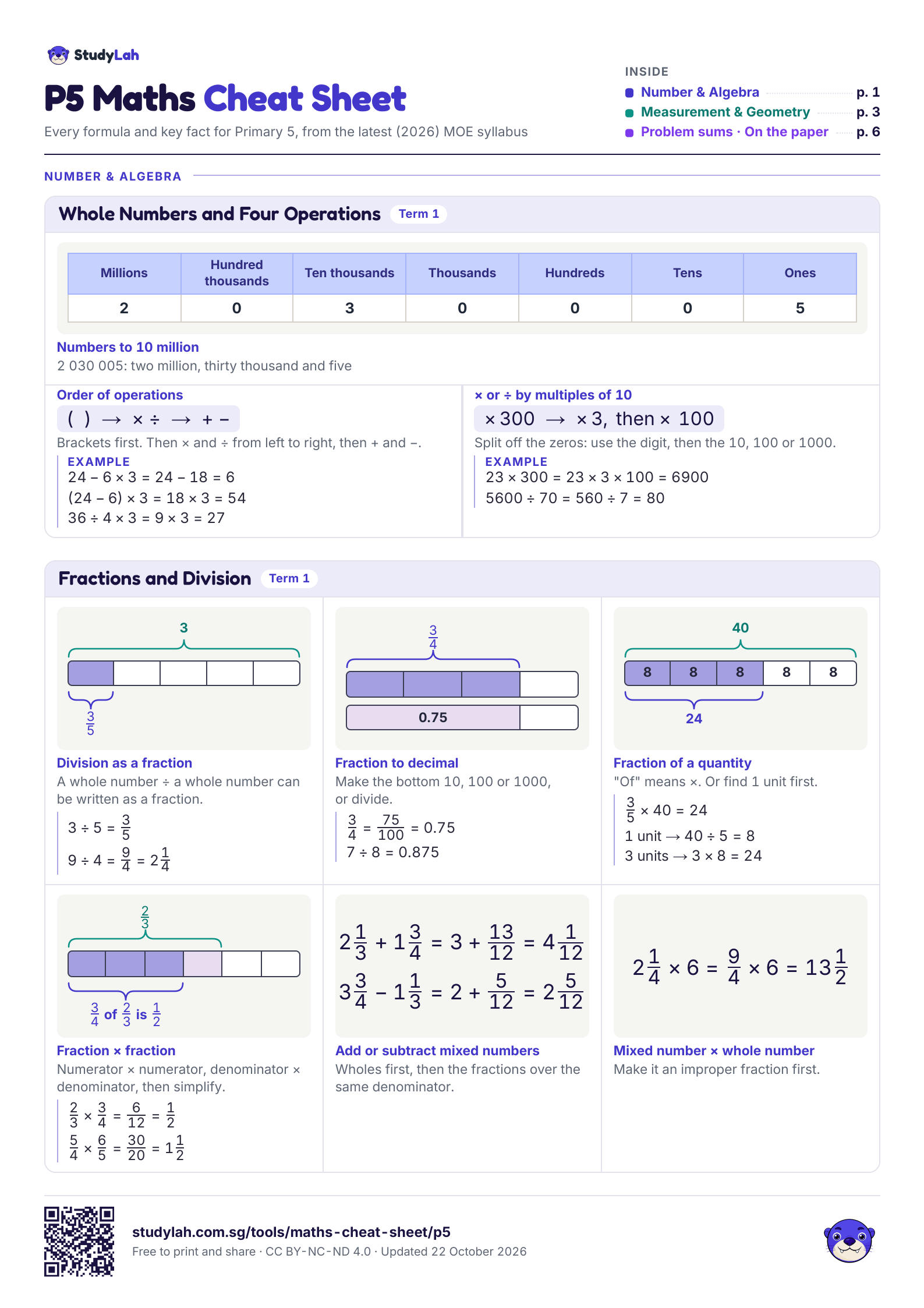
The P5 Maths Cheat Sheet
The P5 sheet holds 48 more formulas and rules, across its 12 topics, on 6 A4 pages.
P5 Maths Cheat Sheet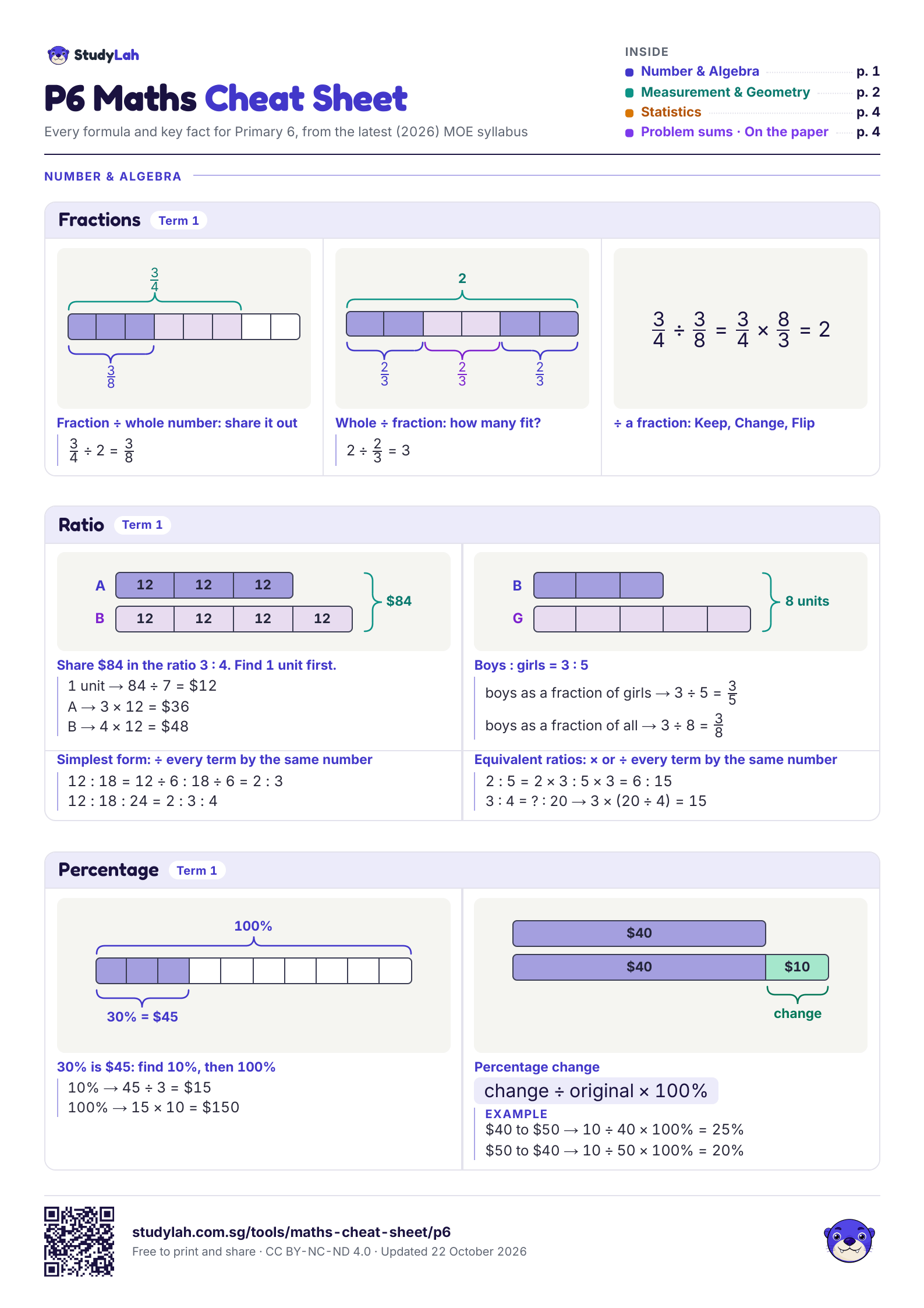
The P6 Maths Cheat Sheet
The P6 sheet holds 36 more formulas and rules, across its 8 topics, on 4 A4 pages.
P6 Maths Cheat SheetThe sheet
All 8 pages, full size
The PDF prints sharp on A4. Each page is also an image you can save or send.
P3 Maths Cheat Sheet, page 1 of 8: formulas for numbers to 10 000 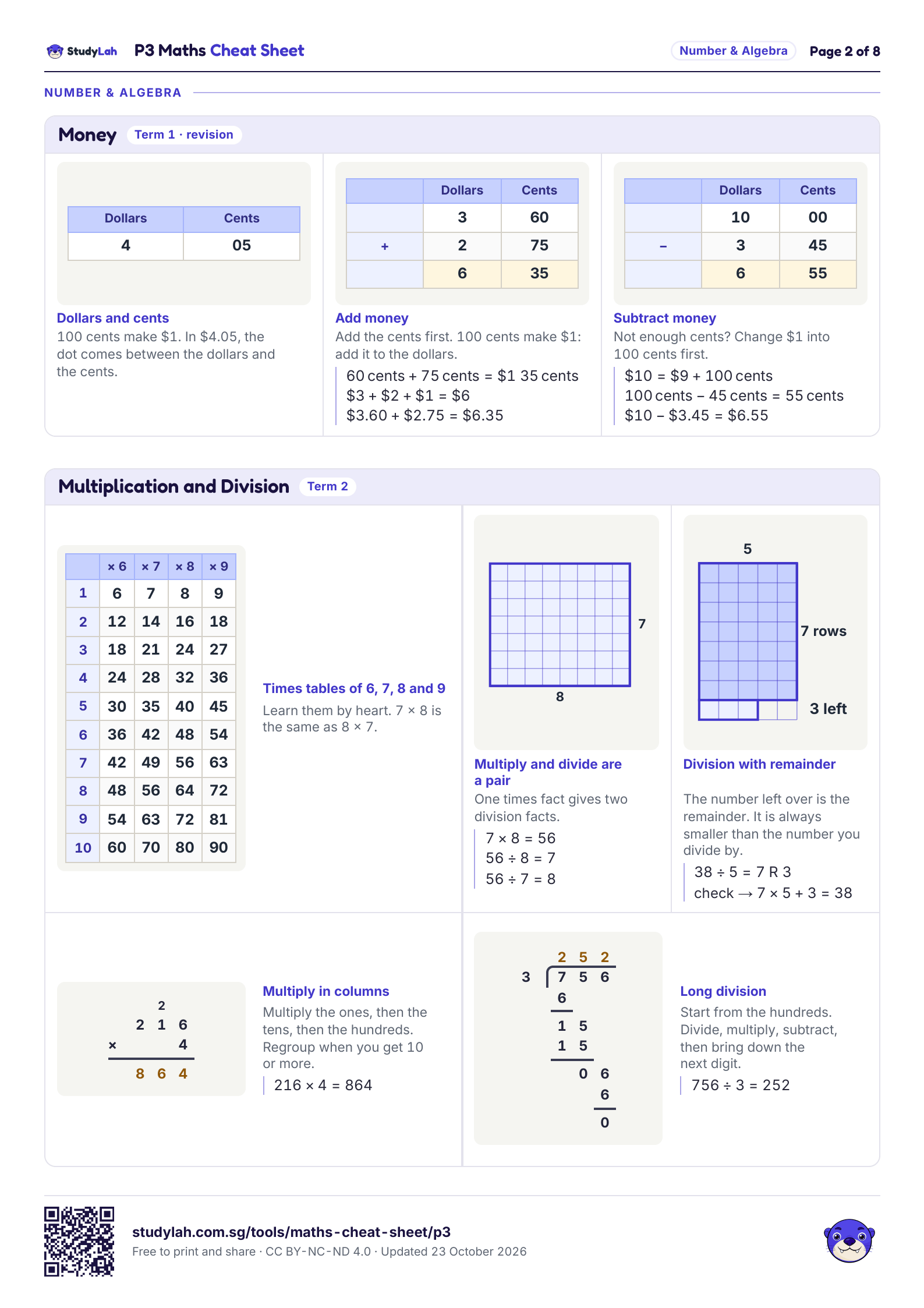
P3 Maths Cheat Sheet, page 2 of 8: formulas for money; and multiplication and division 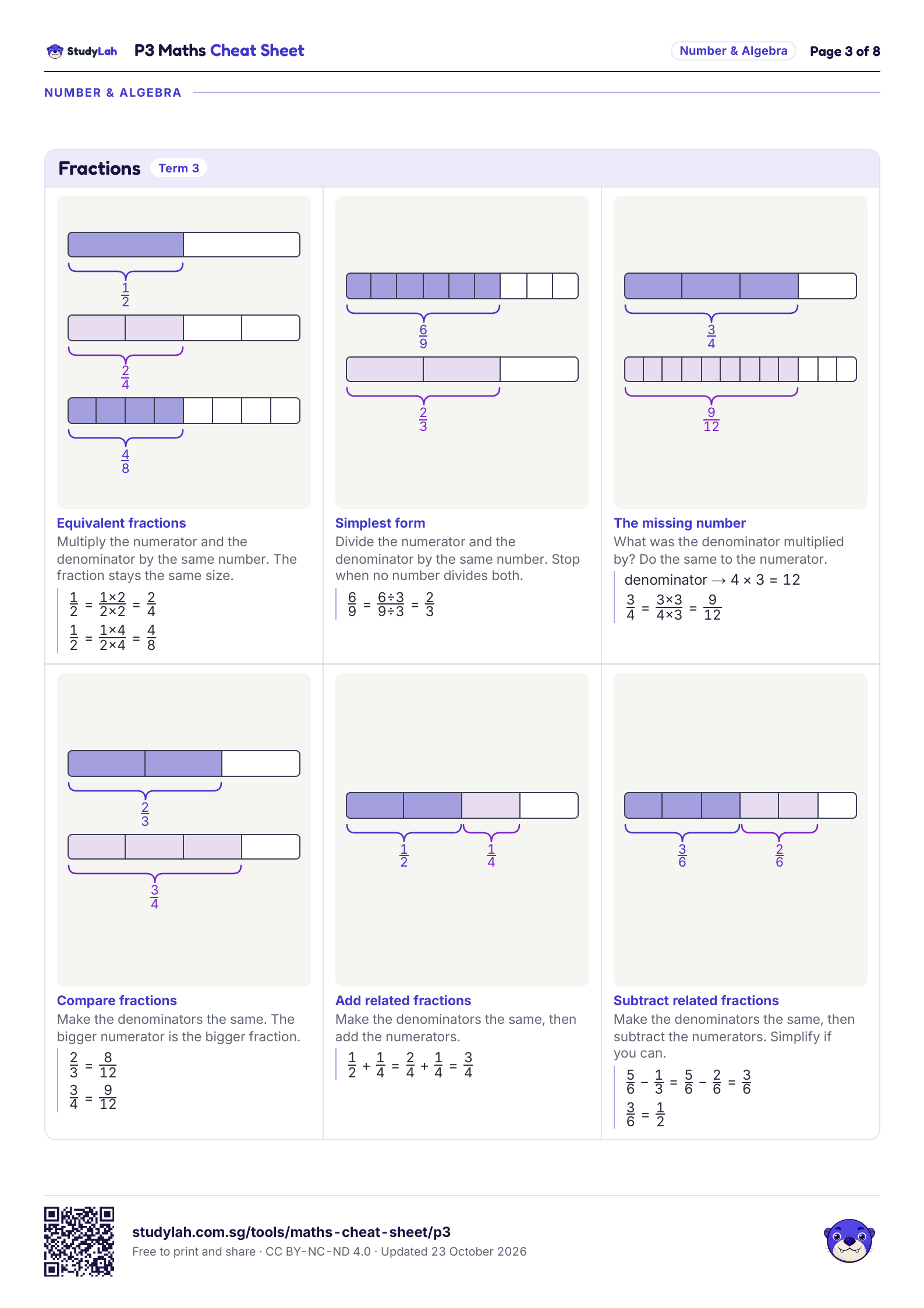
P3 Maths Cheat Sheet, page 3 of 8: formulas for fractions 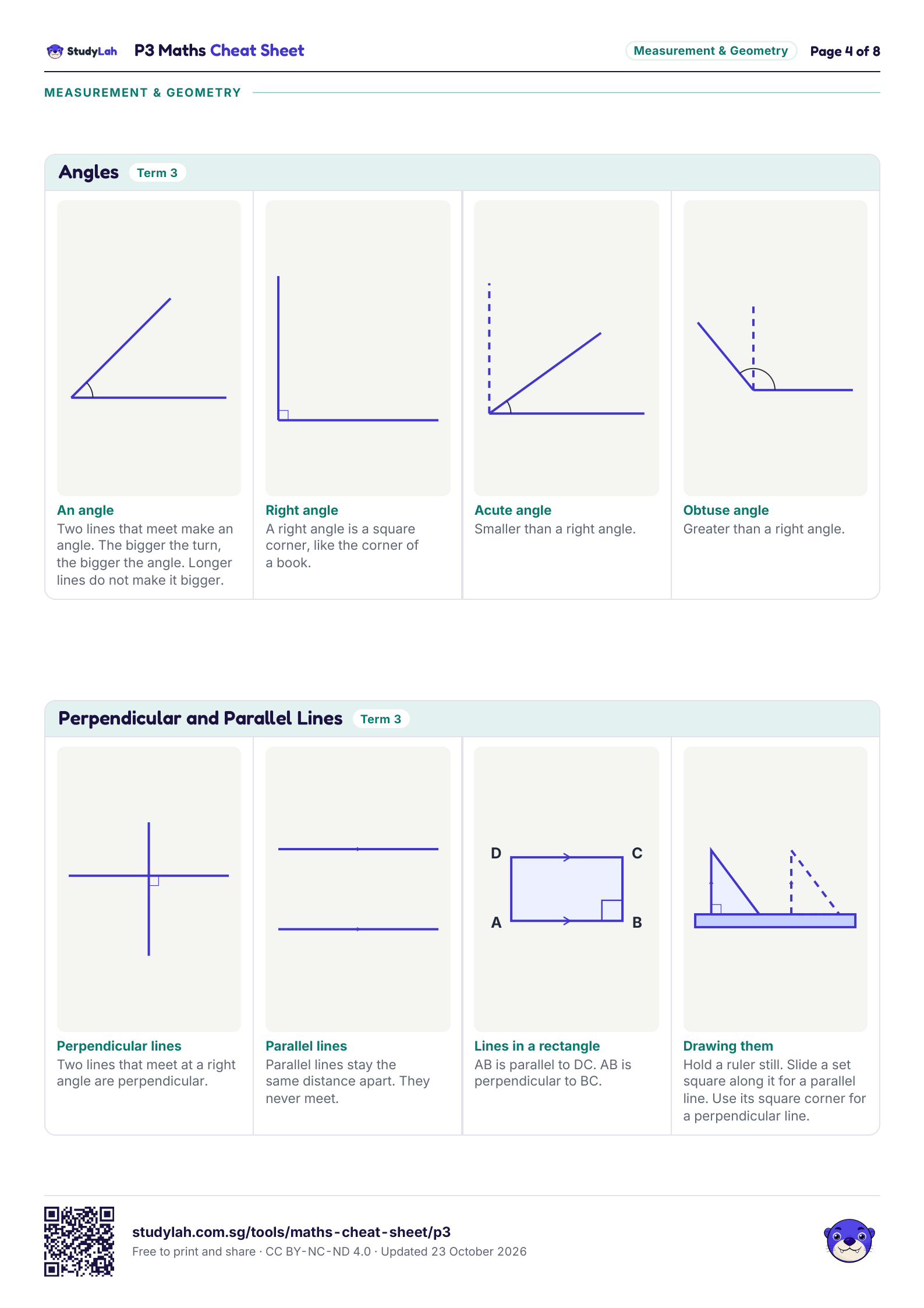
P3 Maths Cheat Sheet, page 4 of 8: formulas for angles; and perpendicular and parallel lines 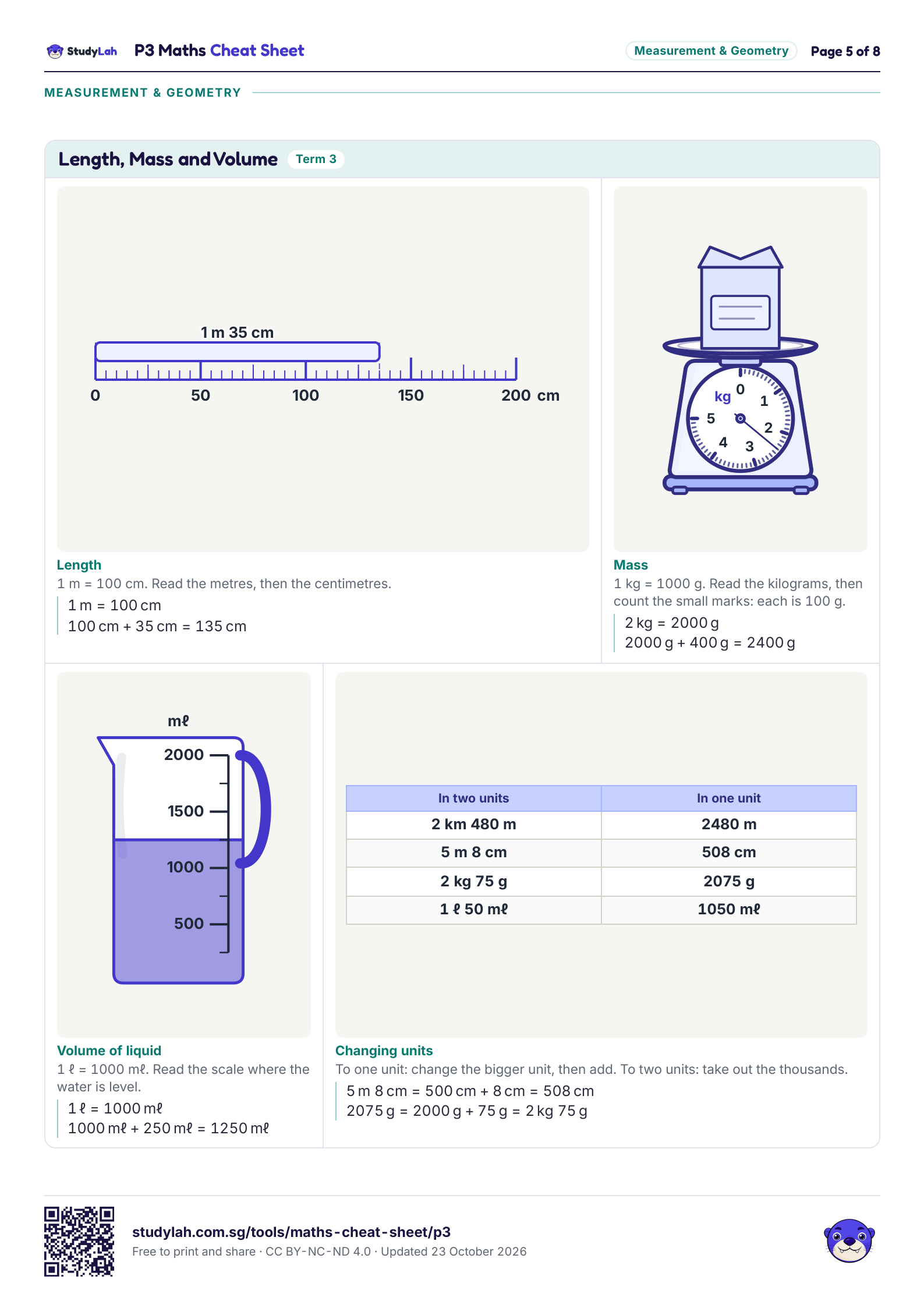
P3 Maths Cheat Sheet, page 5 of 8: formulas for length, mass and volume 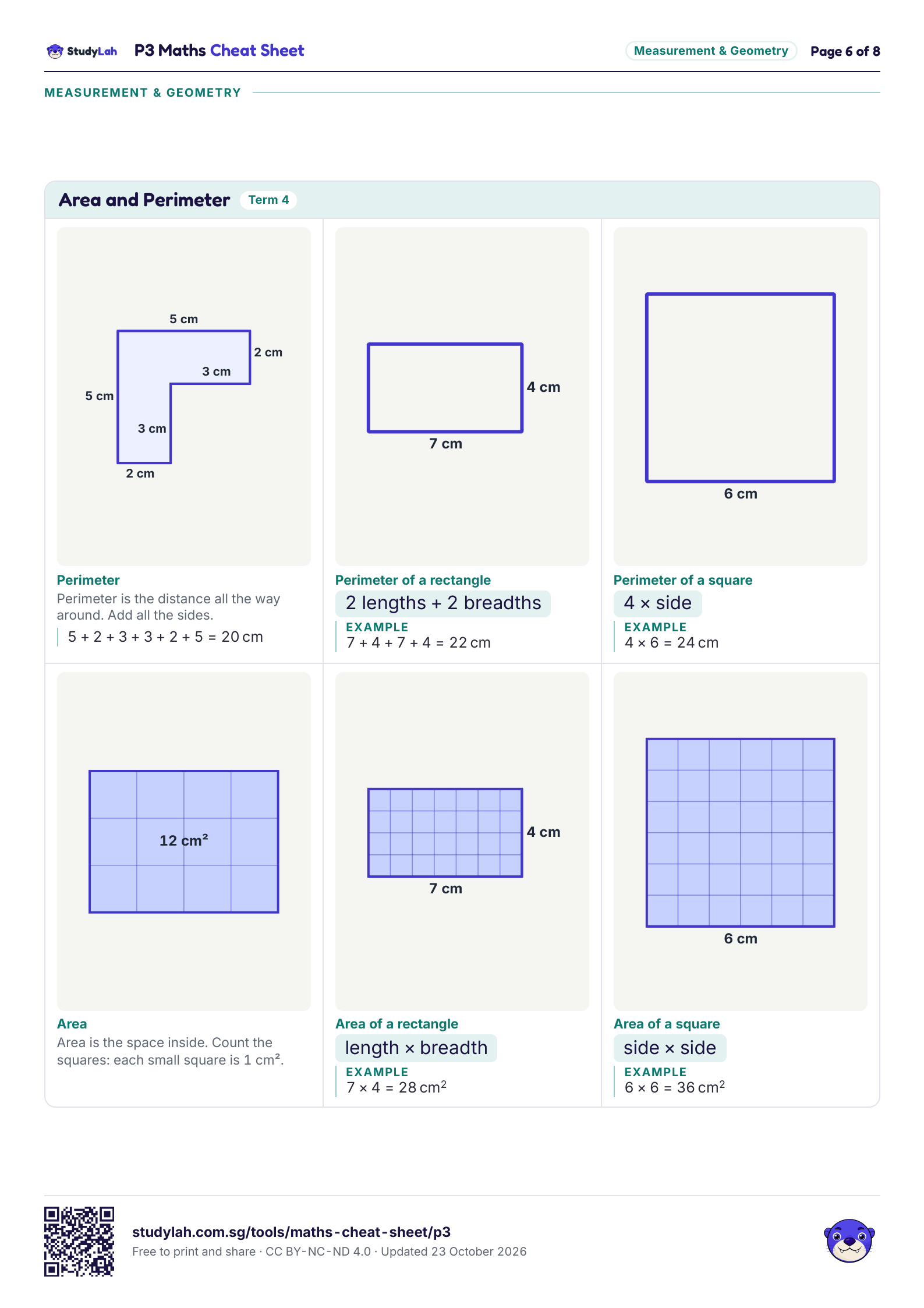
P3 Maths Cheat Sheet, page 6 of 8: formulas for area and perimeter 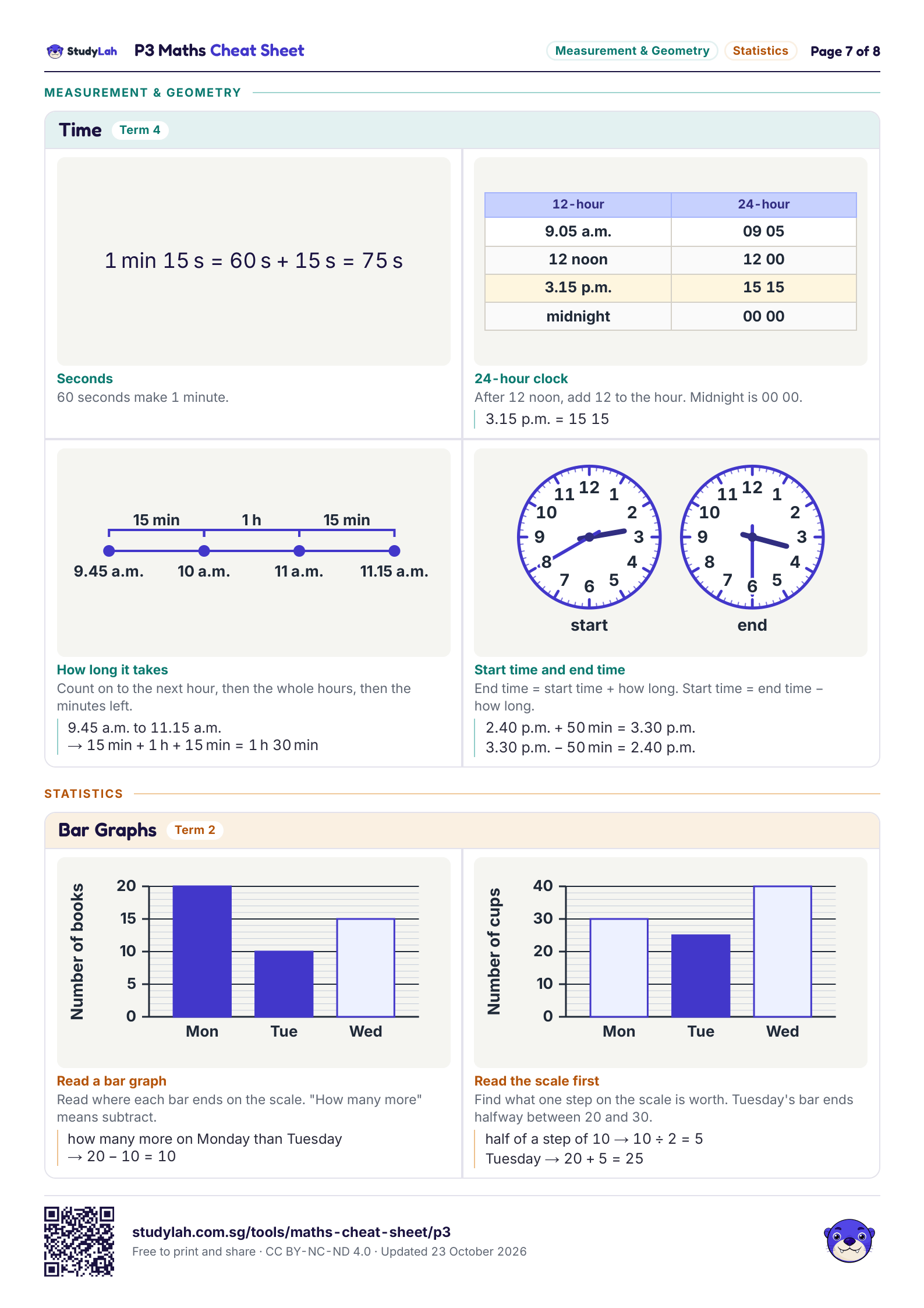
P3 Maths Cheat Sheet, page 7 of 8: formulas for time and bar graphs 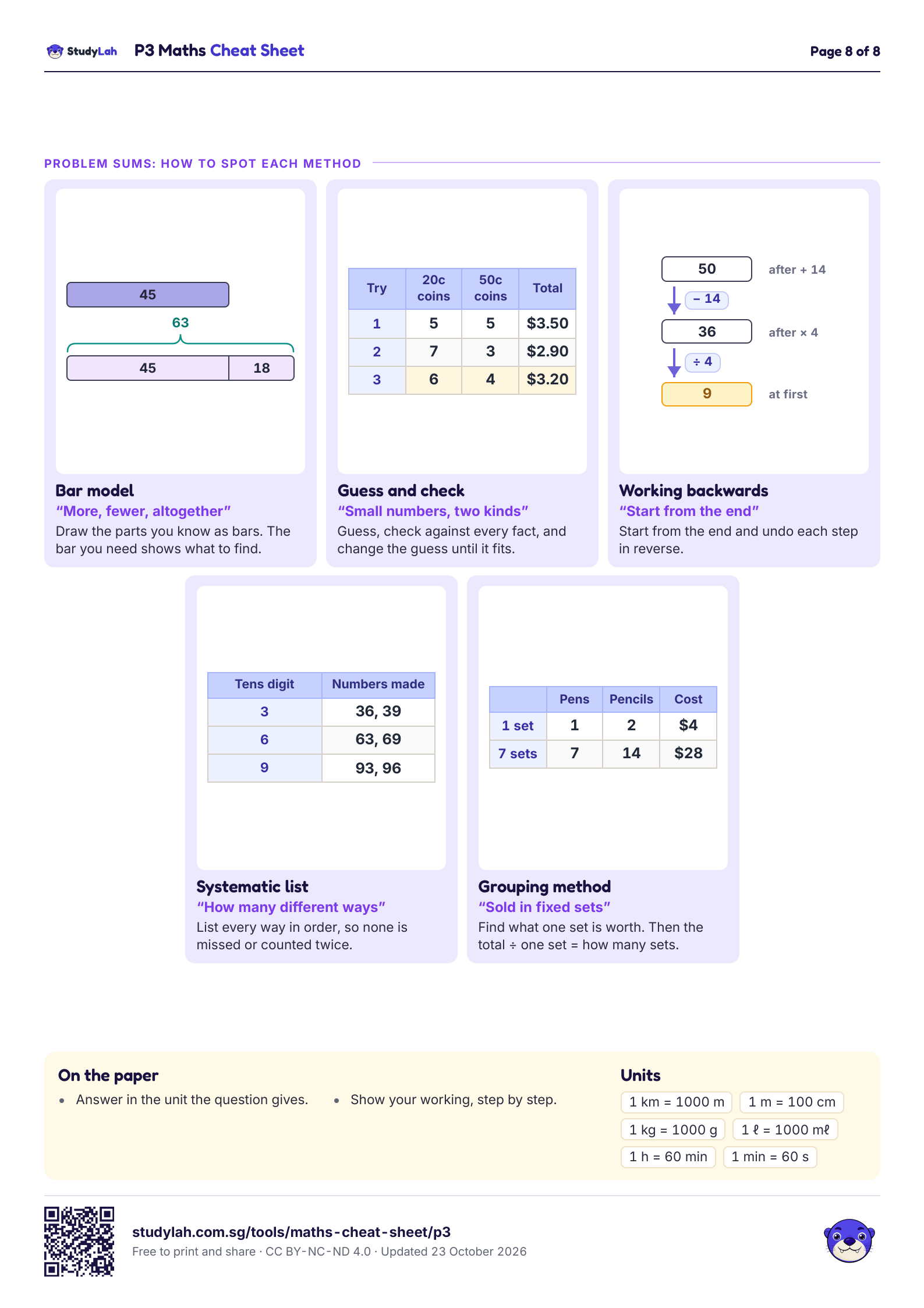
P3 Maths Cheat Sheet, page 8 of 8: problem-sum methods, exam rules and units
Knowing the formula is half of it
The other half is spotting which one a question needs. StudyLah gives your child P3 questions on these topics, and Lah walks through each one step by step. Free: one Daily Practice and one Topic Drill every day, and one exam paper a month.
Try it freeQuestions
Questions parents ask
What maths formulas does a P3 child need to know?
The 45 formulas and rules on this sheet, across numbers to 10 000; money; multiplication and division; bar graphs; angles; perpendicular and parallel lines; fractions; length, mass and volume; area and perimeter; and time. It also shows how to spot 5 problem-sum methods.
What topics are in P3 maths?
10 topics, in the order schools teach them: numbers to 10 000; money; multiplication and division; bar graphs; angles; perpendicular and parallel lines; fractions; length, mass and volume; area and perimeter; and time.
Is area tested in P3?
Yes. Primary 3 pupils find the area of a rectangle and a square: length × breadth, and side × side. They measure it in square units, cm² and m².
Which times tables are learnt in P3?
The 6, 7, 8 and 9 times tables. The 2, 3, 4, 5 and 10 tables come in P2.
Do P3 pupils measure angles in degrees?
No. In P3, an angle is compared with a right angle: smaller, the same, or greater. Measuring angles in degrees starts in P4.
Keep going
- Primary Maths cheat sheets
- Primary 3 maths syllabus
- Numbers to 10 000: the full guide
- Money: the full guide
- Multiplication and Division: the full guide
- Fractions: the full guide
- Angles: the full guide
- Perpendicular and Parallel Lines: the full guide
- Length, Mass and Volume: the full guide
- Area and Perimeter: the full guide
- Time: the full guide
- Bar Graphs: the full guide
- P3 Maths exam paper
Sources: Ministry of Education, Singapore, Primary Mathematics Syllabus (Standard), updated October 2025.
Practise every topic on the P3 sheet
Free for every P3 child. Lah walks through each question.