
Free · Printable · Current syllabus
P4 Maths Cheat Sheet
The short version
Every formula and rule a P4 child needs: 48 of them across 12 topics, on 7 A4 pages to print free. The PSLE tests the whole primary syllabus, so these formulas are in it too.
Every P4 maths formula, by topic
| Rule | Example |
|---|---|
| Place value to 100 000Each place is worth 10 times the place to its right. | the 4 in 47 803 → See it drawn |
| Numerals and wordsA zero keeps an empty place, in numerals and in words. | See it drawn |
| Compare and orderCompare place by place from the left. The first place that differs decides: 72 419 is greater than 72 194. | See it drawn |
| Number patternsFind the step first, then use it. | next → See it drawn |
| Rule | Example |
|---|---|
| Factors come in pairsList them in pairs, starting from 1 × the number, so none is missed. | See it drawn |
| Is it a factor?Divide. Nothing left over means it is a factor, and the number is a multiple of it. | See it drawn |
| Common factorsList the factors of both numbers. The ones in both lists are common factors. | See it drawn |
| Common multiplesList the multiples of each number. The ones in both lists are common multiples. | See it drawn |
| Rule | Example |
|---|---|
| RoundingLook at the digit to the right of the place. 5 or more, round up. | nearest 10 → nearest 100 → nearest 1000 → See it drawn |
| Multiply in columnsMultiply by the ones, then by the tens, then add the two rows. | See it drawn |
| Long divisionFrom the left: divide, multiply, subtract, bring down. | See it drawn |
| Rule | Example |
|---|---|
| Mixed number to improper fractionEach whole is 5 fifths. Count all the fifths. | fifths → See it drawn |
| Improper fraction to mixed numberDivide the numerator by the denominator. What is left over is the fraction. | See it drawn |
| Fraction of a setCut the set into equal units, one for each part. Find 1 unit first. | 1 unit → 3 fifths of 15 → See it drawn |
| Add or subtract fractionsMake the denominators the same, then add or take away the numerators. | See it drawn |
| Rule | Example |
|---|---|
| Tenths, hundredths, thousandthsEach place is worth a tenth of the place to its left. | the 6 in 2.465 → See it drawn |
| Compare and order decimalsLine up the decimal points. Compare the tenths first, then the hundredths: 0.7 is greater than 0.68. | See it drawn |
| Decimal to fractionWrite it over 10, 100 or 1000, then simplify. | See it drawn |
| Fraction to decimalMake the denominator 10 or 100. | See it drawn |
| Rounding decimalsLook at the next digit to the right. 5 or more, round up. | nearest whole number → 1 decimal place → 2 decimal places → See it drawn |
| Add or subtract decimalsLine up the decimal points. Fill an empty place with 0. | See it drawn |
| × or ÷ by a 1-digit numberWork as with whole numbers. Keep the decimal point in line. | See it drawn |
| A whole number ÷ a whole numberWrite zeros after the point to keep dividing. Round the answer when the question asks. | 2 decimal places → See it drawn |
| Rule | Example |
|---|---|
| Naming an angleBy three letters, the corner in the middle: ∠PQR. Or by one: ∠y. | See it drawn |
| Measuring with a protractorCentre on the corner, one arm on 0°. Count up from that 0 to the other arm. | See it drawn |
| Drawing an angleDraw one arm. Centre the protractor on its end, 0° on the arm. Mark the size, then join. | See it drawn |
| Rule | Example |
|---|---|
| RectangleFour right angles. Opposite sides are equal and parallel. | See it drawn |
| SquareFour right angles. All four sides are equal, and opposite sides are parallel. | See it drawn |
| An unknown angleEvery corner is 90°. | ∠y → See it drawn |
| Drawing on a gridCount the squares: opposite sides the same length, every corner a right angle. | See it drawn |
| Rule | Example |
|---|---|
| The breadth from the area | breadth → See it drawn |
| The length from the perimeter | length → See it drawn |
| The side from the perimeter | side → See it drawn |
| The side from the area | side → See it drawn |
| Composite figuresArea: split into rectangles, then add. Perimeter: the outside edge only. | area → perimeter → See it drawn |
| Rule | Example |
|---|---|
| Cube6 equal square faces. A dotted line is a hidden edge. | See it drawn |
| Cuboid6 rectangle faces, in 3 matching pairs. | See it drawn |
| Prism2 matching ends, and a rectangle for each side. | See it drawn |
| PyramidA base, and a triangle for each side, meeting at the top. | See it drawn |
| Cylinder and coneA cylinder has 2 circle faces and a curved surface. A cone has 1 circle face and a curved surface. Their nets are not in the P4 syllabus. | See it drawn |
| Rule | Example |
|---|---|
| Line of symmetryFold along it: the two halves match exactly. | See it drawn |
| Test a lineFold it in your head: do the two halves match? A rectangle has 2 lines of symmetry. | See it drawn |
| Complete on a gridEach shaded square has a partner the same distance from the line, on the other side. | See it drawn |
| Rule | Example |
|---|---|
| Complete a tableA total is the sum of its row or its column. | the missing number → See it drawn |
| Read a line graphRead each point against the scale. Where the line goes up most is the biggest change. | Wed to Thu → See it drawn |
| Rule | Example |
|---|---|
| A sector is a fraction of the wholeA right-angle mark is a quarter of the circle. A straight line across the centre cuts it in half. | See it drawn |
| A part from the totalThe fraction × the total. | a quarter of 120 → See it drawn |
| The total from a partA quarter is 18 pupils, so the whole circle is 4 quarters. | total → See it drawn |
P4 maths revision notes, topic by topic
Numbers to 100 000
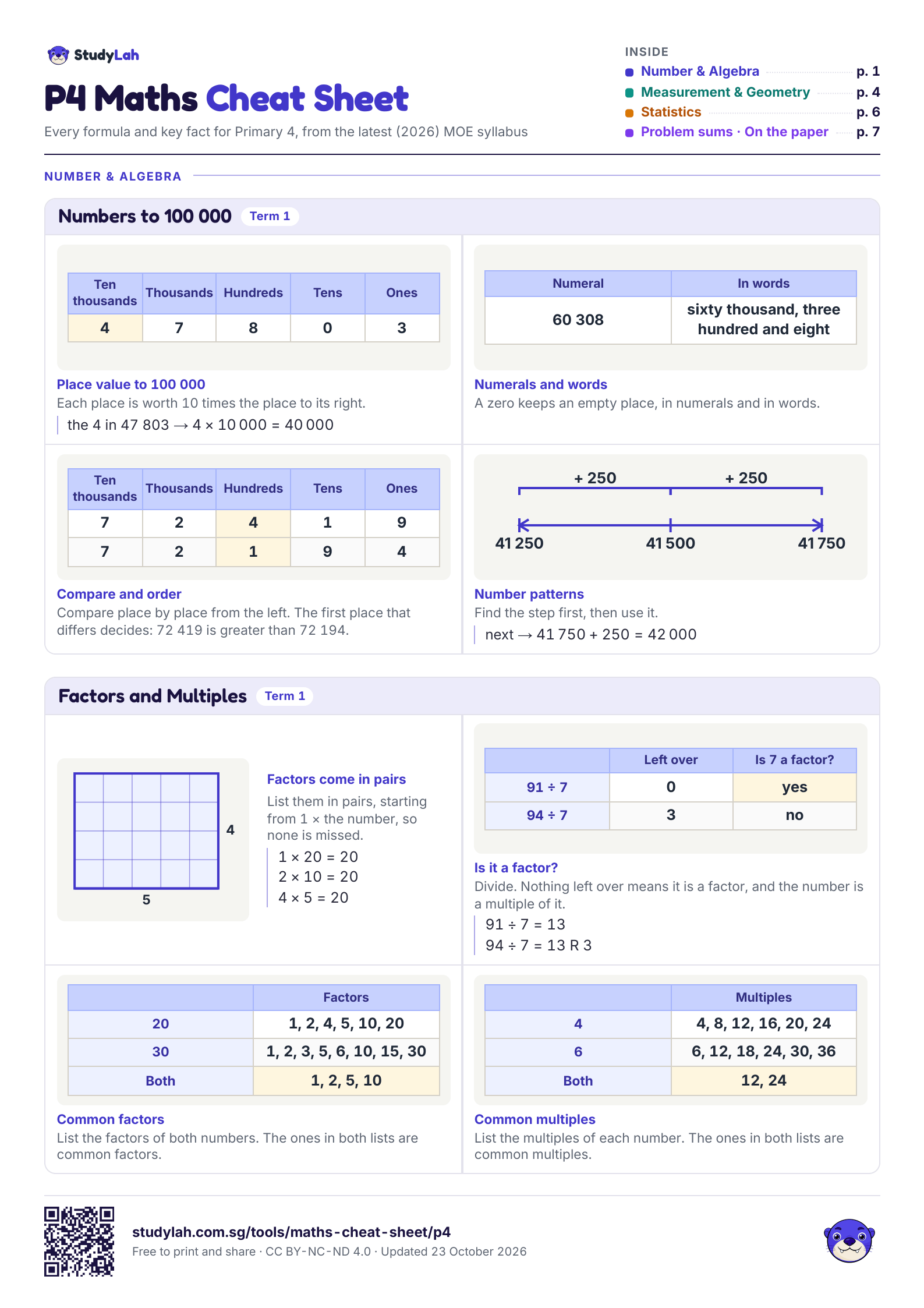
Term 1- Place value to 100 000Each place is worth 10 times the place to its right.the 4 in 47 803 →
Ten thousands Thousands Hundreds Tens Ones 4 7 8 0 3 - Numerals and wordsA zero keeps an empty place, in numerals and in words.
Numeral In words 60 308 sixty thousand, three hundred and eight - Compare and orderCompare place by place from the left. The first place that differs decides: 72 419 is greater than 72 194.
Ten thousands Thousands Hundreds Tens Ones 7 2 4 1 9 7 2 1 9 4 - Number patternsFind the step first, then use it.next →
Point Value 41 250 41250 41 500 41500 41 750 41750
Factors and Multiples
Term 1- Factors come in pairsList them in pairs, starting from 1 × the number, so none is missed.
- Is it a factor?Divide. Nothing left over means it is a factor, and the number is a multiple of it.
Left over Is 7 a factor? 91 ÷ 7 0 yes 94 ÷ 7 3 no - Common factorsList the factors of both numbers. The ones in both lists are common factors.
Factors 20 1, 2, 4, 5, 10, 20 30 1, 2, 3, 5, 6, 10, 15, 30 Both 1, 2, 5, 10 - Common multiplesList the multiples of each number. The ones in both lists are common multiples.
Multiples 4 4, 8, 12, 16, 20, 24 6 6, 12, 18, 24, 30, 36 Both 12, 24
- RoundingLook at the digit to the right of the place. 5 or more, round up.nearest 10 → nearest 100 → nearest 1000 →
Point Value 36 482 36482 - Multiply in columnsMultiply by the ones, then by the tens, then add the two rows.
- Long divisionFrom the left: divide, multiply, subtract, bring down.
Fractions
Term 2- Mixed number to improper fractionEach whole is 5 fifths. Count all the fifths.fifths →
- Improper fraction to mixed numberDivide the numerator by the denominator. What is left over is the fraction.
- Fraction of a setCut the set into equal units, one for each part. Find 1 unit first.1 unit → 3 fifths of 15 →
- Add or subtract fractionsMake the denominators the same, then add or take away the numerators.
Decimals
Term 3- Tenths, hundredths, thousandthsEach place is worth a tenth of the place to its left.the 6 in 2.465 →
Ones . Tenths Hundredths Thousandths 2 . 4 6 5 - Compare and order decimalsLine up the decimal points. Compare the tenths first, then the hundredths: 0.7 is greater than 0.68.
Tenths Hundredths 0.70 7 0 0.68 6 8 - Decimal to fractionWrite it over 10, 100 or 1000, then simplify.
- Fraction to decimalMake the denominator 10 or 100.
- Rounding decimalsLook at the next digit to the right. 5 or more, round up.nearest whole number → 1 decimal place → 2 decimal places →
Point Value 5.374 5.374 - Add or subtract decimalsLine up the decimal points. Fill an empty place with 0.
- × or ÷ by a 1-digit numberWork as with whole numbers. Keep the decimal point in line.
- A whole number ÷ a whole numberWrite zeros after the point to keep dividing. Round the answer when the question asks. 2 decimal places →
Angles
Term 2- Naming an angleBy three letters, the corner in the middle: ∠PQR. Or by one: ∠y.
- Measuring with a protractorCentre on the corner, one arm on 0°. Count up from that 0 to the other arm.
Figure Reading angle under a protractor measure with the scale - Drawing an angleDraw one arm. Centre the protractor on its end, 0° on the arm. Mark the size, then join.
Rectangles and Squares
Term 2- RectangleFour right angles. Opposite sides are equal and parallel.
- SquareFour right angles. All four sides are equal, and opposite sides are parallel.
- An unknown angleEvery corner is 90°.∠y →
- Drawing on a gridCount the squares: opposite sides the same length, every corner a right angle.
Area and Perimeter
Term 4- The breadth from the areaExamplebreadth →
- The length from the perimeterExamplelength →
- The side from the perimeterExampleside →
- The side from the areaExample side →
- Composite figuresArea: split into rectangles, then add. Perimeter: the outside edge only.area → perimeter →
Nets
Term 4- Cube6 equal square faces. A dotted line is a hidden edge.
- Cuboid6 rectangle faces, in 3 matching pairs.
- Prism2 matching ends, and a rectangle for each side.
- PyramidA base, and a triangle for each side, meeting at the top.
- Cylinder and coneA cylinder has 2 circle faces and a curved surface. A cone has 1 circle face and a curved surface. Their nets are not in the P4 syllabus.
Symmetry
Term 4- Line of symmetryFold along it: the two halves match exactly.
- Test a lineFold it in your head: do the two halves match? A rectangle has 2 lines of symmetry.
- Complete on a gridEach shaded square has a partner the same distance from the line, on the other side.
Tables and Line Graphs
Term 1- Complete a tableA total is the sum of its row or its column.the missing number →
Red Blue Total Box A 28 6 34 Box B ? 9 26 Total 45 15 60 - Read a line graphRead each point against the scale. Where the line goes up most is the biggest change.Wed to Thu →
Series 1 Mon 20 Tue 30 Wed 40 Thu 70 Fri 60
Pie Charts
Term 3- A sector is a fraction of the wholeA right-angle mark is a quarter of the circle. A straight line across the centre cuts it in half.
Category Share Value half ? ? quarter ? ? quarter ? ? - A part from the totalThe fraction × the total.a quarter of 120 →
Category Share Value ? ? ? half ? ? quarter ? ? - The total from a partA quarter is 18 pupils, so the whole circle is 4 quarters.total →
Category Share Value A 25% 18 B ? ? C ? ? D ? ?
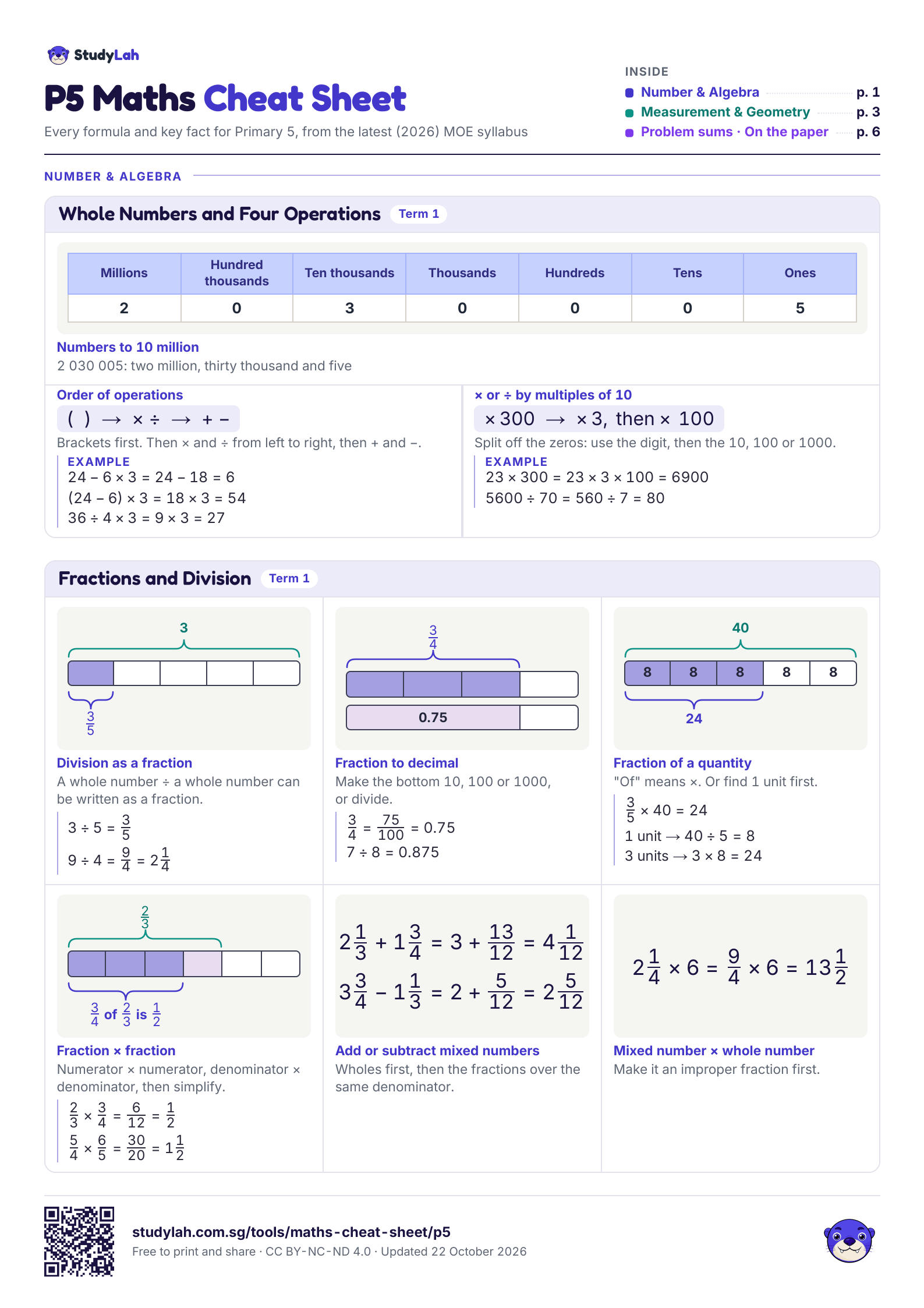
The P5 Maths Cheat Sheet
The P5 sheet holds 48 more formulas and rules, across its 12 topics, on 6 A4 pages.
P5 Maths Cheat Sheet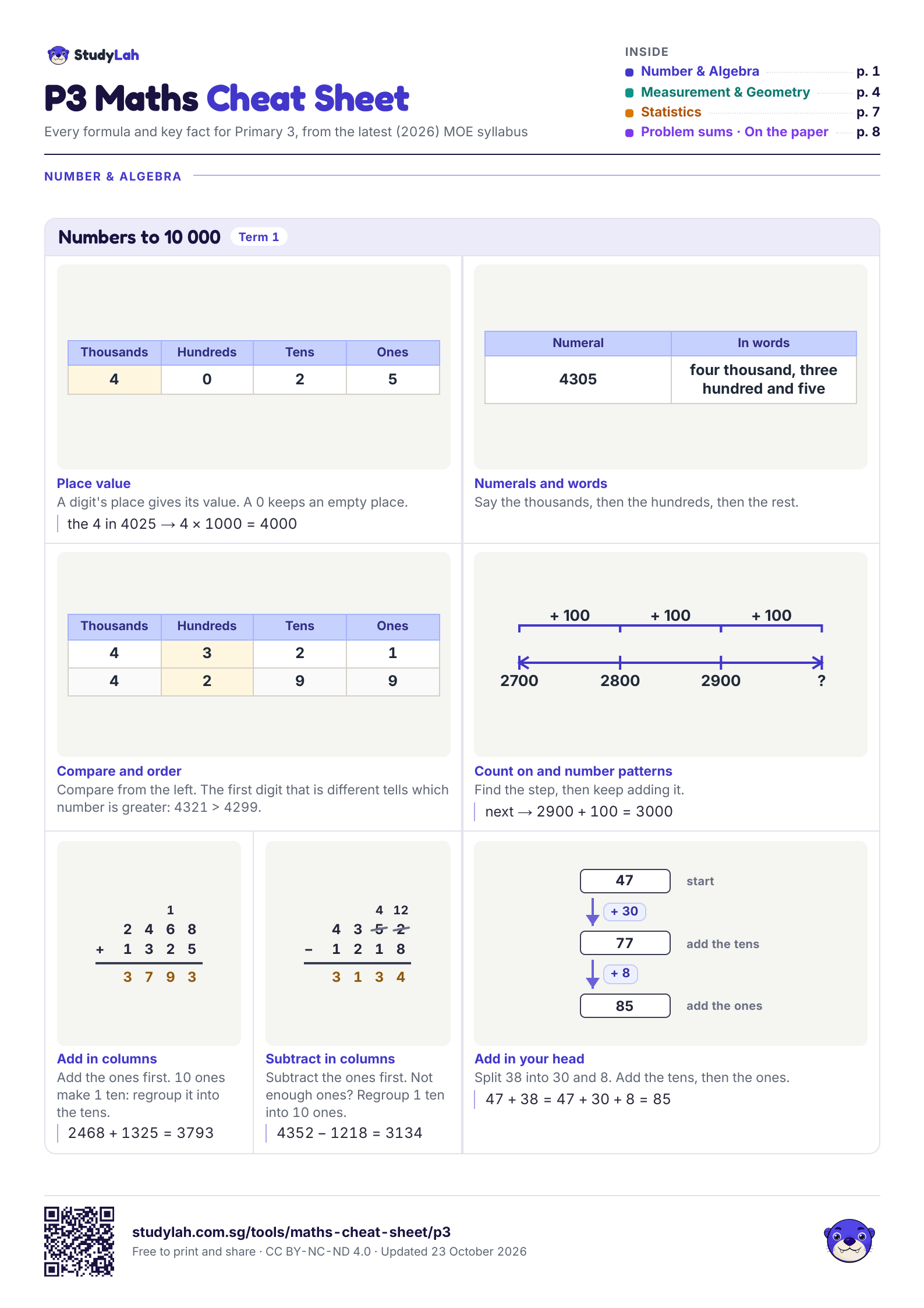
The P3 Maths Cheat Sheet
The P3 sheet holds 45 more formulas and rules, across its 10 topics, on 8 A4 pages.
P3 Maths Cheat Sheet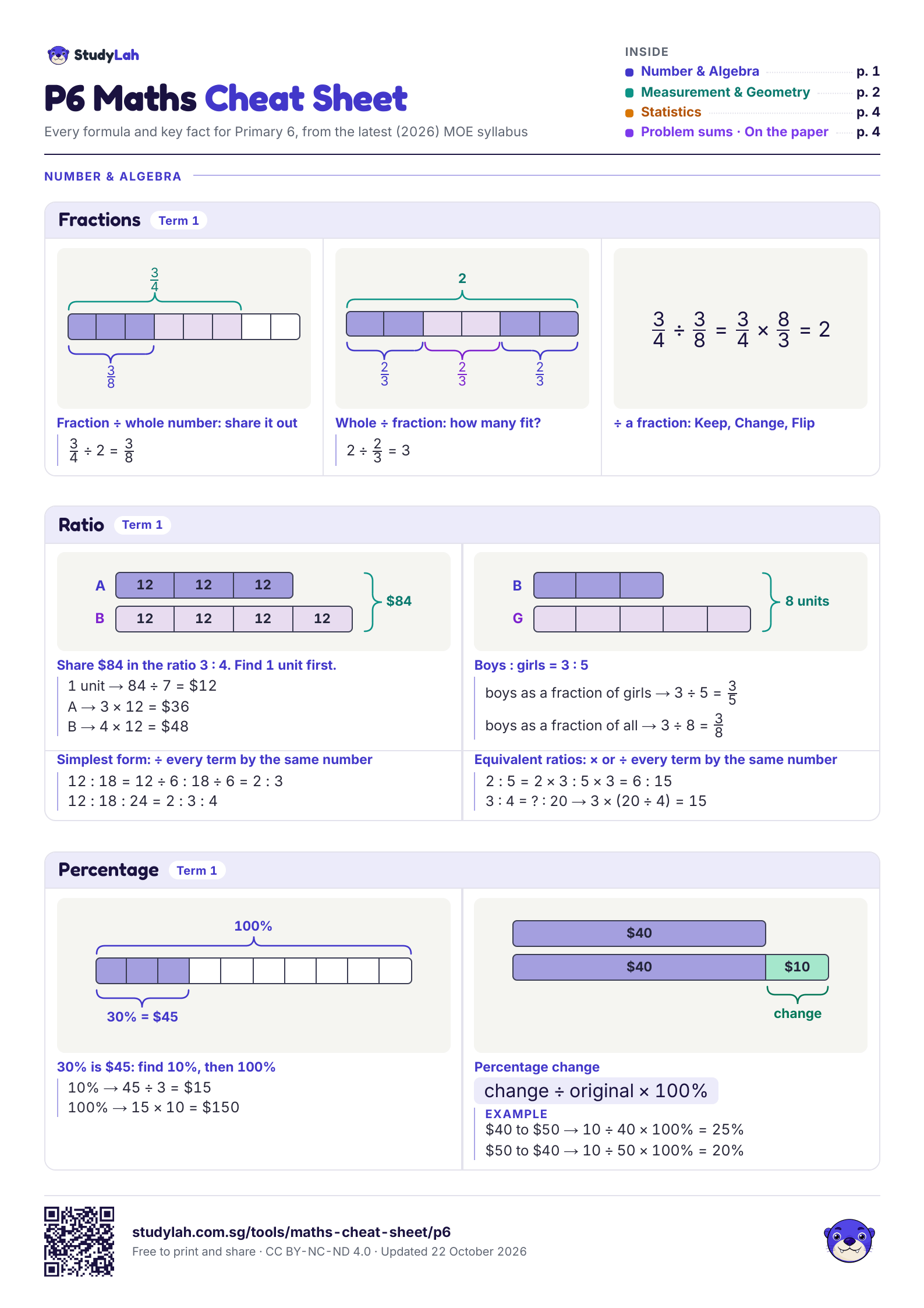
The P6 Maths Cheat Sheet
The P6 sheet holds 36 more formulas and rules, across its 8 topics, on 4 A4 pages.
P6 Maths Cheat SheetThe sheet
All 7 pages, full size
The PDF prints sharp on A4. Each page is also an image you can save or send.
P4 Maths Cheat Sheet, page 1 of 7: formulas for numbers to 100 000; and factors and multiples 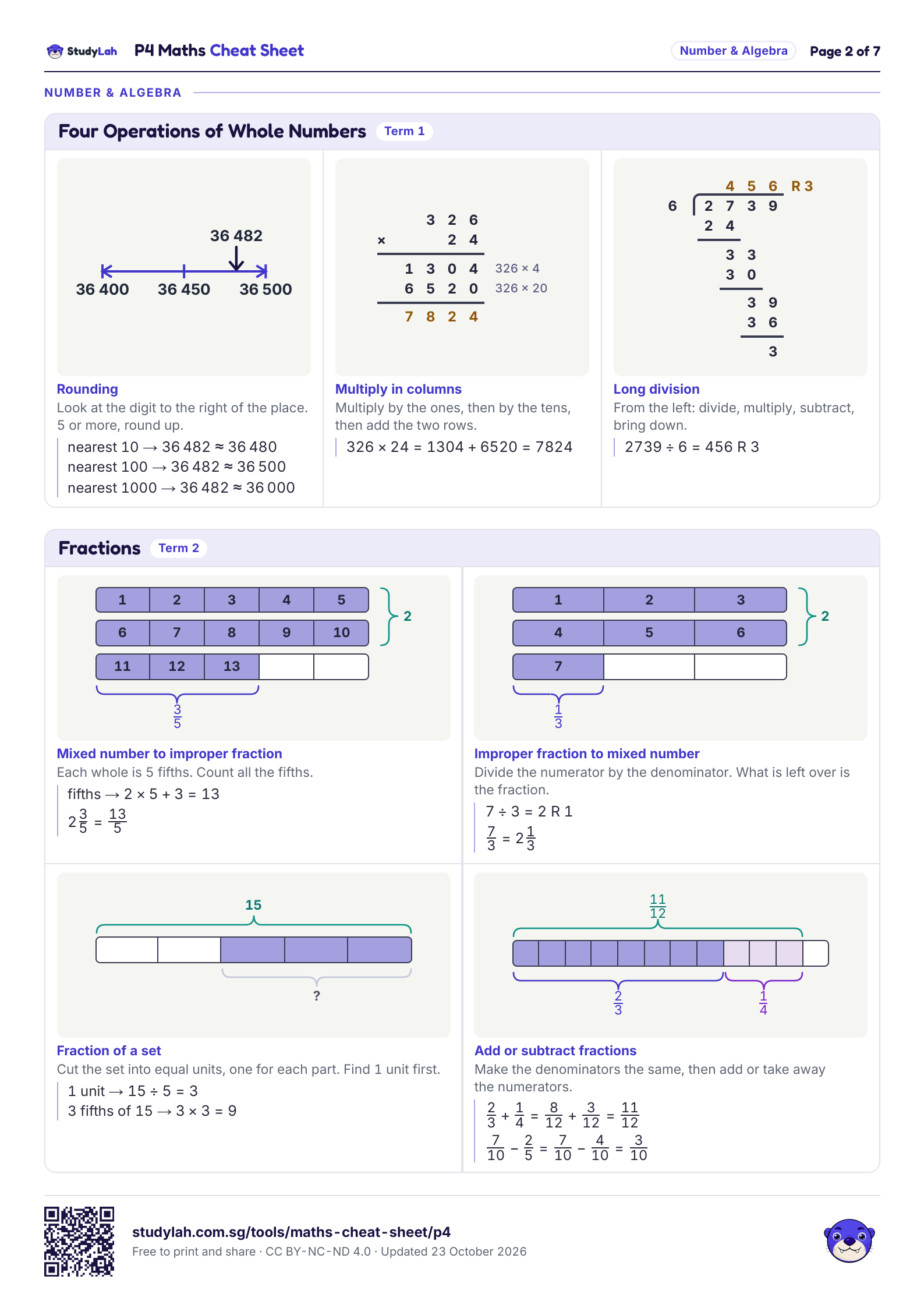
P4 Maths Cheat Sheet, page 2 of 7: formulas for four operations of whole numbers and fractions 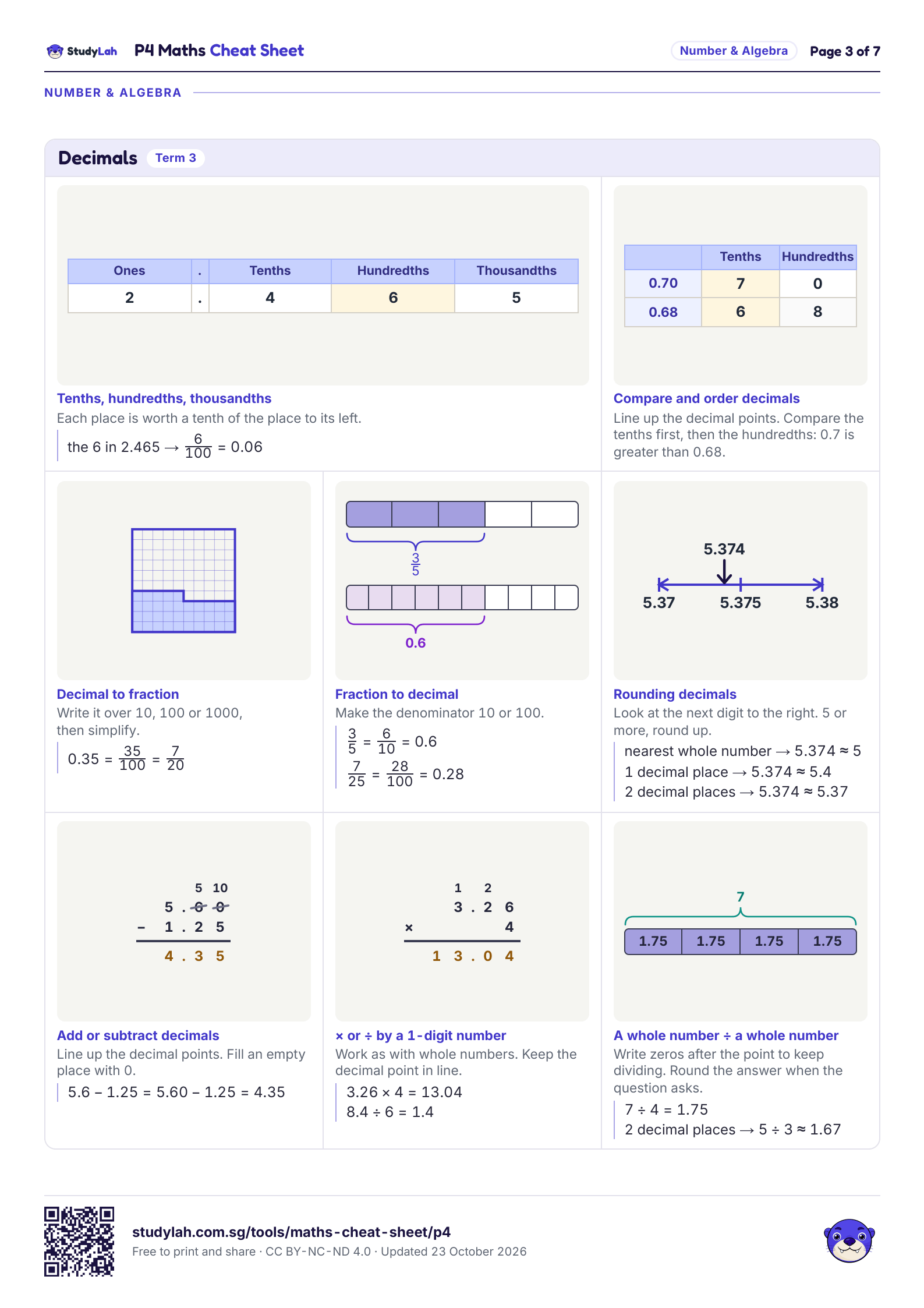
P4 Maths Cheat Sheet, page 3 of 7: formulas for decimals 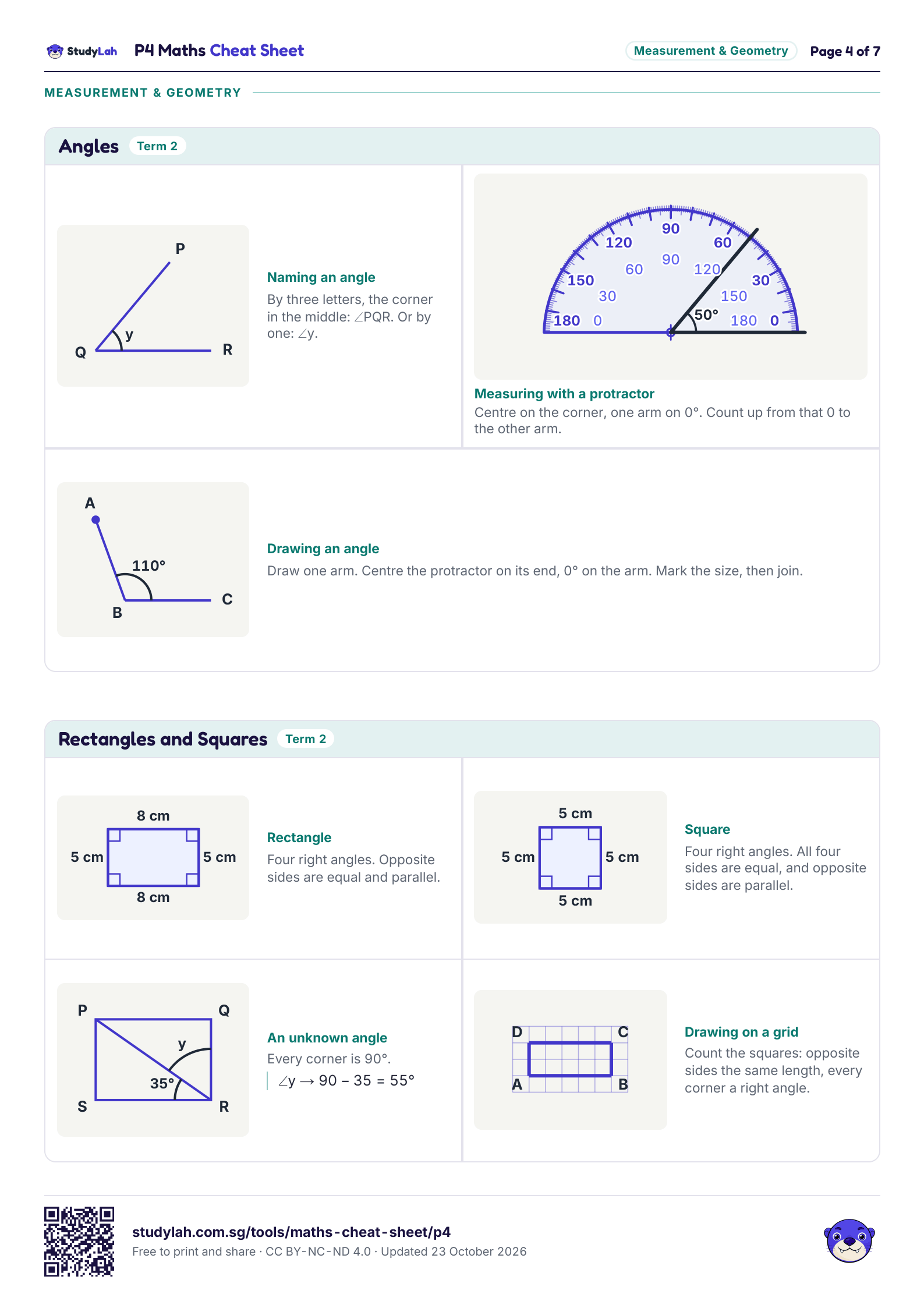
P4 Maths Cheat Sheet, page 4 of 7: formulas for angles; and rectangles and squares 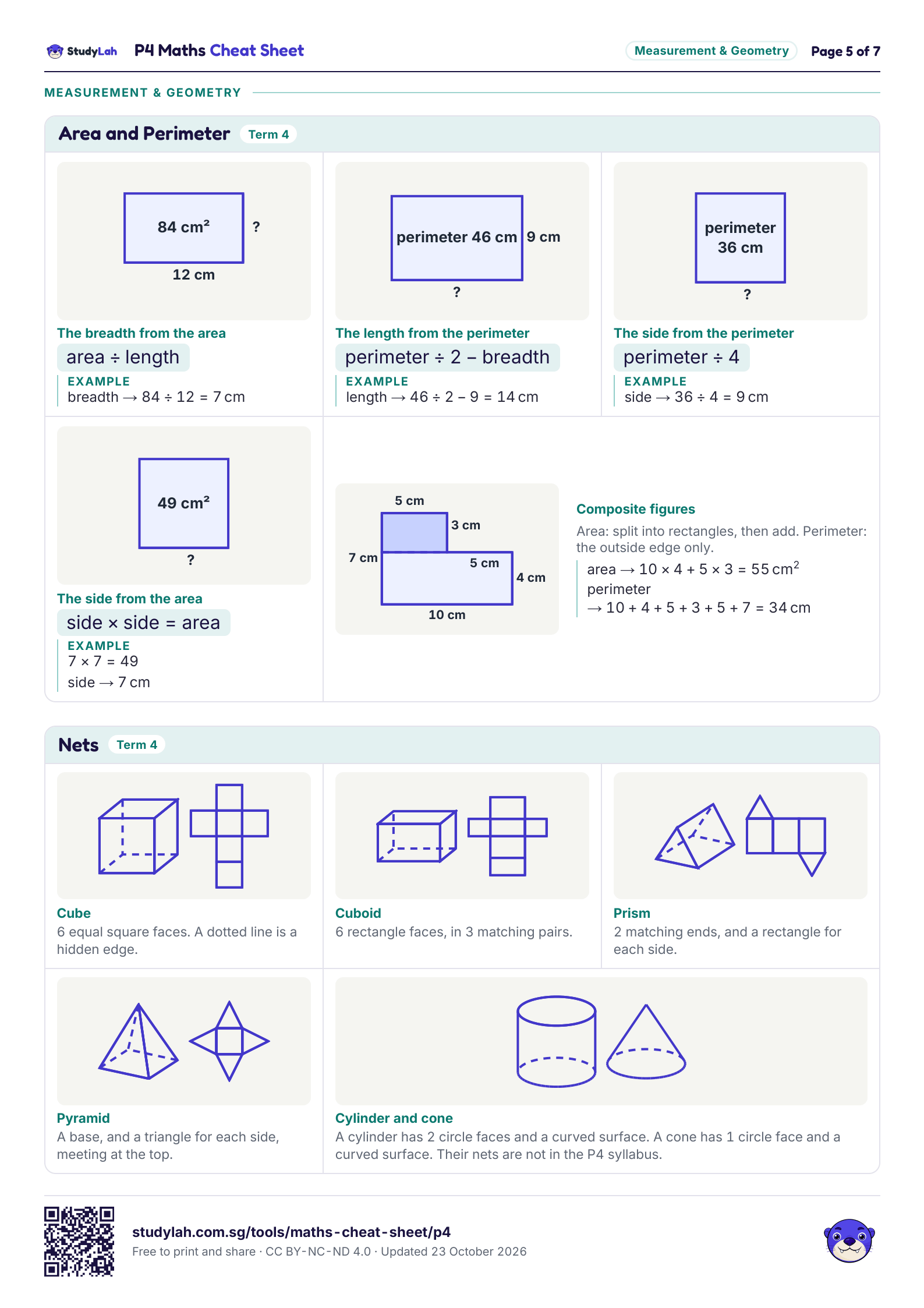
P4 Maths Cheat Sheet, page 5 of 7: formulas for area and perimeter; and nets 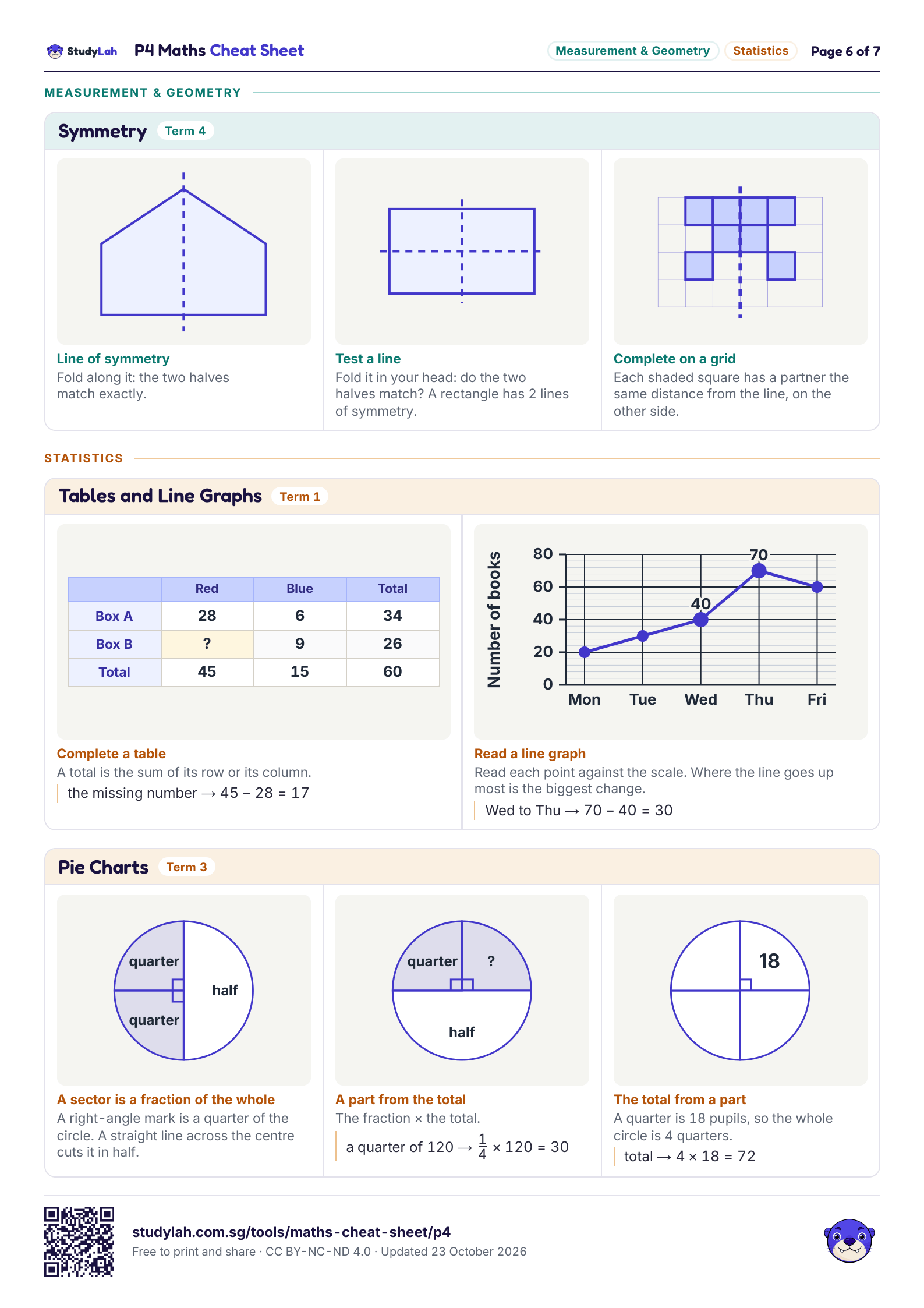
P4 Maths Cheat Sheet, page 6 of 7: formulas for symmetry; tables and line graphs; and pie charts 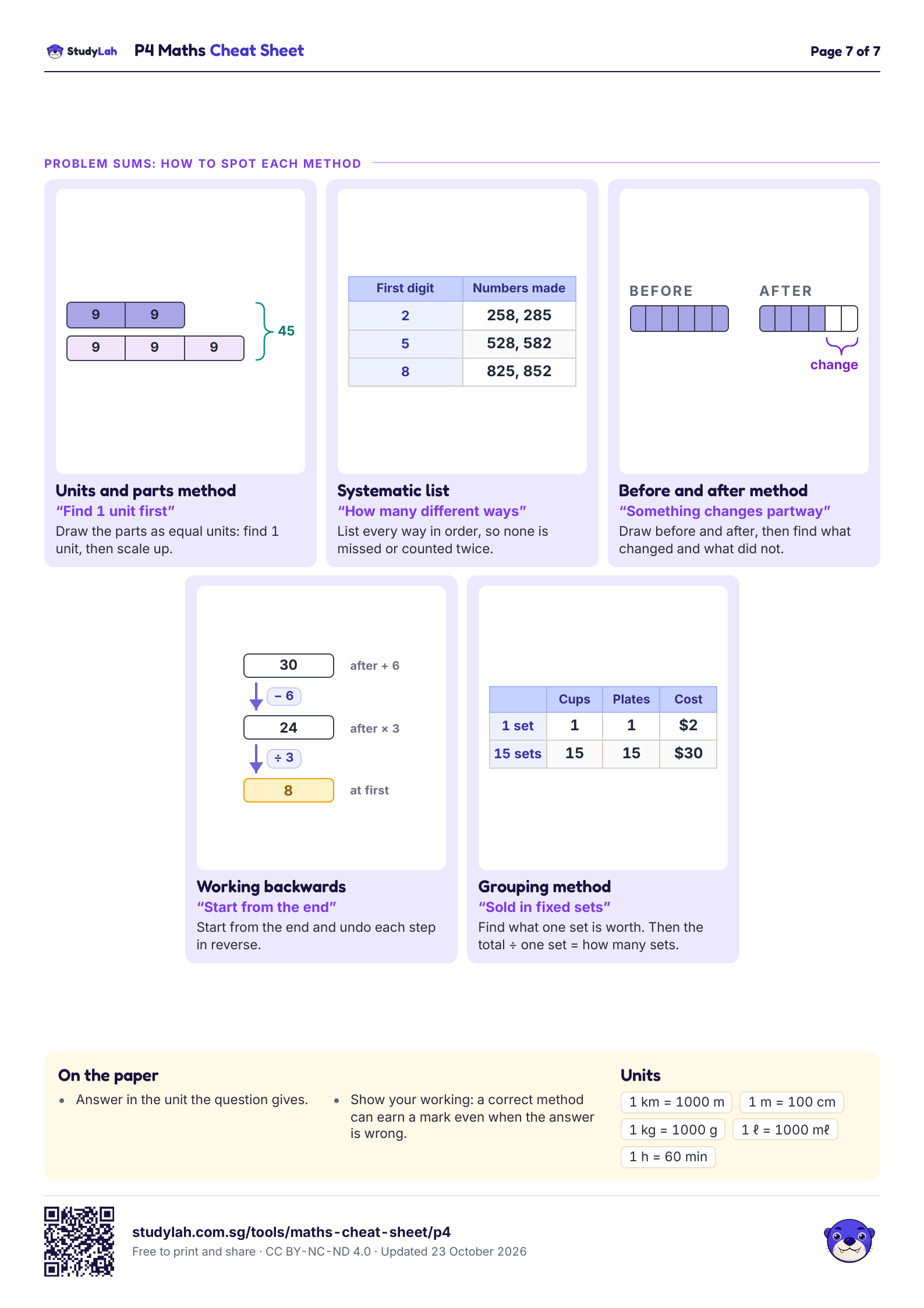
P4 Maths Cheat Sheet, page 7 of 7: problem-sum methods, exam rules and units
Knowing the formula is half of it
The other half is spotting which one a question needs. StudyLah gives your child P4 questions on these topics, and Lah walks through each one step by step. Free: one Daily Practice and one Topic Drill every day, and one exam paper a month.
Try it freeQuestions
Questions parents ask
What maths formulas does a P4 child need to know?
The 48 formulas and rules on this sheet, across numbers to 100 000; factors and multiples; four operations of whole numbers; tables and line graphs; fractions; angles; rectangles and squares; decimals; pie charts; area and perimeter; nets; and symmetry. It also shows how to spot 5 problem-sum methods.
What topics are in P4 maths?
12 topics, in the order schools teach them: numbers to 100 000; factors and multiples; four operations of whole numbers; tables and line graphs; fractions; angles; rectangles and squares; decimals; pie charts; area and perimeter; nets; and symmetry.
Keep going
- Primary Maths cheat sheets
- Primary 4 maths syllabus
- Numbers to 100 000: the full guide
- Factors and Multiples: the full guide
- Four Operations of Whole Numbers: the full guide
- Fractions: the full guide
- Decimals: the full guide
- Angles: the full guide
- Rectangles and Squares: the full guide
- Area and Perimeter: the full guide
- Nets: the full guide
- Symmetry: the full guide
- Tables and Line Graphs: the full guide
- Pie Charts: the full guide
- P4 Maths exam paper
Sources: Ministry of Education, Singapore, Primary Mathematics Syllabus (Standard), updated October 2025. Singapore Examinations and Assessment Board, PSLE Mathematics (0008), for examination from 2026.
Practise every topic on the P4 sheet
Free for every P4 child. Lah walks through each question.