
Free · Printable · Current syllabus
P5 Maths Cheat Sheet
The short version
Every formula and rule a P5 child needs: 48 of them across 12 topics, on 6 A4 pages to print free. The PSLE paper gives no formula list, so your child has to know each one by heart.
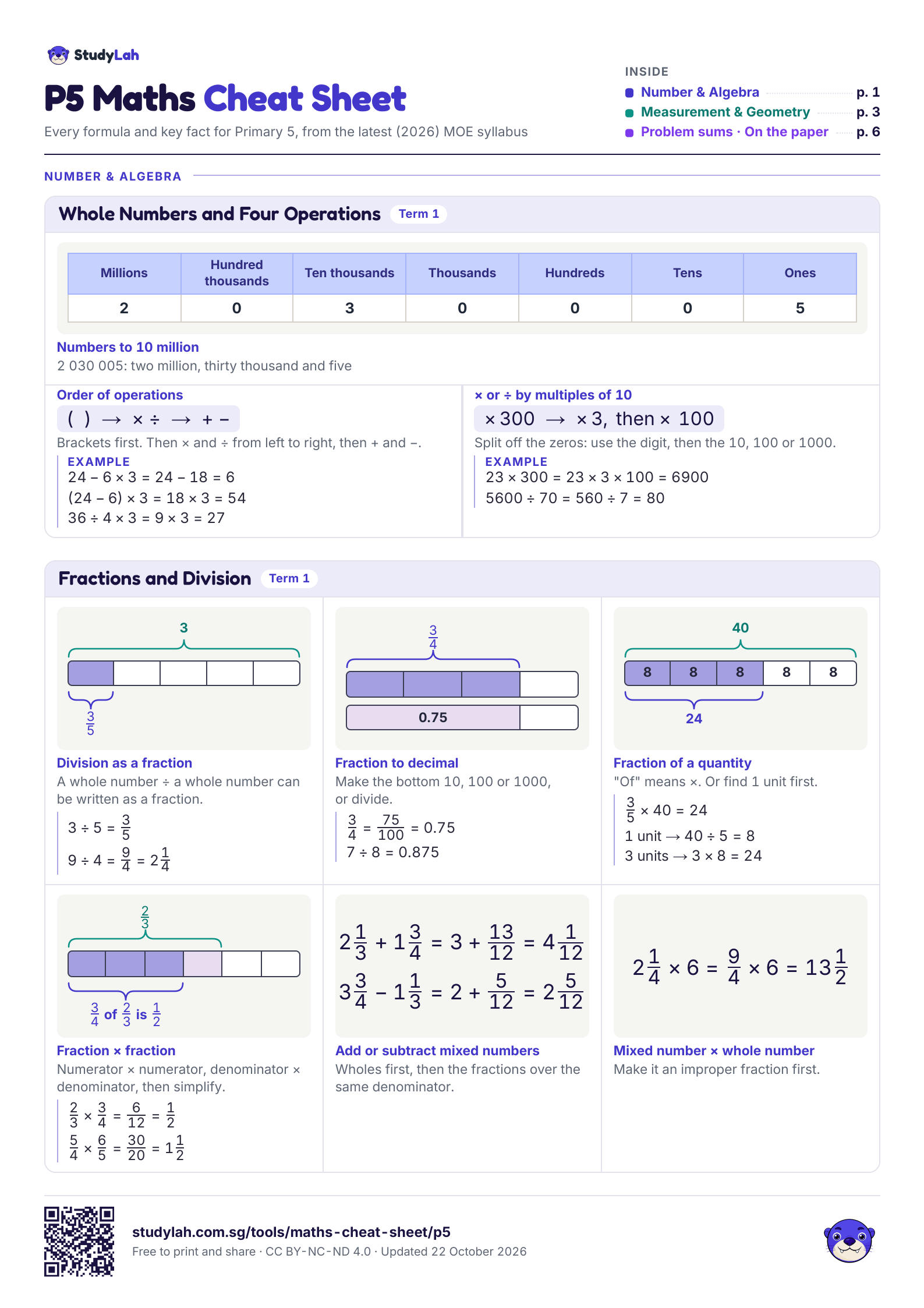
Every P5 maths formula, by topic
| Rule | Example |
|---|---|
| Numbers to 10 million2 030 005: two million, thirty thousand and five | See it drawn |
| Order of operationsBrackets first. Then × and ÷ from left to right, then + and −. | |
| × or ÷ by multiples of 10Split off the zeros: use the digit, then the 10, 100 or 1000. |
| Rule | Example |
|---|---|
| Division as a fractionA whole number ÷ a whole number can be written as a fraction. | See it drawn |
| Fraction to decimalMake the bottom 10, 100 or 1000, or divide. | See it drawn |
| Fraction of a quantity"Of" means ×. Or find 1 unit first. | 1 unit → 3 units → See it drawn |
| Fraction × fractionNumerator × numerator, denominator × denominator, then simplify. | See it drawn |
| Add or subtract mixed numbersWholes first, then the fractions over the same denominator. | |
| Mixed number × whole numberMake it an improper fraction first. |
| Rule | Example |
|---|---|
| × or ÷ by 10, 100, 1000× moves every digit 1, 2 or 3 places left. ÷ moves them right. | See it drawn |
| Changing unitsTo a bigger unit, ÷. To a smaller unit, ×. | 3.8 kg → See it drawn |
| Rule | Example |
|---|---|
| Percent means out of 100To a percentage, × 100%. Back to a decimal, ÷ 100. | See it drawn |
| Part as a percentage | 18 out of 24 → See it drawn |
| Fractions as percentages | See it drawn |
| Percentage of a quantity | 15% of $60 → See it drawn |
| DiscountPrice after discount = usual price − discount | 20% off $45 → pay → See it drawn |
| GSTPrice with GST = price + GST. Use the rate the question gives. | 9% GST on $200 → pay → See it drawn |
| Annual interestA percentage of the money saved, paid each year. | 3% a year on $2500 → after 1 year → See it drawn |
| Rule | Example |
|---|---|
| RateThe amount for 1 unit. | $42 for 6 kg → See it drawn |
| Total amount | 9 kg → See it drawn |
| Number of units | $35 → See it drawn |
| Rule | Example |
|---|---|
| Number pattern: any termTo reach the 20th term, add 19 jumps to the first term. | 20th term → See it drawn |
| Shape patternFigure 1 is 4 sticks. Each new square adds 3 sticks. | Figure 10 → See it drawn |
| Repeating patternDivide by the length of the repeat. The remainder is the place: R 2 is the 2nd shape, a triangle. | 50th, repeat of 4 → See it drawn |
| Rule | Example |
|---|---|
| Area of a triangle | See it drawn |
| The height can be outsideIt is always at right angles to the base. | See it drawn |
| Half of its rectangleSame base and height as the rectangle: half its area. | See it drawn |
| Composite figuresSplit into rectangles, squares and triangles. Add, or take away. | See it drawn |
| Rule | Example |
|---|---|
| Volume in unit cubesEach cube is 1 cm³. This block is 3 cubes long, 2 wide and 2 high. | See it drawn |
| Volume of a cuboid | See it drawn |
| Volume of a cube | See it drawn |
| Water in a tankVolume of water = length × breadth × height of the water | See it drawn |
| Water added or taken outVolume = length × breadth × the change in height | See it drawn |
| Litres and cm³1 mℓ = 1 cm³ |
| Rule | Example |
|---|---|
| Count cubes layer by layerCount each layer, from the bottom up. | bottom to top → See it drawn |
| Front and side viewsLook straight at one face. Draw only the squares you see. | See it drawn |
| Cubes to fill a boxCubes the full box holds − cubes already in it | See it drawn |
| Rule | Example |
|---|---|
| Angles on a straight lineThey add up to 180°. | a → See it drawn |
| Angles at a pointThey add up to 360°. | See it drawn |
| Vertically opposite angles are equalSo a = 110°. | See it drawn |
| Angles in a right angleThey add up to 90°. | a → See it drawn |
| Rule | Example |
|---|---|
| Angles in a triangleThey add up to 180°. | See it drawn |
| Isosceles triangle2 equal sides, 2 equal base angles. | See it drawn |
| Equilateral triangle3 equal sides. Every angle is 60°. | See it drawn |
| Right-angled triangleThe other two angles add up to 90°. | a → See it drawn |
| Rule | Example |
|---|---|
| ParallelogramOpposite sides parallel and equal. Angles next to each other add up to 180°. | a → See it drawn |
| RhombusAll 4 sides equal. Opposite angles equal: a = 58°. | See it drawn |
| TrapeziumOne pair of parallel sides. The angles between them add up to 180°. | a → See it drawn |
P5 maths revision notes, topic by topic
- Numbers to 10 million2 030 005: two million, thirty thousand and five
Millions Hundred thousands Ten thousands Thousands Hundreds Tens Ones 2 0 3 0 0 0 5 - Order of operationsBrackets first. Then × and ÷ from left to right, then + and −.Example
- × or ÷ by multiples of 10Split off the zeros: use the digit, then the 10, 100 or 1000.Example
Fractions and Division
Term 1- Division as a fractionA whole number ÷ a whole number can be written as a fraction.
- Fraction to decimalMake the bottom 10, 100 or 1000, or divide.
- Fraction of a quantity"Of" means ×. Or find 1 unit first. 1 unit → 3 units →
- Fraction × fractionNumerator × numerator, denominator × denominator, then simplify.
- Add or subtract mixed numbersWholes first, then the fractions over the same denominator.
- Mixed number × whole numberMake it an improper fraction first.
Decimals
Term 3 · revision- × or ÷ by 10, 100, 1000× moves every digit 1, 2 or 3 places left. ÷ moves them right.
Hundreds Tens Ones . Tenths Hundredths Thousandths 2.375 2 . 3 7 5 × 100 2 3 7 . 5 - Changing unitsTo a bigger unit, ÷. To a smaller unit, ×.3.8 kg →cm4500÷ 100m45÷ 1000km0.045
Percentage
Term 3- Percent means out of 100To a percentage, × 100%. Back to a decimal, ÷ 100.
- Part as a percentageExample18 out of 24 →
- Fractions as percentages
- Percentage of a quantity15% of $60 →
- DiscountPrice after discount = usual price − discount20% off $45 → pay →
- GSTPrice with GST = price + GST. Use the rate the question gives.9% GST on $200 → pay →
- Annual interestA percentage of the money saved, paid each year.3% a year on $2500 → after 1 year →
Rate
Term 3- RateThe amount for 1 unit.Example$42 for 6 kg →
- Total amountExample9 kg →
- Number of unitsExample$35 →
- Number pattern: any termTo reach the 20th term, add 19 jumps to the first term.20th term →
- Shape patternFigure 1 is 4 sticks. Each new square adds 3 sticks.Figure 10 →
- Repeating patternDivide by the length of the repeat. The remainder is the place: R 2 is the 2nd shape, a triangle.50th, repeat of 4 →
Area of Triangle
Term 2- Area of a triangleExample
- The height can be outsideIt is always at right angles to the base.
- Half of its rectangleSame base and height as the rectangle: half its area.
- Composite figuresSplit into rectangles, squares and triangles. Add, or take away.
- Volume in unit cubesEach cube is 1 cm³. This block is 3 cubes long, 2 wide and 2 high.
- Volume of a cuboidExample
- Volume of a cubeExample
- Water in a tankVolume of water = length × breadth × height of the water
- Water added or taken outVolume = length × breadth × the change in height
- Litres and cm³1 mℓ = 1 cm³Example
- Count cubes layer by layerCount each layer, from the bottom up.bottom to top →
- Front and side viewsLook straight at one face. Draw only the squares you see.
- Cubes to fill a boxCubes the full box holds − cubes already in it
Angles
Term 3- Angles on a straight lineThey add up to 180°.a →
- Angles at a pointThey add up to 360°.
- Vertically opposite angles are equalSo a = 110°.
- Angles in a right angleThey add up to 90°.a →
Properties of Triangles
Term 4- Angles in a triangleThey add up to 180°.
- Isosceles triangle2 equal sides, 2 equal base angles.
- Equilateral triangle3 equal sides. Every angle is 60°.
- Right-angled triangleThe other two angles add up to 90°.a →
- ParallelogramOpposite sides parallel and equal. Angles next to each other add up to 180°.a →
- RhombusAll 4 sides equal. Opposite angles equal: a = 58°.
- TrapeziumOne pair of parallel sides. The angles between them add up to 180°.a →
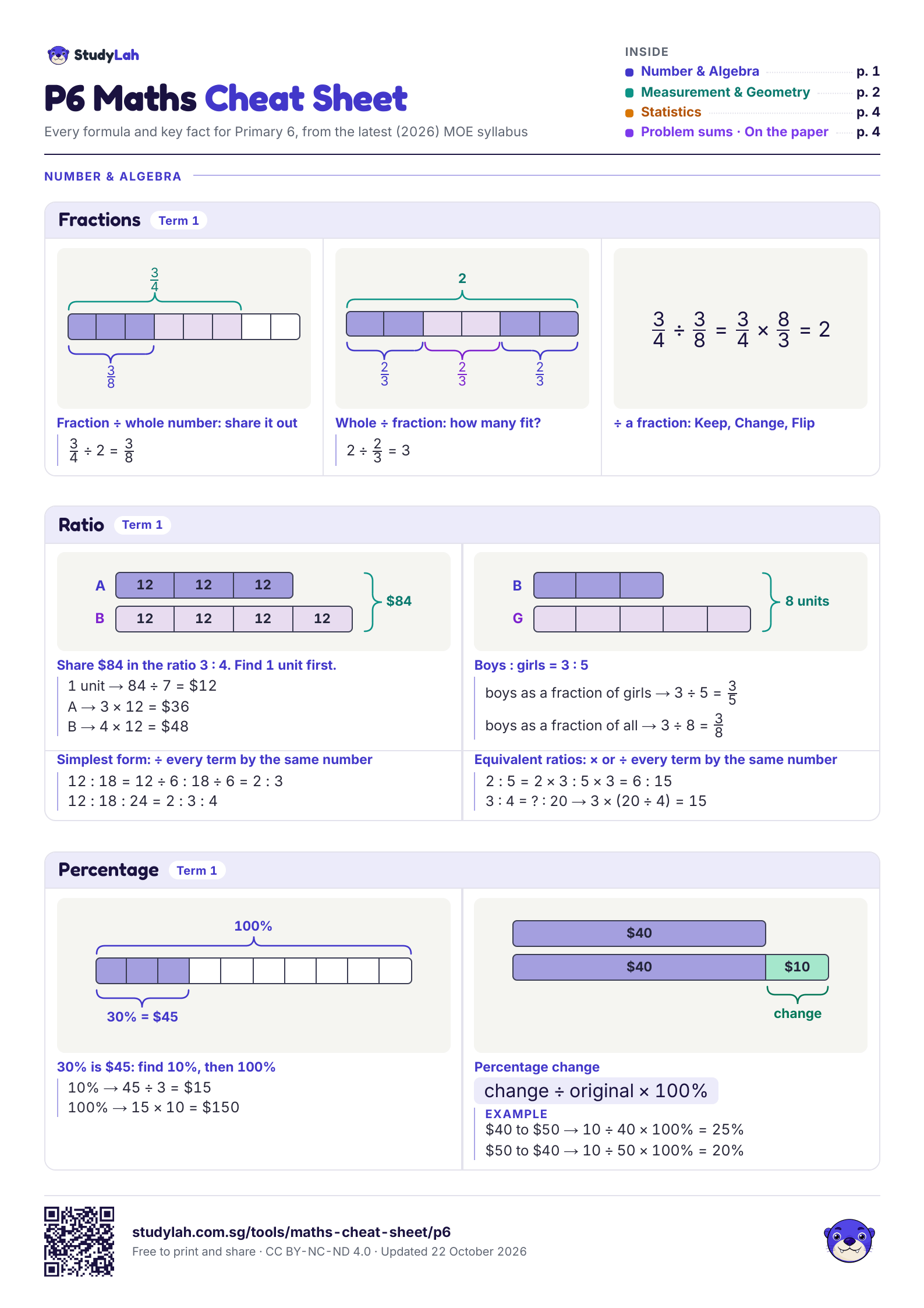
The P6 sheet, for the PSLE year
The P6 sheet holds 36 more formulas and rules, across its 8 topics, on 4 A4 pages.
P6 Maths Cheat Sheet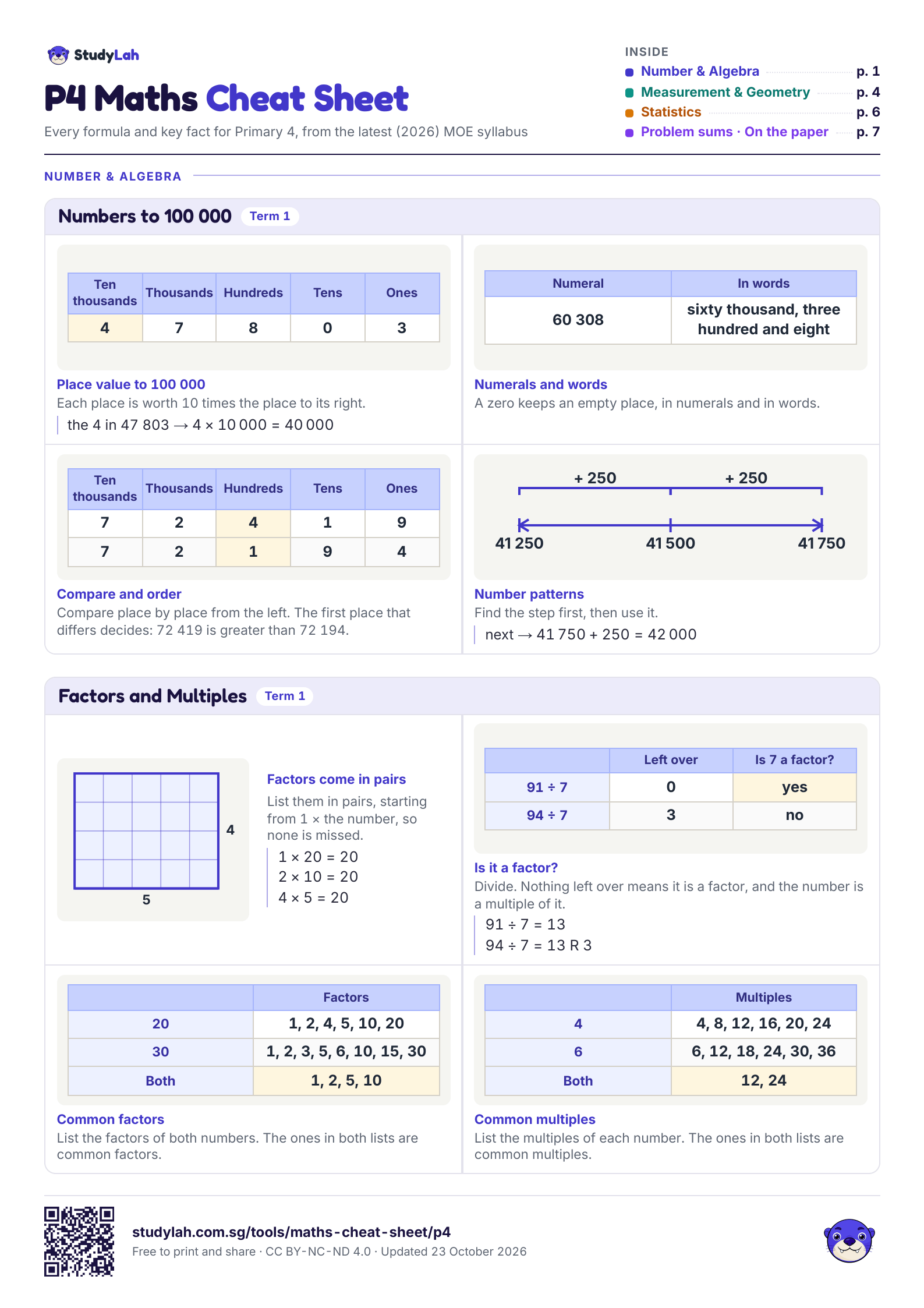
The P4 Maths Cheat Sheet
The P4 sheet holds 48 more formulas and rules, across its 12 topics, on 7 A4 pages.
P4 Maths Cheat Sheet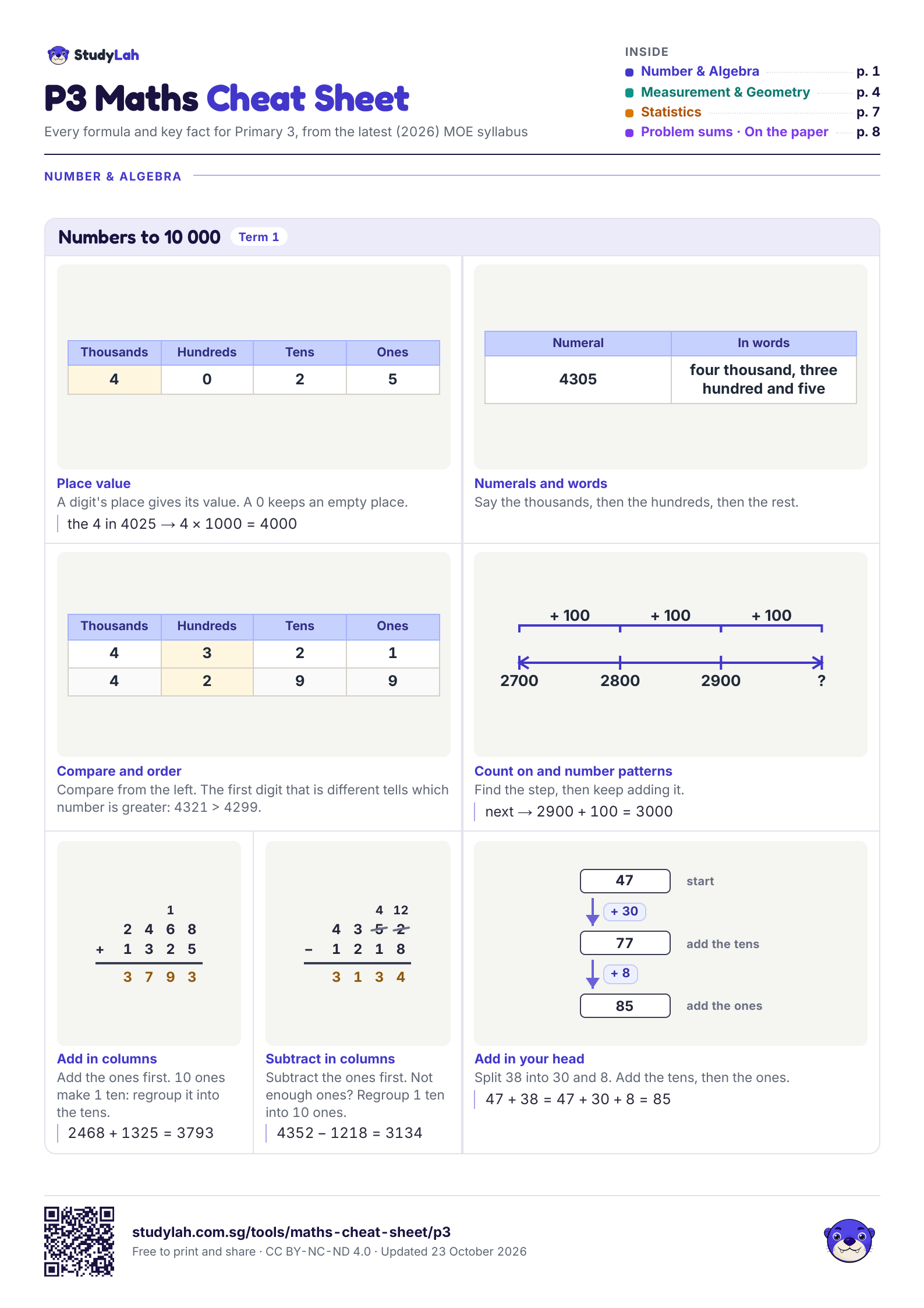
The P3 Maths Cheat Sheet
The P3 sheet holds 45 more formulas and rules, across its 10 topics, on 8 A4 pages.
P3 Maths Cheat SheetThe sheet
All 6 pages, full size
The PDF prints sharp on A4. Each page is also an image you can save or send.
P5 Maths Cheat Sheet, page 1 of 6: formulas for whole numbers and four operations; and fractions and division 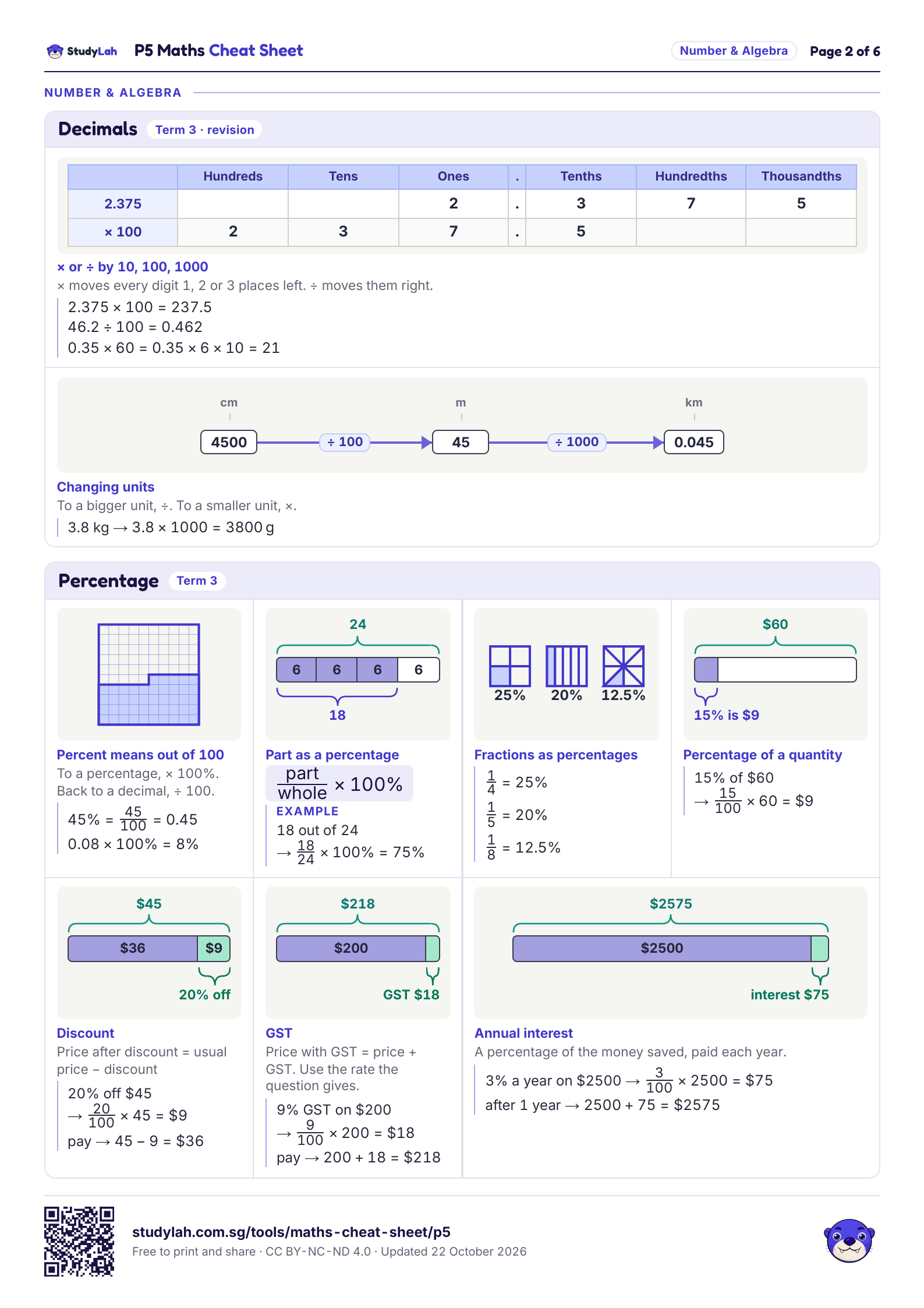
P5 Maths Cheat Sheet, page 2 of 6: formulas for decimals and percentage 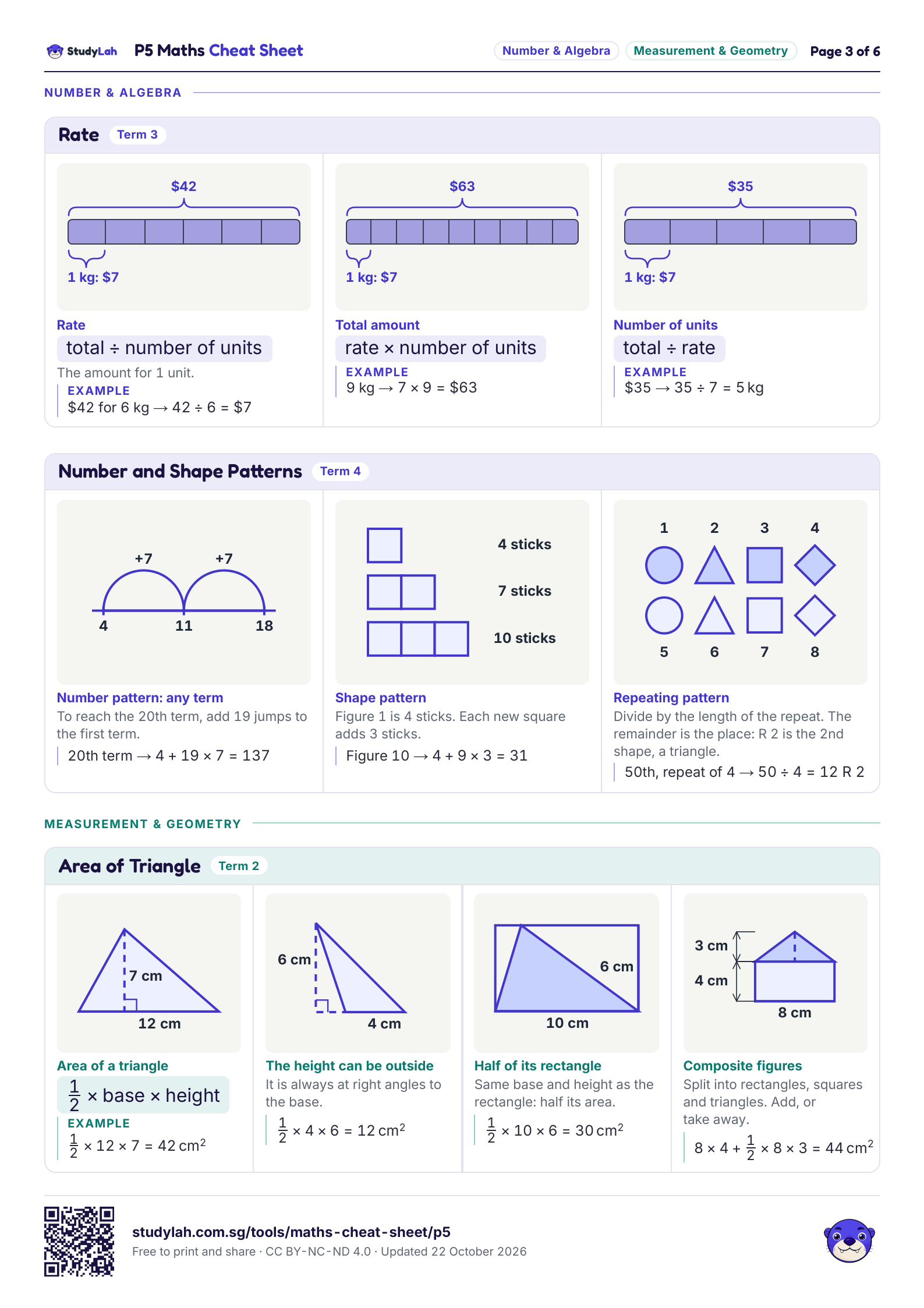
P5 Maths Cheat Sheet, page 3 of 6: formulas for rate; number and shape patterns; and area of triangle 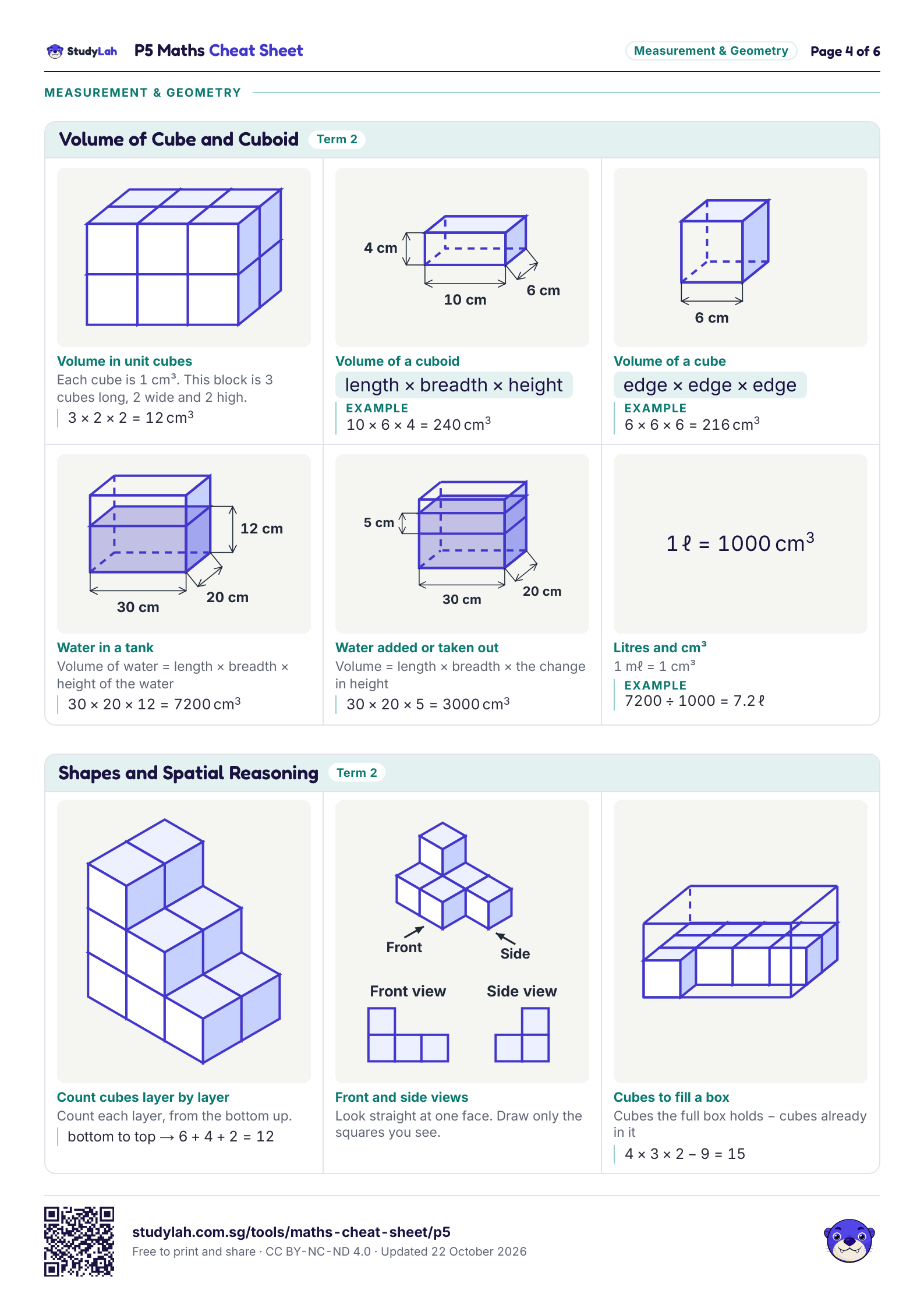
P5 Maths Cheat Sheet, page 4 of 6: formulas for volume of cube and cuboid; and shapes and spatial reasoning 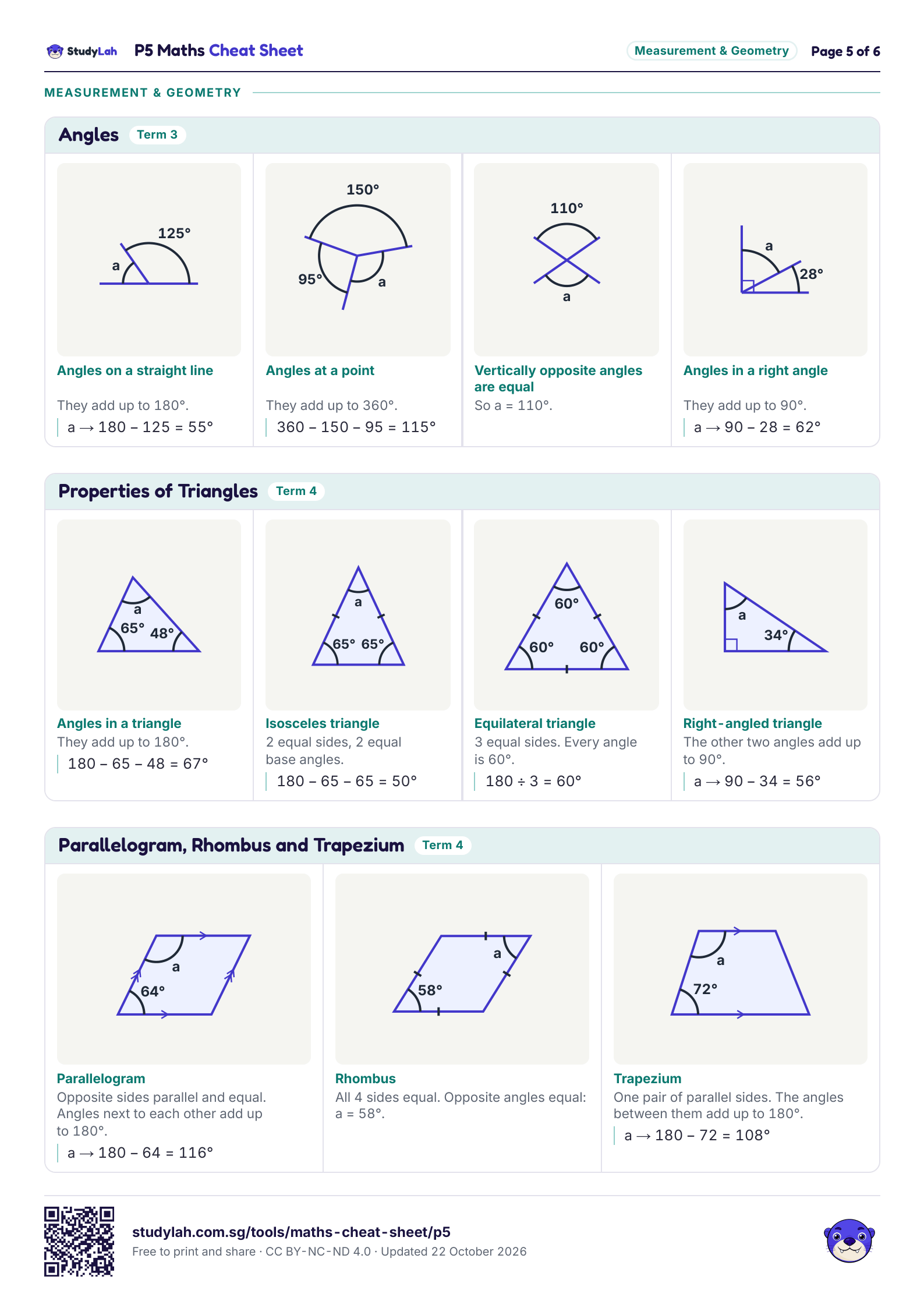
P5 Maths Cheat Sheet, page 5 of 6: formulas for angles; properties of triangles; and parallelogram, rhombus and trapezium 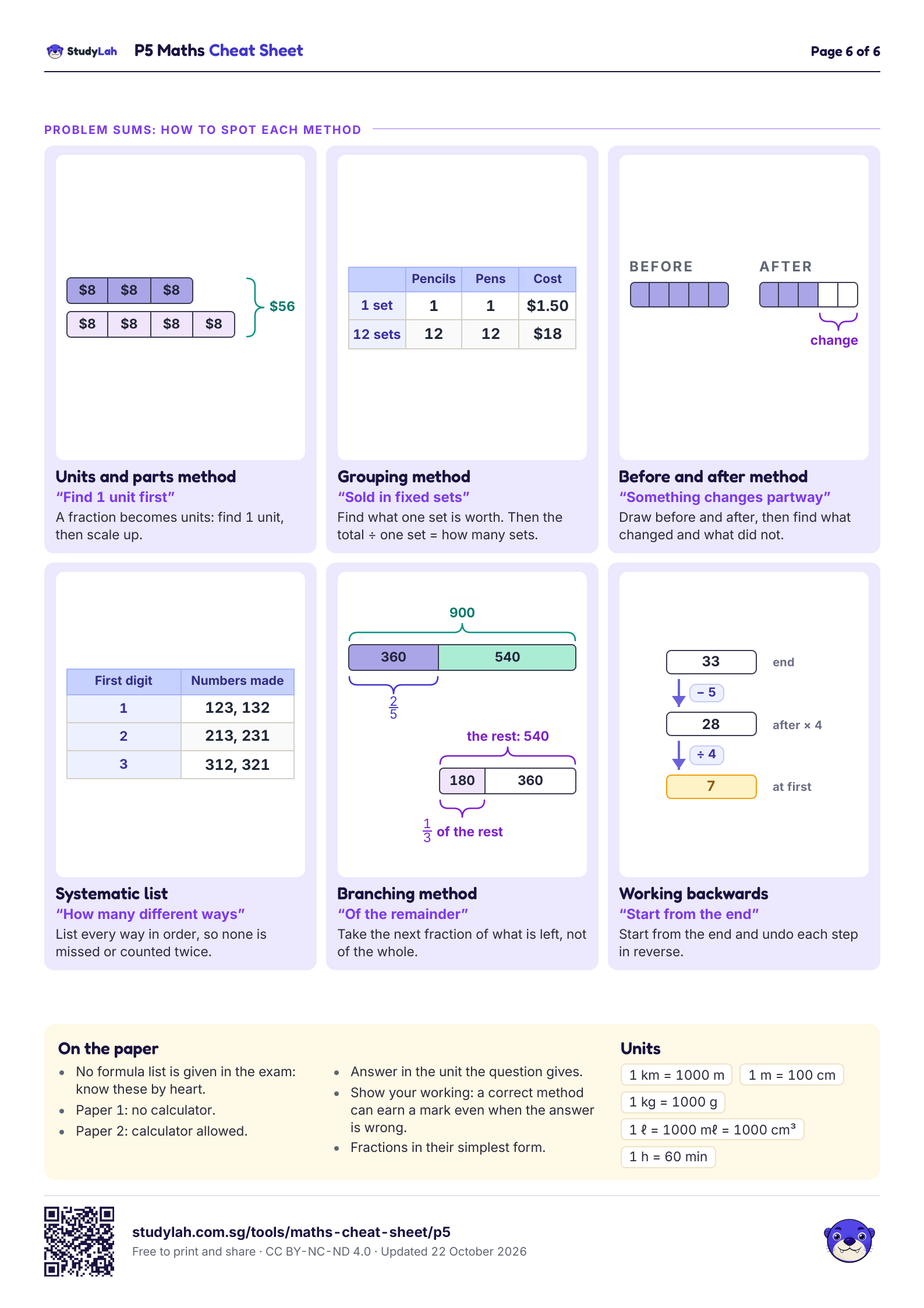
P5 Maths Cheat Sheet, page 6 of 6: problem-sum methods, exam rules and units
Knowing the formula is half of it
The other half is spotting which one a question needs. StudyLah gives your child P5 questions on these topics, and Lah walks through each one step by step. Free: one Daily Practice and one Topic Drill every day, and one exam paper a month.
Try it freeQuestions
Questions parents ask
What maths formulas does a P5 child need to know?
The 48 formulas and rules on this sheet, across whole numbers and four operations; fractions and division; area of triangle; volume of cube and cuboid; shapes and spatial reasoning; decimals; percentage; rate; angles; properties of triangles; parallelogram, rhombus and trapezium; and number and shape patterns. It also shows how to spot 6 problem-sum methods. The PSLE tests them too, with the P6 formulas.
What topics are in P5 maths?
12 topics, in the order schools teach them: whole numbers and four operations; fractions and division; area of triangle; volume of cube and cuboid; shapes and spatial reasoning; decimals; percentage; rate; angles; properties of triangles; parallelogram, rhombus and trapezium; and number and shape patterns.
Keep going
- Primary Maths cheat sheets
- Primary 5 maths syllabus
- Whole Numbers and Four Operations: the full guide
- Fractions and Division: the full guide
- Decimals: the full guide
- Percentage: the full guide
- Rate: the full guide
- Number and Shape Patterns: the full guide
- Area of Triangle: the full guide
- Volume of Cube and Cuboid: the full guide
- Shapes and Spatial Reasoning: the full guide
- Angles: the full guide
- Properties of Triangles: the full guide
- Parallelogram, Rhombus and Trapezium: the full guide
- P5 Maths exam paper
Sources: Ministry of Education, Singapore, Primary Mathematics Syllabus (Standard), updated October 2025. Singapore Examinations and Assessment Board, PSLE Mathematics (0008), for examination from 2026.
Practise every topic on the P5 sheet
Free for every P5 child. Lah walks through each question.