
Free · Printable · Current syllabus
P2 Maths Cheat Sheet
The short version
Every formula and rule a P2 child needs: 35 of them across 12 topics, on 7 A4 pages to print free. The PSLE tests the whole primary syllabus, so these formulas are in it too.
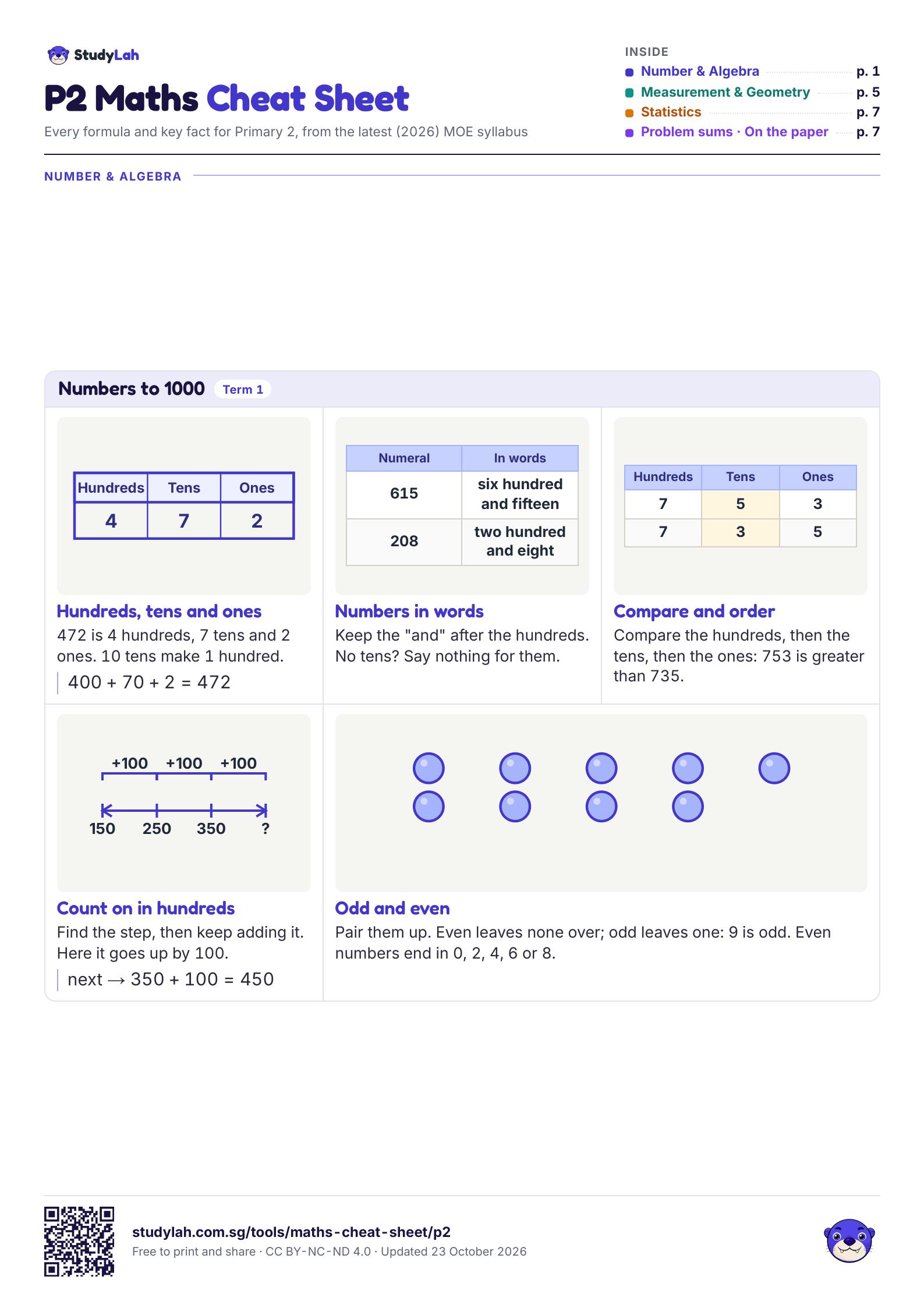
Every P2 maths formula, by topic
| Rule | Example |
|---|---|
| Hundreds, tens and ones472 is 4 hundreds, 7 tens and 2 ones. 10 tens make 1 hundred. | See it drawn |
| Numbers in wordsKeep the "and" after the hundreds. No tens? Say nothing for them. | See it drawn |
| Compare and orderCompare the hundreds, then the tens, then the ones: 753 is greater than 735. | See it drawn |
| Count on in hundredsFind the step, then keep adding it. Here it goes up by 100. | next → See it drawn |
| Odd and evenPair them up. Even leaves none over; odd leaves one: 9 is odd. Even numbers end in 0, 2, 4, 6 or 8. | See it drawn |
| Rule | Example |
|---|---|
| Add in columnsAdd the ones first. 10 ones make 1 ten: regroup it into the tens. | See it drawn |
| Subtract in columnsSubtract the ones first. Not enough ones? Regroup 1 ten into 10 ones. | See it drawn |
| Add in your headAdding tens or hundreds? Only that place changes. | See it drawn |
| Rule | Example |
|---|---|
| Times tables of 2, 5 and 10Count in equal steps. 4 × 5 is the same as 5 × 4. | See it drawn |
| × and ÷ are a pairEvery ÷ fact has a × fact behind it. Check a division by multiplying back. | See it drawn |
| SharingYou know how many groups. Find how many in each. | See it drawn |
| GroupingYou know how many in each group. Find how many groups. | See it drawn |
| Rule | Example |
|---|---|
| Times tables of 3 and 4Learn them by heart. 3 × 8 is the same as 8 × 3. | See it drawn |
| Double the 2s4 × 6 is double 2 × 6. | See it drawn |
| Divide with the tables3 rows of 7 make 21. So 21 shared into 3 equal rows is 7 in each. | See it drawn |
| Rule | Example |
|---|---|
| Equal parts of a wholeThe bottom number counts the equal parts. The top counts the shaded ones: 3 quarters. | See it drawn |
| Unit fractionsMore equal parts means smaller parts: one third is greater than one sixth. | See it drawn |
| Like fractionsSame bottom number? The greater top number is the greater fraction. | See it drawn |
| Add like fractionsAdd the top numbers. The bottom number stays the same. | See it drawn |
| Rule | Example |
|---|---|
| Count notes and coinsCount the notes first, then the coins. | See it drawn |
| Dollars and centsDollars before the point, cents after, always 2 places. $1 is 100 cents. | See it drawn |
| Compare amountsCompare the dollars first. Same dollars? Then compare the cents. 60 cents is more than 25 cents. | See it drawn |
| Rule | Example |
|---|---|
| Centimetres and metresShort things in cm, like a pencil. Long things in m, like this rope: 3 m. Start at 0. | See it drawn |
| Compare lengthsStart them on the same line. Then compare the numbers. | how much longer → See it drawn |
| Rule | Example |
|---|---|
| Read a scaleFind what one small mark is worth first. The numbers go up in 2s, so each mark is 1 kg: 7 kg. | See it drawn |
| Heavier and lighterOn a balance, the heavier side goes down. The small ball is heavier than the big box A. | See it drawn |
| Rule | Example |
|---|---|
| Tell the time to the minuteHour hand first. Count the minute hand in fives, then in ones: 45, 46, 47. | See it drawn |
| Hours and minutes1 h is 60 min. Change the hours into minutes, then add. | See it drawn |
| Rule | Example |
|---|---|
| Measure in litresFind what one small mark is worth first. Here each mark is 1 ℓ. | See it drawn |
| Compare the litresRead each container's litres, then compare the numbers. B holds more. | how much more in B → See it drawn |
| Rule | Example |
|---|---|
| Cube and cuboidAll flat faces, so they stack and slide. A cube's 6 faces are squares. | See it drawn |
| Cylinder and coneA curved surface rolls. A cylinder has 2 flat faces; a cone has 1. | See it drawn |
| SphereOne curved surface and no flat faces, like a ball. It rolls every way. | See it drawn |
| Repeating patternsFind the part that repeats, then say what comes next. A pattern can change by size, shape, colour or turn. | See it drawn |
| Rule | Example |
|---|---|
| Read the key firstOne picture can stand for more than 1. Multiply by the key. | Tuesday → how many more on Tuesday than Monday → See it drawn |
P2 maths revision notes, topic by topic
Numbers to 1000
Term 1- Hundreds, tens and ones472 is 4 hundreds, 7 tens and 2 ones. 10 tens make 1 hundred.
Place How many Hundreds 4 Tens 7 Ones 2 - Numbers in wordsKeep the "and" after the hundreds. No tens? Say nothing for them.
Numeral In words 615 six hundred and fifteen 208 two hundred and eight - Compare and orderCompare the hundreds, then the tens, then the ones: 753 is greater than 735.
Hundreds Tens Ones 7 5 3 7 3 5 - Count on in hundredsFind the step, then keep adding it. Here it goes up by 100.next →
Point Value 150 150 250 250 350 350 ? 450 - Odd and evenPair them up. Even leaves none over; odd leaves one: 9 is odd. Even numbers end in 0, 2, 4, 6 or 8.
Group Detail 9
- Add in columnsAdd the ones first. 10 ones make 1 ten: regroup it into the tens.
- Subtract in columnsSubtract the ones first. Not enough ones? Regroup 1 ten into 10 ones.
- Add in your headAdding tens or hundreds? Only that place changes.
Point Value 365 365 375 375 385 385 395 395
- Times tables of 2, 5 and 10Count in equal steps. 4 × 5 is the same as 5 × 4.
× 2 × 5 × 10 1 2 5 10 2 4 10 20 3 6 15 30 4 8 20 40 5 10 25 50 6 12 30 60 7 14 35 70 8 16 40 80 9 18 45 90 10 20 50 100 - × and ÷ are a pairEvery ÷ fact has a × fact behind it. Check a division by multiplying back.
Group Detail 15 - GroupingYou know how many in each group. Find how many groups.
Group Detail 5 5
- Times tables of 3 and 4Learn them by heart. 3 × 8 is the same as 8 × 3.
× 3 × 4 1 3 4 2 6 8 3 9 12 4 12 16 5 15 20 6 18 24 7 21 28 8 24 32 9 27 36 10 30 40 - Double the 2s4 × 6 is double 2 × 6.
Group Detail 6 6×counter 6 6×counter 6 6×counter 6 6×counter - Divide with the tables3 rows of 7 make 21. So 21 shared into 3 equal rows is 7 in each.
Group Detail 7 7×counter 7 7×counter 7 7×counter
Fractions
Term 3- Equal parts of a wholeThe bottom number counts the equal parts. The top counts the shaded ones: 3 quarters.
- Unit fractionsMore equal parts means smaller parts: one third is greater than one sixth.
- Like fractionsSame bottom number? The greater top number is the greater fraction.
- Add like fractionsAdd the top numbers. The bottom number stays the same.
Money
Term 4- Count notes and coinsCount the notes first, then the coins.
Group Detail 1×$5, 1×$2 1×50c, 1×20c - Dollars and centsDollars before the point, cents after, always 2 places. $1 is 100 cents.
In dollars In cents $3.45 345¢ $0.80 80¢ - Compare amountsCompare the dollars first. Same dollars? Then compare the cents. 60 cents is more than 25 cents.
Dollars Cents 4 60 4 25
Length
Term 1- Centimetres and metresShort things in cm, like a pencil. Long things in m, like this rope: 3 m. Start at 0.
Object Left (m) Right (m) rope 0 3 - Compare lengthsStart them on the same line. Then compare the numbers.how much longer →
Object Left (m) Right (m) A 0 8 B 0 5
Mass
Term 2- Read a scaleFind what one small mark is worth first. The numbers go up in 2s, so each mark is 1 kg: 7 kg.
Figure Reading box on a kitchen scale read the mass off the scale - Heavier and lighterOn a balance, the heavier side goes down. The small ball is heavier than the big box A.
Group Detail 1×A 1×ball
Time
Term 2- Tell the time to the minuteHour hand first. Count the minute hand in fives, then in ones: 45, 46, 47.
Clock Time 10.47 read from the hands - Hours and minutes1 h is 60 min. Change the hours into minutes, then add.
Point Value (min) 0 0 15 15 30 30 45 45 60 60 75 75
Volume
Term 3- Measure in litresFind what one small mark is worth first. Here each mark is 1 ℓ.
Reading ℓ Level 3 - Compare the litresRead each container's litres, then compare the numbers. B holds more.how much more in B →
Reading ℓ Level 2 Reading ℓ Level 3
Shapes and Patterns
Term 4- Cube and cuboidAll flat faces, so they stack and slide. A cube's 6 faces are squares.
- Cylinder and coneA curved surface rolls. A cylinder has 2 flat faces; a cone has 1.
- SphereOne curved surface and no flat faces, like a ball. It rolls every way.
- Repeating patternsFind the part that repeats, then say what comes next. A pattern can change by size, shape, colour or turn.
Group Detail 1×circle, 1×square, 1×triangle, 1×circle, 1×square, 1×triangle
Picture Graphs
Term 4- Read the key firstOne picture can stand for more than 1. Multiply by the key.Tuesday → how many more on Tuesday than Monday →
Row books Monday 10 Tuesday 20 Wednesday 15
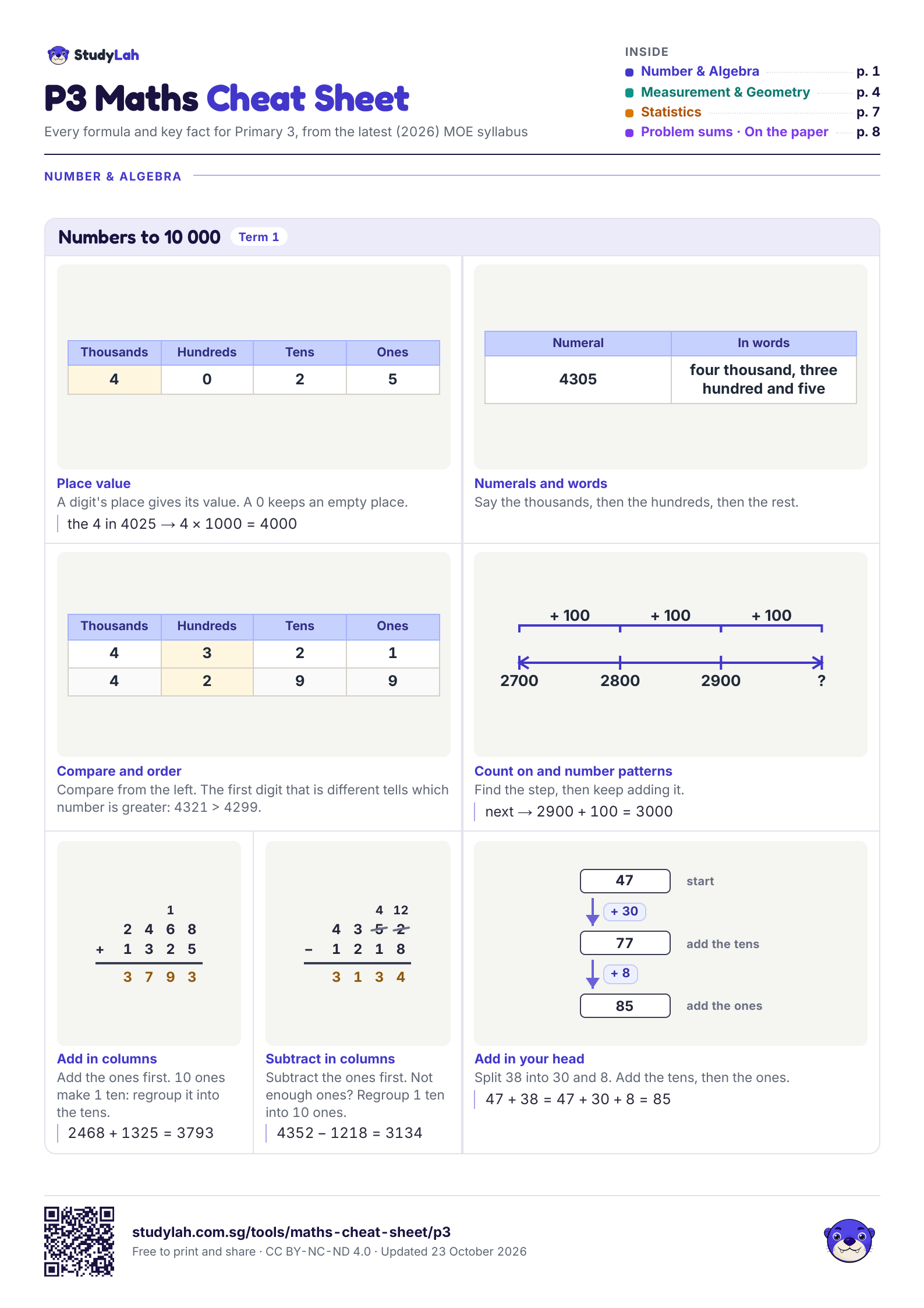
The P3 Maths Cheat Sheet
The P3 sheet holds 45 more formulas and rules, across its 10 topics, on 8 A4 pages.
P3 Maths Cheat Sheet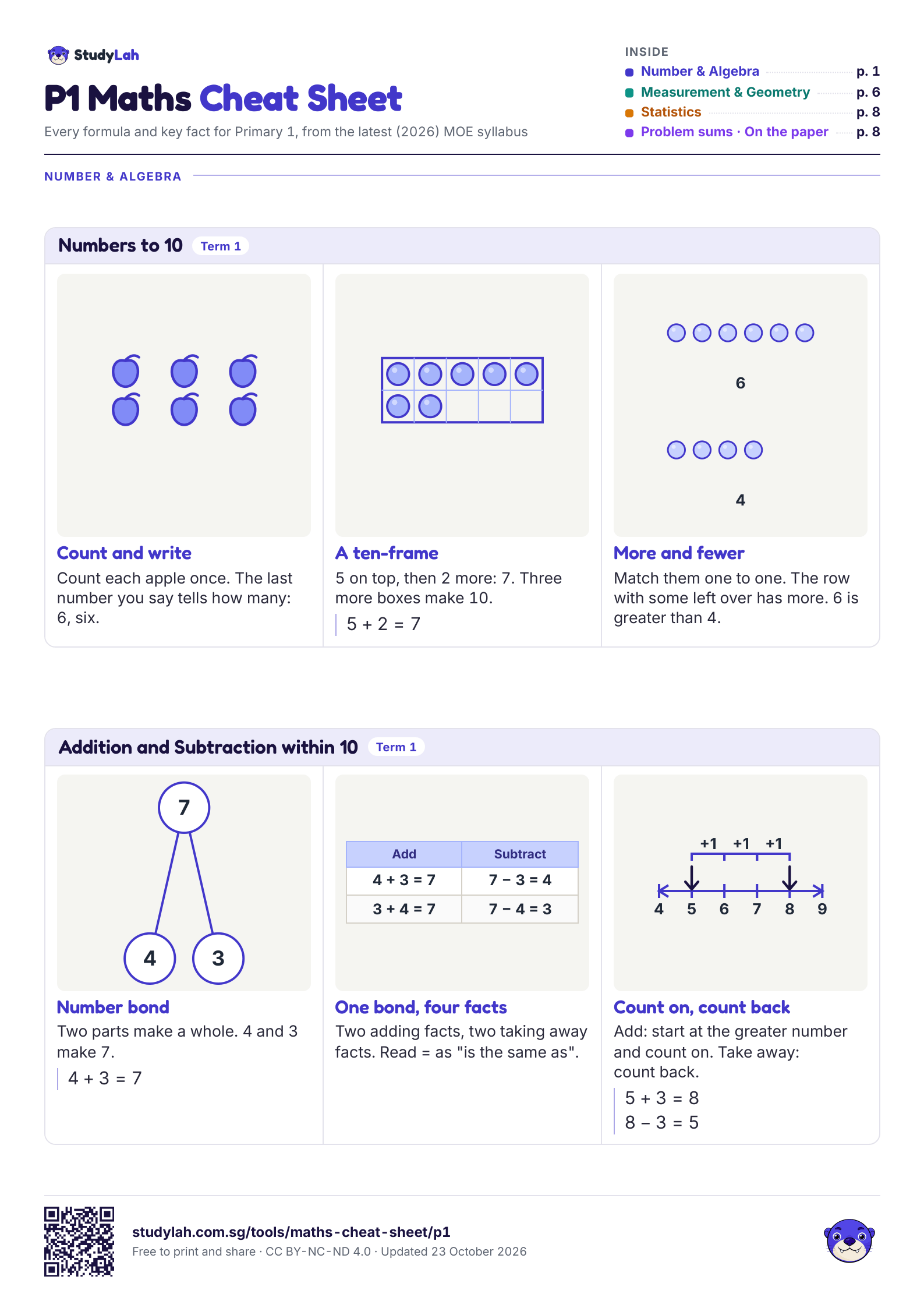
The P1 Maths Cheat Sheet
The P1 sheet holds 41 more formulas and rules, across its 13 topics, on 8 A4 pages.
P1 Maths Cheat Sheet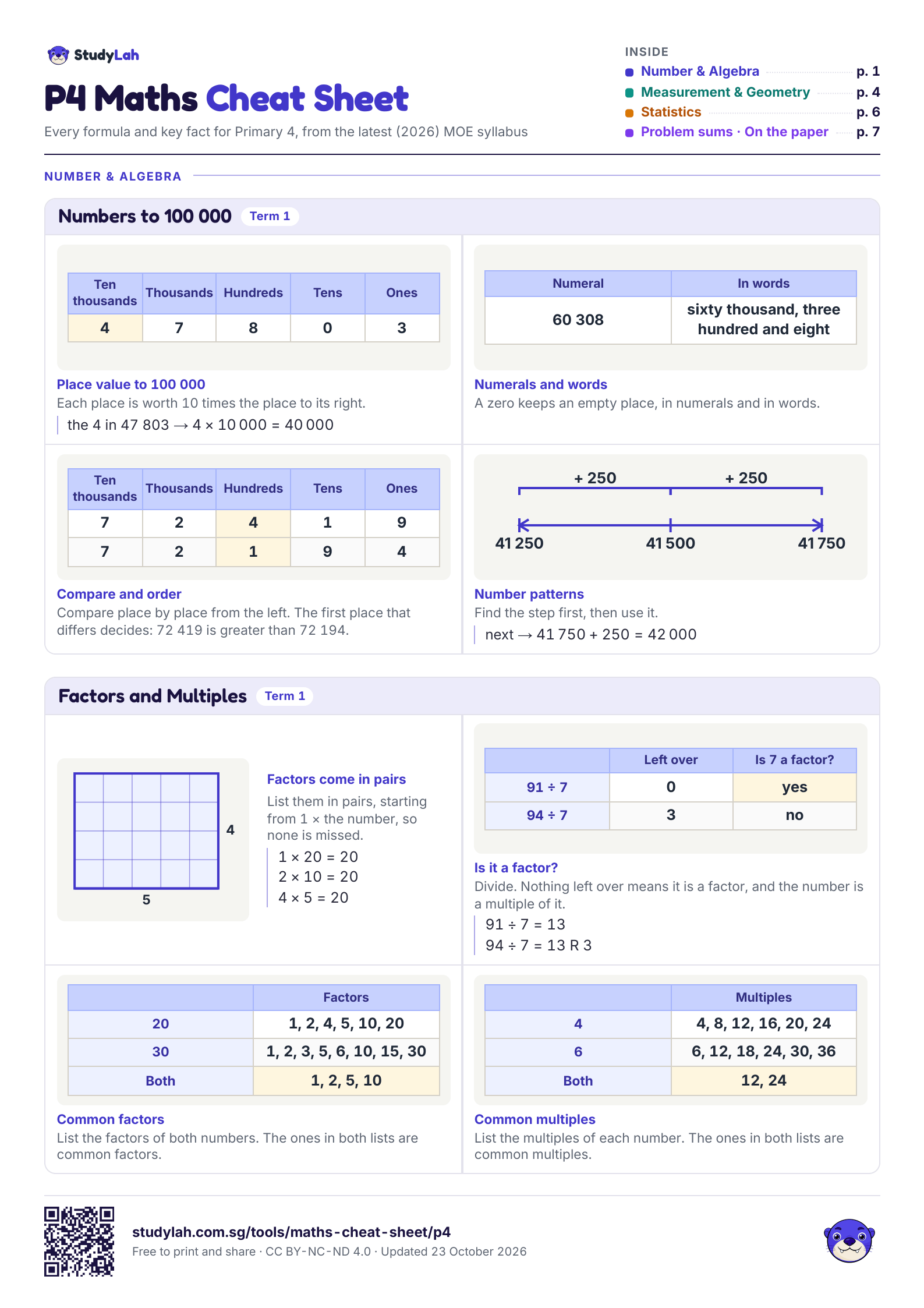
The P4 Maths Cheat Sheet
The P4 sheet holds 48 more formulas and rules, across its 12 topics, on 7 A4 pages.
P4 Maths Cheat Sheet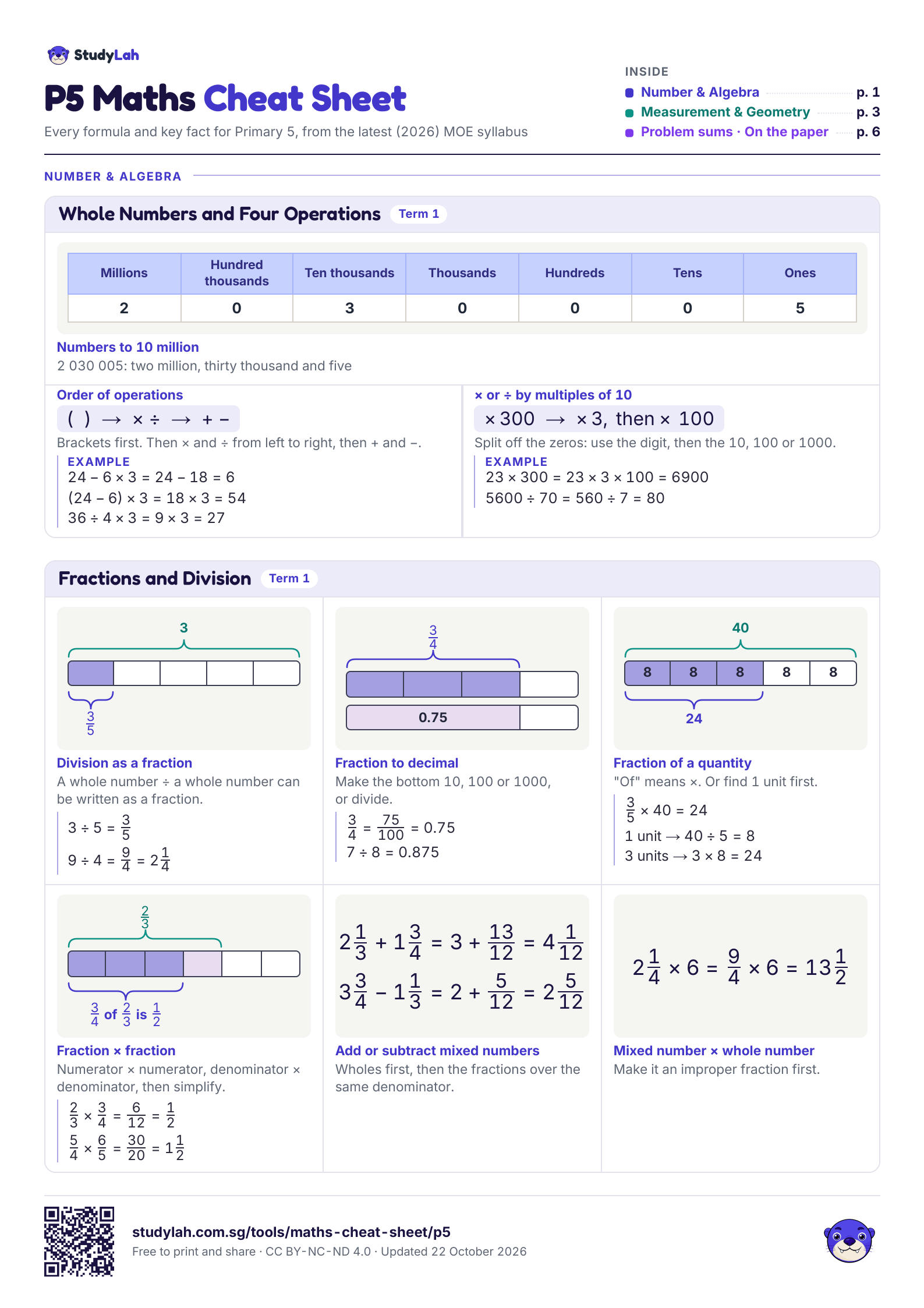
The P5 Maths Cheat Sheet
The P5 sheet holds 48 more formulas and rules, across its 12 topics, on 6 A4 pages.
P5 Maths Cheat Sheet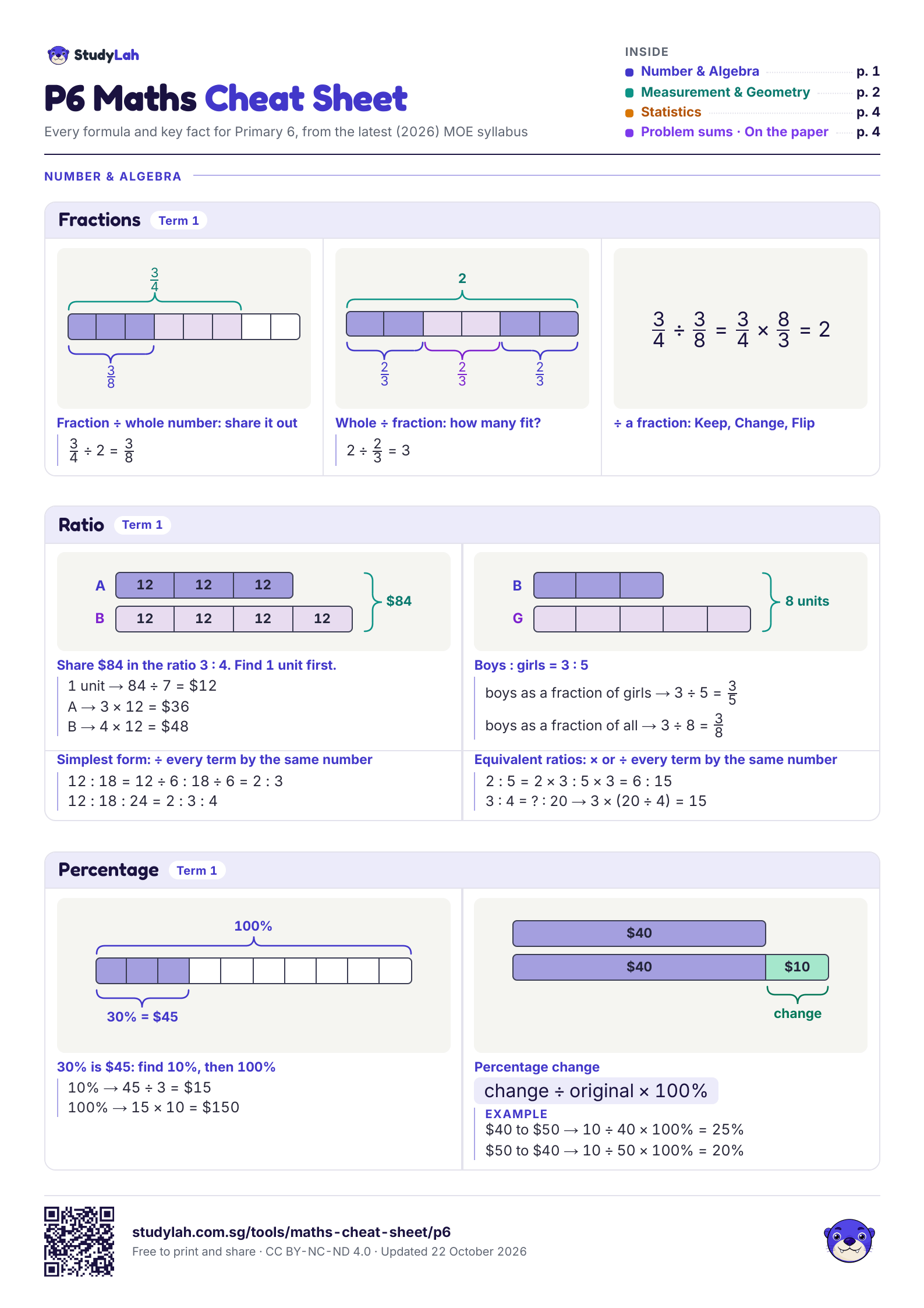
The P6 Maths Cheat Sheet
The P6 sheet holds 36 more formulas and rules, across its 8 topics, on 4 A4 pages.
P6 Maths Cheat SheetThe sheet
All 7 pages, full size
The PDF prints sharp on A4. Each page is also an image you can save or send.
P2 Maths Cheat Sheet, page 1 of 7: formulas for numbers to 1000 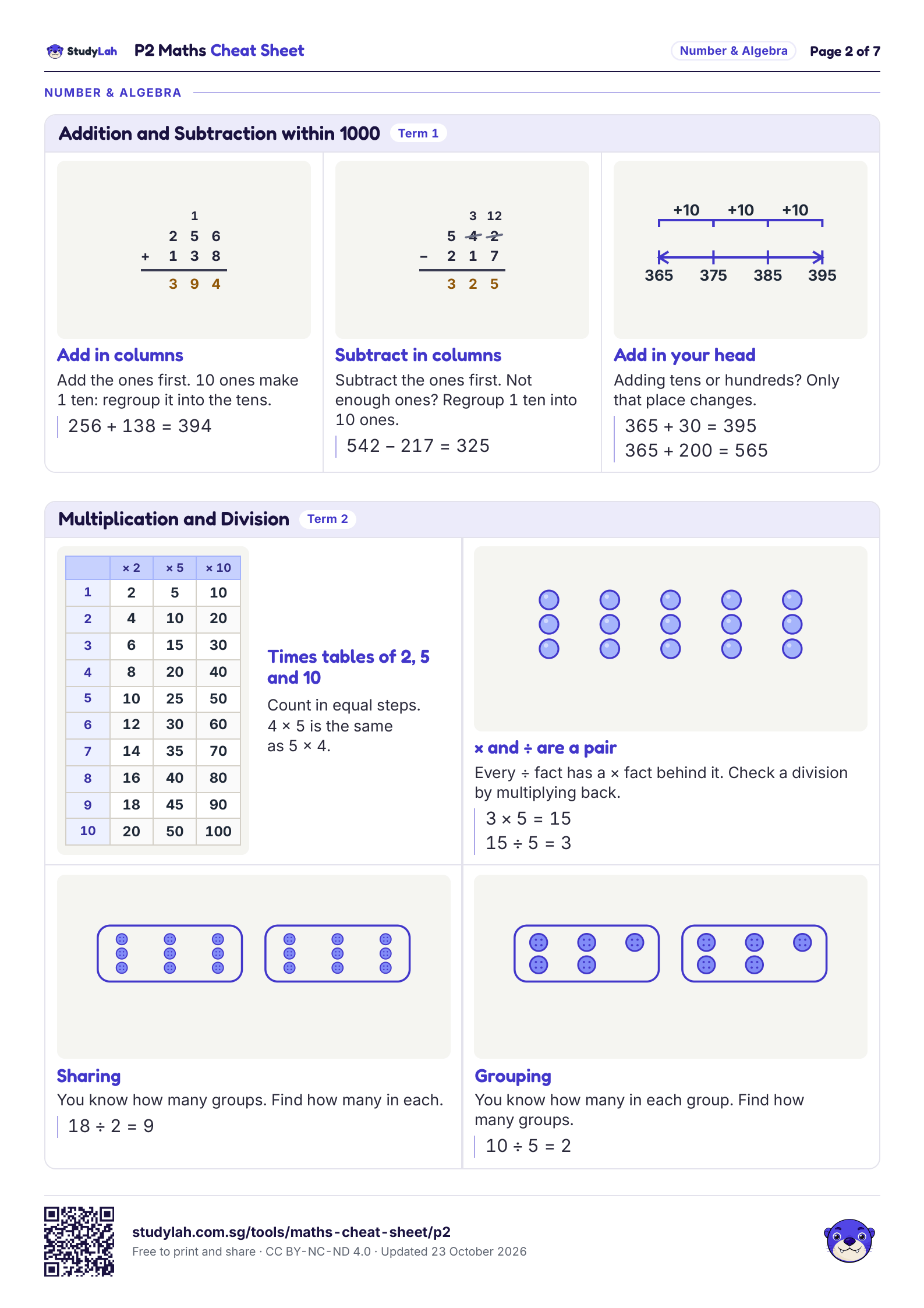
P2 Maths Cheat Sheet, page 2 of 7: formulas for addition and subtraction within 1000; and multiplication and division 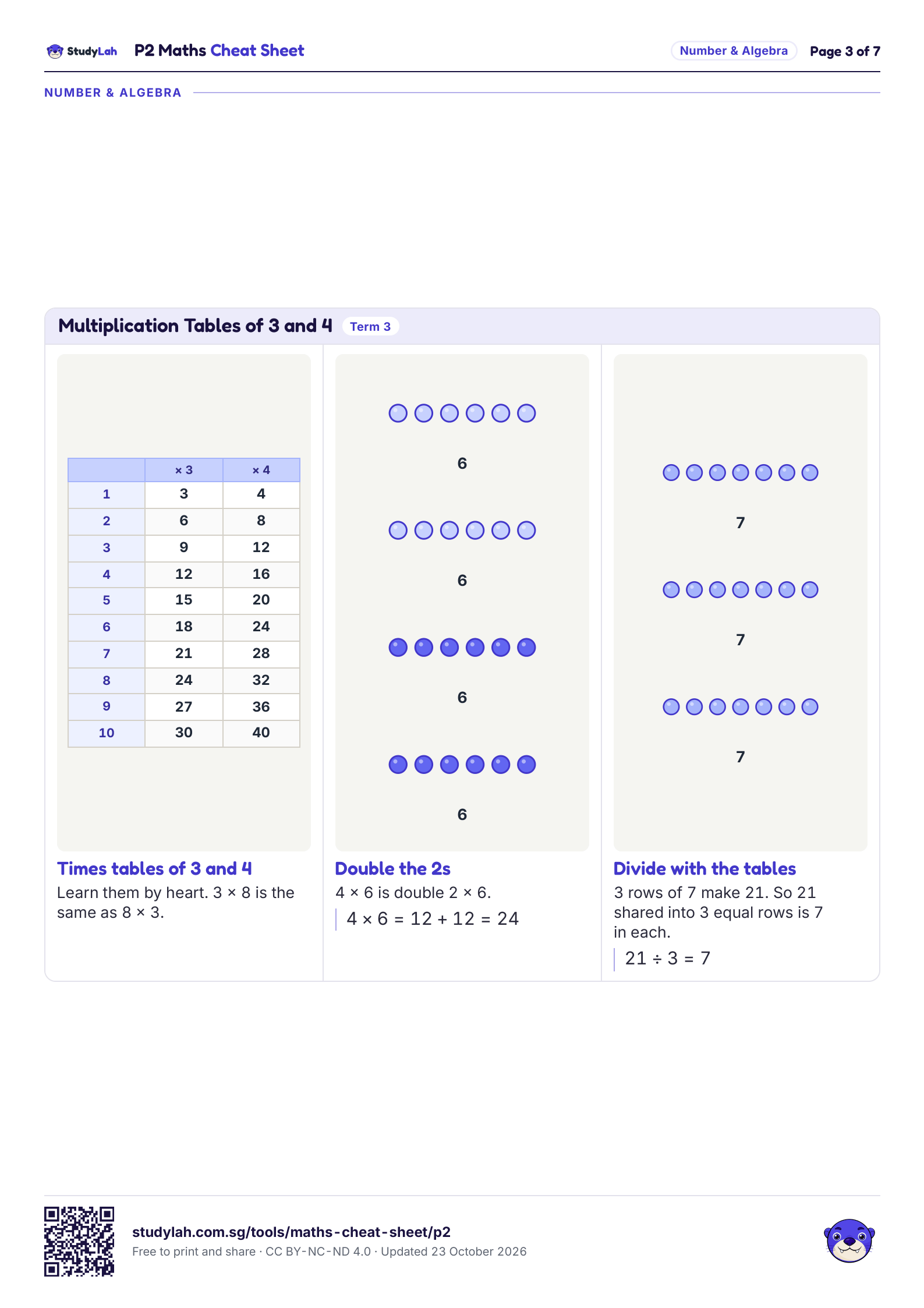
P2 Maths Cheat Sheet, page 3 of 7: formulas for multiplication tables of 3 and 4 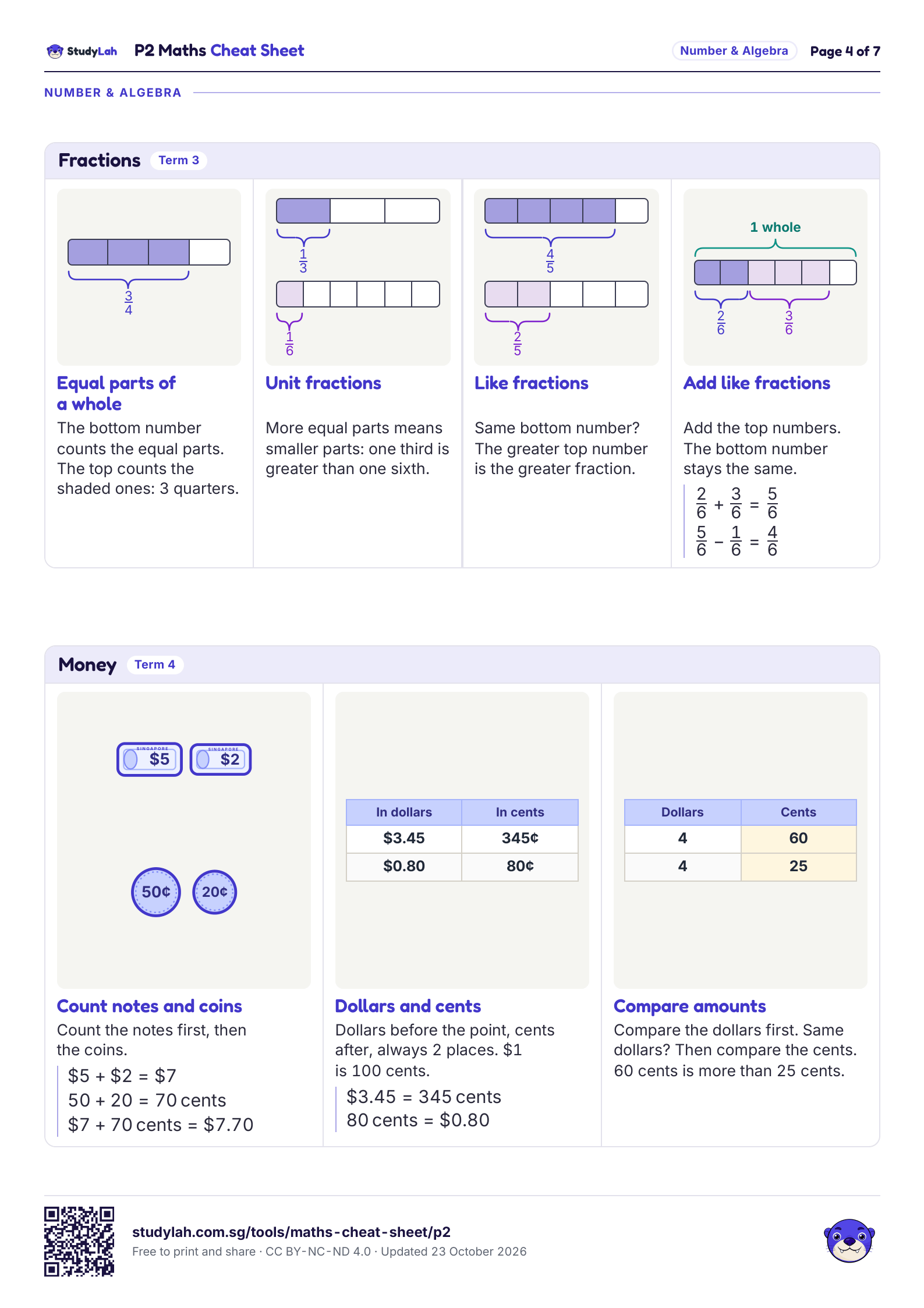
P2 Maths Cheat Sheet, page 4 of 7: formulas for fractions and money 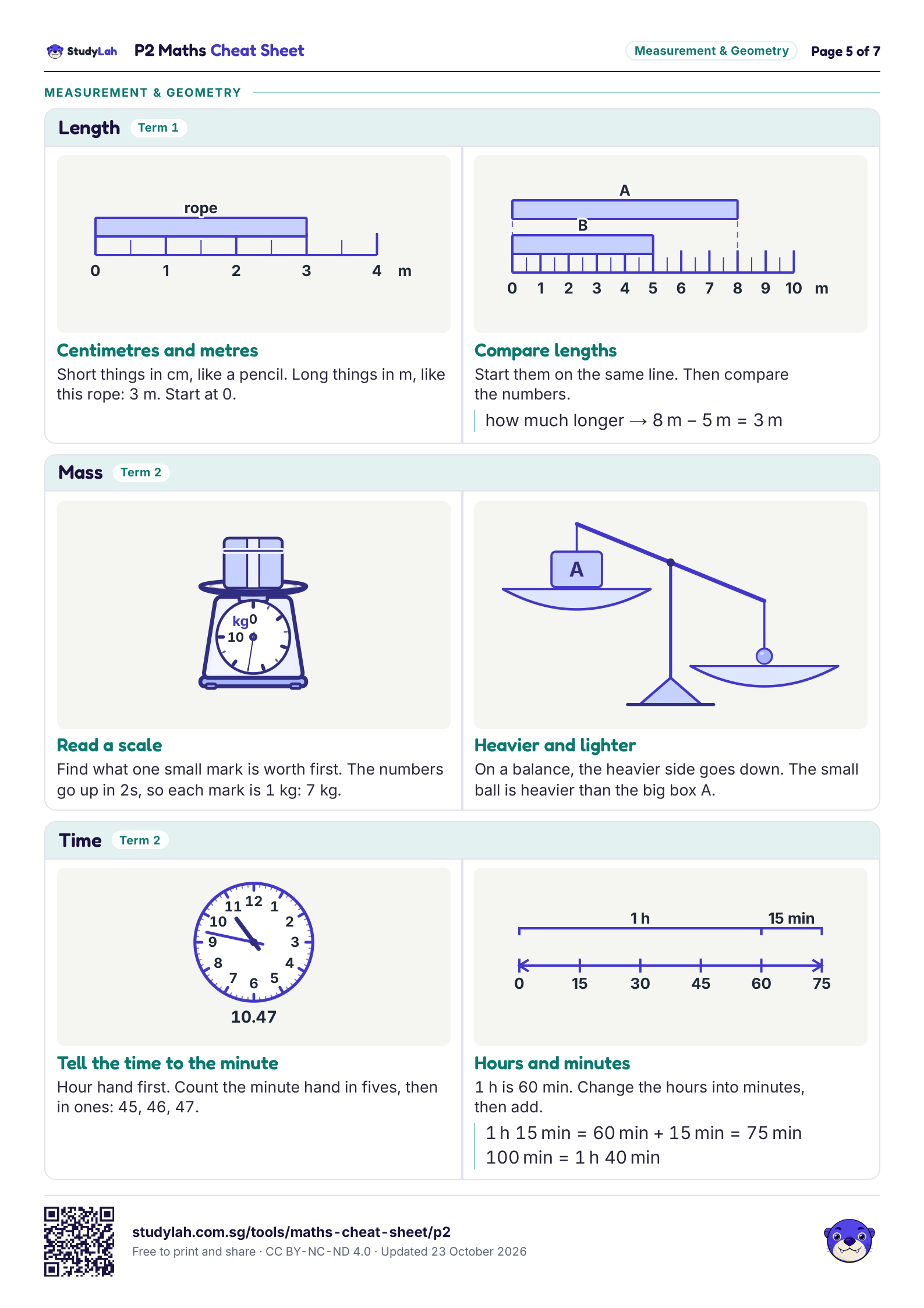
P2 Maths Cheat Sheet, page 5 of 7: formulas for length, mass and time 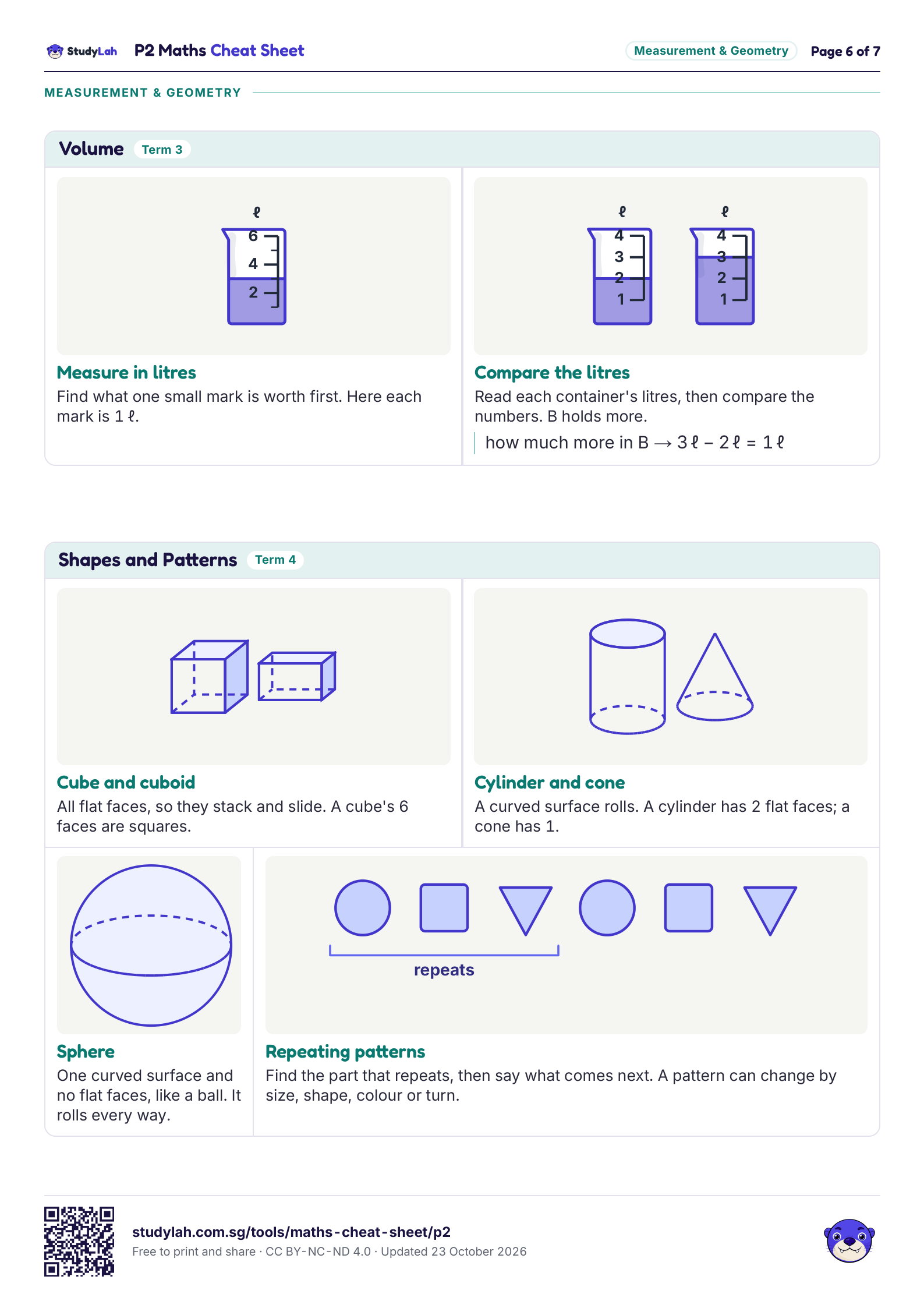
P2 Maths Cheat Sheet, page 6 of 7: formulas for volume; and shapes and patterns 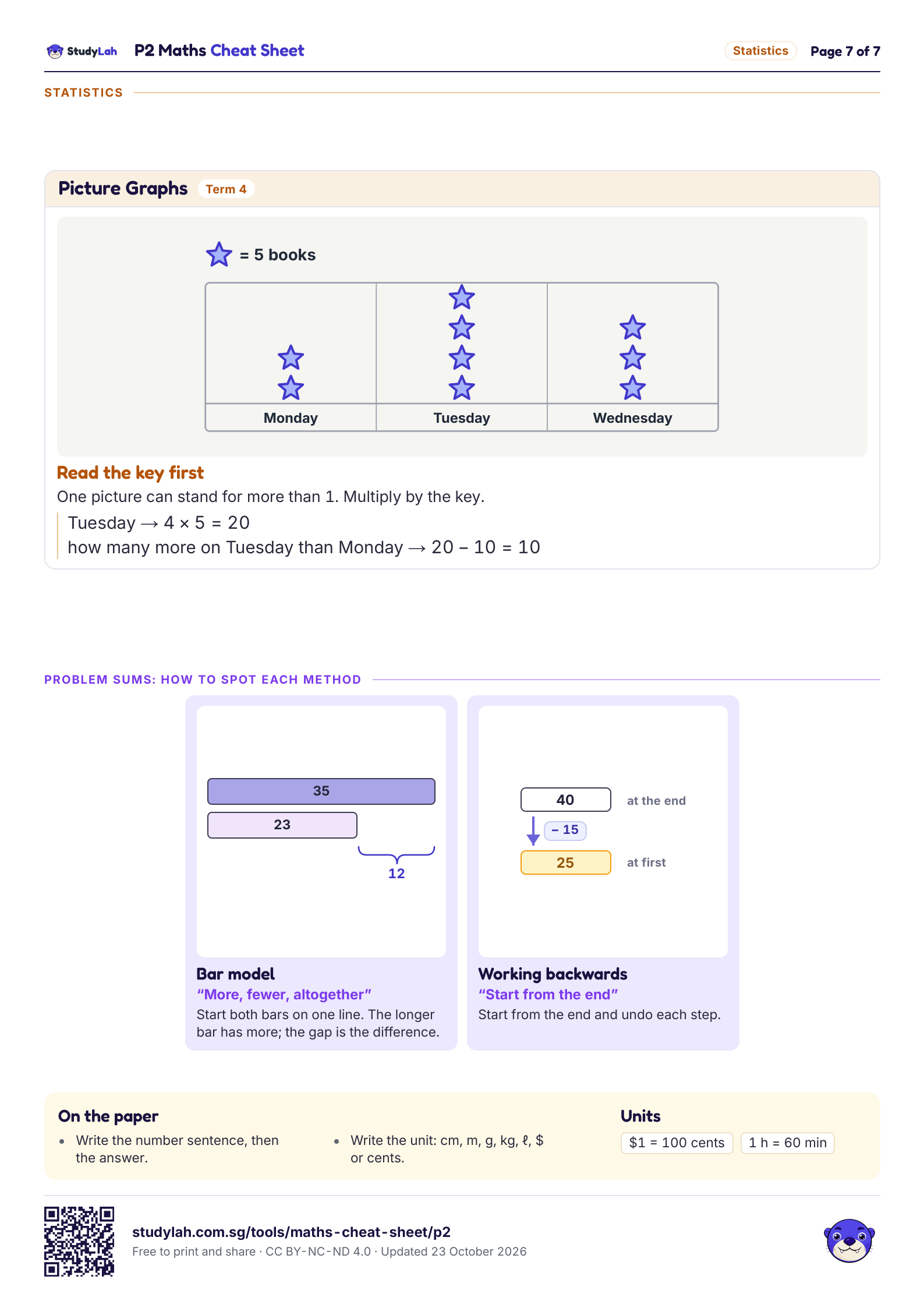
P2 Maths Cheat Sheet, page 7 of 7: formulas for picture graphs, problem-sum methods, exam rules and units
Knowing the formula is half of it
The other half is spotting which one a question needs. StudyLah gives your child P2 questions on these topics, and Lah walks through each one step by step. Free: one Daily Practice and one Topic Drill every day, and one exam paper a month.
Try it freeQuestions
Questions parents ask
What maths formulas does a P2 child need to know?
The 35 formulas and rules on this sheet, across numbers to 1000; addition and subtraction within 1000; length; multiplication and division; mass; time; multiplication tables of 3 and 4; fractions; volume; money; picture graphs; and shapes and patterns. It also shows how to spot 2 problem-sum methods.
What topics are in P2 maths?
12 topics, in the order schools teach them: numbers to 1000; addition and subtraction within 1000; length; multiplication and division; mass; time; multiplication tables of 3 and 4; fractions; volume; money; picture graphs; and shapes and patterns.
Keep going
- Primary Maths cheat sheets
- Primary 2 maths syllabus
- Numbers to 1000: the full guide
- Addition and Subtraction within 1000: the full guide
- Multiplication and Division: the full guide
- Multiplication Tables of 3 and 4: the full guide
- Fractions: the full guide
- Money: the full guide
- Length: the full guide
- Mass: the full guide
- Time: the full guide
- Volume: the full guide
- Shapes and Patterns: the full guide
- Picture Graphs: the full guide
- P2 Maths exam paper
Sources: Ministry of Education, Singapore, Primary Mathematics Syllabus (Standard), updated October 2025.
Practise every topic on the P2 sheet
Free for every P2 child. Lah walks through each question.