
Problem-solving method · Go through the process
The before and after method
The before and after method draws a problem sum twice, once before the change and once after, so your child can see what moved and what stayed. Schools call it the before-after concept, and most hard word problems have one underneath.
- Taught
- P1 to P6
- Also called
- before-after concept
- Spot it by
- Something changes partway
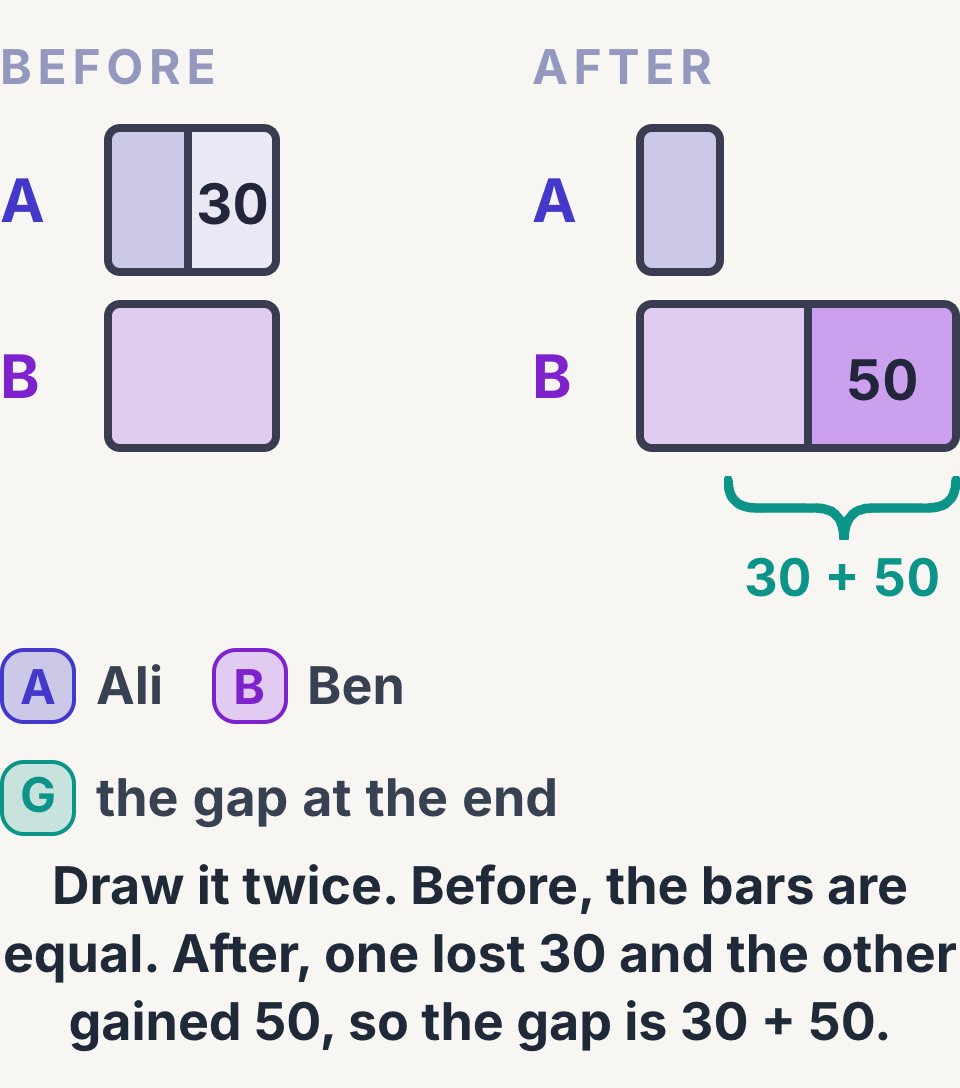
When to use the before and after method
The words in a question that point at this method. You do not need to solve the question to spot them.
“at first”
There is a before picture, and the question is almost certainly about the change since.
“gave 30 stickers to”
A transfer. Two pictures, and the total across both people does not change.
“after spending”
You are told the after picture, and the before is what you want.
“in the end”
You are handed the finish line. Draw the after picture, then work back to the before.
“ended up with 5 times as many”
The relationship in the AFTER picture. It describes the second drawing, not the first.
Words to know
- Before
- The first picture, drawn as things were at the start.
- After
- The second picture, drawn once the change has happened.
- The change
- What was given, spent, bought or moved between the two pictures.
- Stayed the same
- The total, the gap or one share. Find it, and work in units of it.
How to do the before and after method, step by step
A real question, the way Lah works every question in StudyLah: one step at a time, writing as she goes.
Kavitha and Mei Ling had the same number of stickers. Kavitha gave away 40 and Mei Ling bought 95. How many more did Mei Ling have in the end?
- Draw a before and after model. Kavitha and Mei Ling started with the same number of stickers, so draw two equal bars.
- Kavitha gave away 40, so take 40 off that bar. Mei Ling bought 95 more, so add 95 to the other.
- Now compare the bars. The gap at the end is the 40 Kavitha lost plus the 95 Mei Ling gained.
- Add them: 40 + 95 = 135.
- So Mei Ling had 135 more stickers than Kavitha in the end.
Every question in StudyLah comes with a walkthrough like this one.
Try it freeThe one it gets confused with
Two pictures is the frame. What you do with them is a separate decision, and these are the three it gets confused with.
Does anything actually change? If the question is one moment in time, one picture is enough and a second only adds work.
Constant total and constant difference
Once both pictures exist, what stayed the same is the very next question, and it picks the method from there.
Is the change a chain of steps with only the ending known? Then undo them one at a time rather than drawing two states.
Before and after method questions
Real questions from the years it is taught. Try one together, then tap to check.
P4 question
Aravind and Wei Ming had equal numbers of stickers. Aravind gave 30 to Wei Ming, who then had 5 times as many. How many did Aravind have left?
Show answer
Answer15. Draw before and after. Giving 30 makes the gap 30 + 30 = 60. That gap is 5 − 1 = 4 units, so 1 unit is 15.
P5 question
Box P had 18 more marbles than Box Q. Then 30 were moved from P to Q. How many more were in Q than in P in the end?
Show answer
Answer42. Draw both moments. Moving 30 takes P down 30 and Q up 30, so the gap swings by 60, and Q ends 60 − 18 = 42 ahead.
P6 question
Class A had 15 more pupils than B. After 24 moved from A to B, B had 4 times as many as A. How many did B have at first?
Show answer
Answer20. After the move B leads by 24 + 24 − 15 = 33. That is 3 units, so 1 unit is 11 and B ends with 44.
Helping at home
How to tell it has clicked
Give them a question with "at first" in it and watch what gets drawn. Two labelled pictures before any arithmetic means the habit is there. One bar with numbers crossed out and rewritten means it is not.
The other tell is the check at the end. A child who knows why the two totals match in a transfer will notice on their own when they do not.
Try this tonight
Whenever a question says at first or in the end, ask for two empty boxes on the page before anything else. One labelled before, one labelled after.
That is the whole exercise. Half of these questions come apart the moment the two moments stop sharing a drawing, and it takes ten seconds.
Where your child will meet it
The topics it turns up in
Want the bigger picture on how these methods fit together? Maths heuristics: every method
See which methods your child reaches for
StudyLah names the method in every worked solution, so you can see whether the problem was the method or the arithmetic.