
Problem-solving method · Go through the process
Constant total and constant difference
Constant total and constant difference are how Singapore schools teach ratio problem sums where the amounts change. Each one starts from the same question: what did not change?
- Taught
- P3 to P6
- Also called
- constant part
- Spot it by
- What did not change?
When to use constant total and constant difference
The words in a question that point at this method. You do not need to solve the question to spot them.
“gave of his share to”
An internal transfer. Nothing entered or left the pair, so the total is what held still.
“each of them bought a bag at the same price”
Both sides moved by the same amount, so the gap between them is unchanged even though both numbers are new.
“In 3 years' time”
Ages. The gap between two people never changes, so this is a constant difference question every single time.
“Billy spent $16”
Read what is NOT in that sentence. If Ali did not spend anything, Ali's share is the fixed thing to match units against.
“Ali saved $60 and Billy spent $150”
Different amounts in different directions, so nothing is constant. This is the hard class, and naming it as such is half the battle.
Words to know
- Constant total
- Things only move between people, so the total stays the same.
- Constant difference
- Both change by the same amount, so the gap stays the same.
- Constant part
- One person's amount never changes, so match the units to it.
- Re-cut the units
- Split every unit into smaller equal ones so two pictures match.
The four kinds, and what stays the same in each
Each one is decided by what does not change. Spot that, and the method follows.
Constant total: something moves across
One person gives to the other, and nothing comes in or goes out. The total holds still, so both pictures use the same number of units.
Constant difference: both change the same
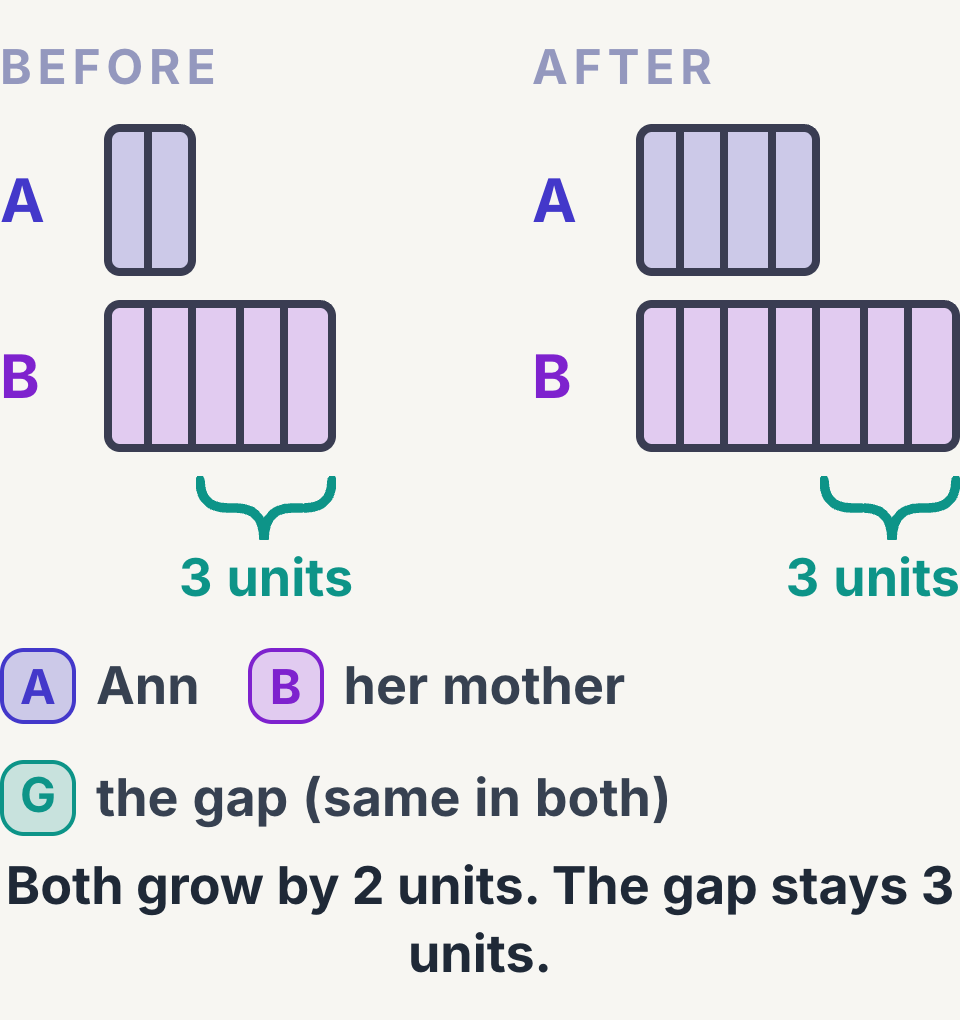
Both grow older by the same years, or both spend the same amount. The gap holds still, so draw it the same width in both pictures.
Constant part: one side never changes
Only one person's amount changes. Match the units to the one that stayed, and one unit means the same in both pictures.
Nothing stays the same
Both change, by different amounts. Keep the same units and draw each change as its own block. It is the hardest kind, so name it early.
How to do constant total and constant difference, step by step
A real question, the way Lah works every question in StudyLah: one step at a time, writing as she goes.
Mei Ling is 9 years old and her brother is 21 years old. How many years ago was her brother 4 times as old as Mei Ling?
- Draw a bar model for the ages some years ago: Mei Ling 1 unit, her brother 4 units. Both grew by the same years, so add an equal piece to each bar. Mei Ling is now 9 and her brother is 21.
- The gap never changes. Today it is 21 − 9 = 12 years, so it was 12 years back then too.
- Back then the gap was 4 units − 1 unit = 3 units, so 3 units = 12. One unit is 12 ÷ 3 = 4.
- Mei Ling was 4, and she is 9 now. Subtract: 9 − 4 = 5 years.
- So it was 5 years ago.
Every question in StudyLah comes with a walkthrough like this one.
Try it freeThe one it gets confused with
This is the useful part of the page. Four questions, and the one your child can answer tells you which method they are looking at.
Constant difference
Did both sides change by the same amount, or is it about ages? Then the gap held still, not the total, and the gap is what you match units against.
Constant part
Did only one of them change? Then the other person's share is the fixed thing. Match its unit count across both pictures.
Everything changed
Did they change by different amounts, in different directions? Then nothing is constant. Work in units of one person and use the second fact to pin them down.
Does the ratio not change at all? Then there is no before and after to reconcile. Find one unit and scale.
Constant total and constant difference questions
Real questions from the years it is taught. Try one together, then tap to check.
P3 question
Mr Tan had 300 more cards than Mr Ong. He gave away 120 cards and then had twice as many as Mr Ong. How many did he have at first?
Show answer
Answer480. Only Mr Tan's cards changed, so Mr Ong's is the constant part. The gap became 180, which is 1 unit, so Mr Tan had 360 + 120 = 480.
P4 question
Aina had $1340 and Bina had $860. Each bought the same bag. Now Aina has 4 times as much money as Bina. How much did the bag cost?
Show answer
Answer$700. Both spent the same, so the gap stays $480. 4 − 1 = 3 units = $480, so Bina has $160 left: $860 − $160 = $700.
P5 question
Ben had 120 more marbles than Amy. Amy gave Ben 45 marbles. Then Ben had twice as many as Amy. How many marbles did Amy have at first?
Show answer
Answer255. Marbles only moved, so the total held. The gap grew to 120 + 45 + 45 = 210, which is 1 unit. Amy had 210 + 45 = 255.
Helping at home
How to tell it has clicked
Hand them a changing-ratio question and ask what did not change, before any working. A child who answers that in one sentence has the method, even if the arithmetic afterwards goes wrong.
The thing to watch for is a ratio equation with a cross-multiplication under it. It sometimes lands on the right answer, it is not what Primary 6 is taught to do, and it skips the only step worth learning here.
Try this tonight
Before any arithmetic, ask one thing: what didn't change? Total, gap, or one person's share.
You do not need to be able to solve the question to ask it. If they cannot answer, read it again together and look only for whether anything entered or left the group.
Where your child will meet it
The topics it turns up in
Want the bigger picture on how these methods fit together? Maths heuristics: every method
See which methods your child reaches for
StudyLah names the method in every worked solution, so you can see whether the problem was the method or the arithmetic.