
Problem-solving method · Give a representation
The units and parts method
The units and parts method turns a ratio or a fraction into real amounts: draw equal units, find what 1 unit is worth, then multiply. The "parts" are a second size of unit, for when two people's pieces cannot be the same size.
- Taught
- P3 to P6
- Family
- Give a representation
- Spot it by
- Find 1 unit first
When to use the units and parts method
The words in a question that point at this method. You do not need to solve the question to spot them.
“in the ratio 3 : 4”
A ratio, so nothing has a value yet. Draw 3 units and 4 units rather than writing numbers you do not have.
“ of the buttons”
The denominator picks the unit count. Thirds means three units, and one of them is the thing worth finding.
“4 times as many stickers as”
The smaller amount is 1 unit and the bigger one is 4 of the same units. Count the units, then find one.
“each of them used 160”
One value pinned to two different unit counts. This is the line that sizes a unit, and it is usually near the end.
“How many buttons were there in the jar at first”
You will scale back up to a whole at the end, so keep track of how many units the whole is worth.
Words to know
- Unit
- One equal piece of a bar, worth the same everywhere it is drawn.
- 1 unit
- The line that pins a piece to a real number. Every answer comes from it.
- Parts
- A second, different-sized piece, so it is never added to the units.
- Scale up
- Multiply 1 unit by the number of units the question asks about.
How to do the units and parts method, step by step
A real question, the way Lah works every question in StudyLah: one step at a time, writing as she goes.
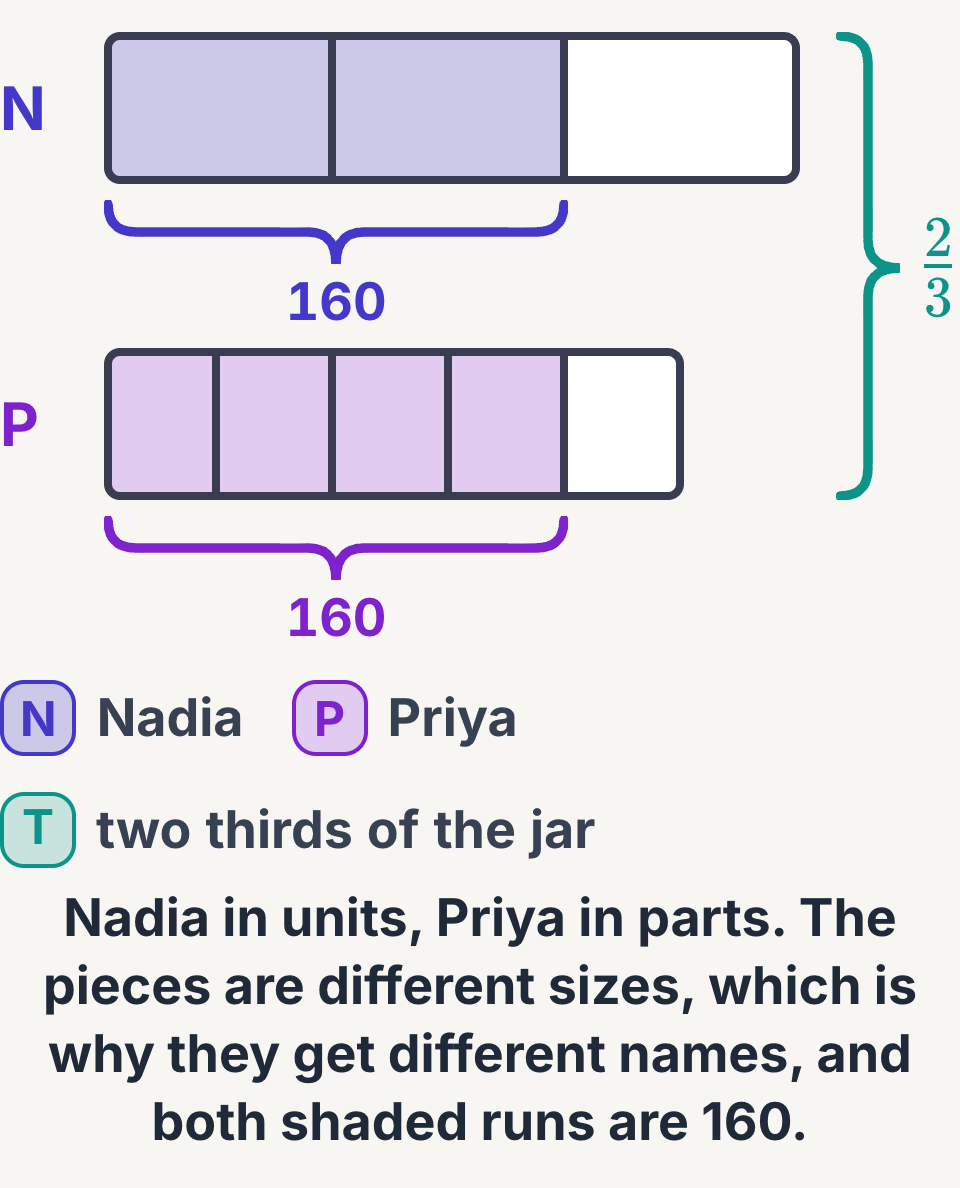
Nadia and Priya shared of a jar of buttons. Nadia used of hers and Priya of hers, 160 each. How many buttons were in the jar?
- Each girl used 160, so cut each share into units. Nadia's share is 3 units, and 2 of them are 160. So 1 unit = 160 ÷ 2 = 80.
- Priya's units are a different size. Her share is 5 units, and 4 of them are 160. So 1 unit = 160 ÷ 4 = 40.
- Nadia had 3 × 80 = 240 and Priya had 5 × 40 = 200. Together they shared 240 + 200 = 440.
- The 440 buttons are two thirds of the jar. Draw a bar model of 3 units with 2 of them holding 440. So 1 unit = 440 ÷ 2 = 220, and the jar held 3 × 220 = 660.
- So there were 660 buttons in the jar at first.
Every question in StudyLah comes with a walkthrough like this one.
Try it freeThe one it gets confused with
All of these still draw as bars. What changes is what the units are counting, and that decision comes before any arithmetic.
Does the question already give real amounts? Then write the numbers straight into the bars. Counting units is for when nothing has a value yet.
Constant total and constant difference
Does a ratio change partway through? Then the question is which thing stayed fixed, and that picks the method before you draw anything.
Does a second fraction apply to what is left over rather than the whole? Then split the remainder first and count units afterwards.
Units and parts, the before-and-after version
Some tuition notes use "units" for a ratio before a change and "parts" for the same ratio after it, for the same reason we do here. If your child's worksheet does that, that page is the one you want.
Units and parts method questions
Real questions from the years it is taught. Try one together, then tap to check.
P3 question
Ravi has 4 times as many stickers as Sara. Together they have 150 stickers. How many stickers does Sara have?
Show answer
Answer30. Sara is 1 unit and Ravi is 4 units, so 5 units = 150. 1 unit = 150 ÷ 5 = 30.
P4 question
of the biscuits Mr Goh baked were oatmeal. He baked 180 more oatmeal biscuits than raisin ones. How many raisin biscuits were there?
Show answer
Answer90. Quarters means 4 units: oatmeal 3, raisin 1. The gap is 2 units = 180, so 1 unit = 90.
P6 question
Ravi has 2 boxes and 5 packets holding 819 buttons in total. A box holds 4 times as many as a packet. How many buttons are in each packet?
Show answer
Answer63. A packet is 1 unit and a box is 4, so 8 + 5 = 13 units = 819. 1 unit = 819 ÷ 13 = 63.
Helping at home
How to tell it has clicked
Ask what one unit is worth. A child who has the method points straight at the line in the question that answers it. A child who has not starts multiplying fractions together and hopes.
Watch for one unit used for both people when their pieces differ. The working looks busy and correct, every line is a real sum, and the answer is wrong by a margin nobody can trace afterwards.
Try this tonight
Take any question with a ratio in it, cover the numbers, and ask one thing: what is one unit worth?
If they cannot say, hunt together for the sentence that pins a unit to a real amount. It is nearly always near the end. Finding it is the skill, and the multiplication after it is the easy half.
Where your child will meet it
The topics it turns up in
In the PSLE's hardest questions
Want the bigger picture on how these methods fit together? Maths heuristics: every method
See which methods your child reaches for
StudyLah names the method in every worked solution, so you can see whether the problem was the method or the arithmetic.