
Problem-solving method · Give a representation
The branching method
The branching method is for problem sums where a second fraction is taken of what is left: split the bar once, then split the remainder again. Tuition centres also call it the remainder concept, or a fraction of the remainder.
- Taught
- P5 to P6
- Also called
- remainder concept
- Spot it by
- Of the remainder
When to use the branching method
The words in a question that point at this method. You do not need to solve the question to spot them.
“of the remainder”
The signal, and the most reliable one on this page. Whatever follows is a fraction of what is left, not of the total.
“of the remaining buns”
The same instruction in the question's own nouns. Branch at this word.
“then she gave of what was left”
What was left is now the whole. Everything measured after this point is measured against it.
“after spending , he spent of the rest”
Two fractions in a row, and the second is of the rest. This is the full shape in one sentence.
“had 150 buns left”
The final leftover, as a real number. It is usually what pins the whole chain to actual amounts.
Words to know
- Remainder
- What is left after the first part is taken away.
- The new whole
- The remainder, once the next fraction is measured against it.
- Branch
- A second bar drawn under the remainder only, never under the whole.
- Of what?
- The question to ask at every fraction in the problem sum.
How to do the branching method, step by step
A real question, the way Lah works every question in StudyLah: one step at a time, writing as she goes.
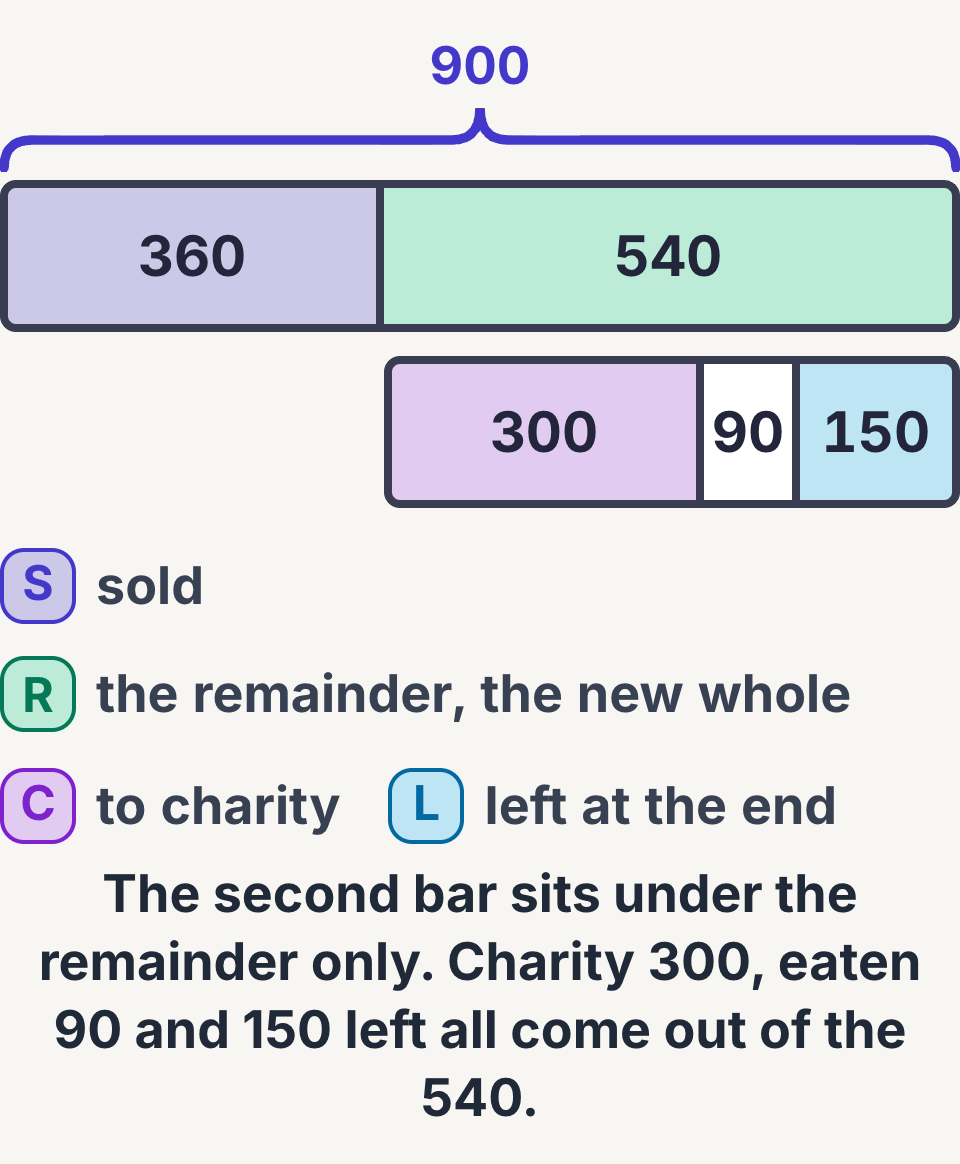
A baker made 900 buns. She sold 40% and gave of the remaining buns to charity. She ate some, leaving 150. What percentage of them did she eat?
- Draw one bar for all 900 buns. 40% were sold, and 40% of 900 = 360. That leaves 900 − 360 = 540.
- Branch the remainder: the charity got five ninths of those 540. 1 unit = 540 ÷ 9 = 60, so 5 units = 5 × 60 = 300.
- That leaves 540 − 300 = 240. She had 150 left at the end, so she ate 240 − 150 = 90.
- Now find the percentage of all 900 she made: 90 ÷ 900 × 100% = 10%.
- So she ate 10% of the buns she made.
Every question in StudyLah comes with a walkthrough like this one.
Try it freeThe one it gets confused with
Each of these draws bars too. The question is how many wholes are in play, and whether they are the same whole.
Do both fractions apply to the same whole? Then one split is enough and there is nothing to branch.
Once the remainder is split you are back to counting units. Branching only decides which bar you count them on.
Is the change a transfer between two people rather than a sequence of removals? Then draw two states instead of one branch.
Branching method questions
Real questions from the years it is taught. Try one together, then tap to check.
P5 question
Priya spent of her money on a bag and of the rest on a book. She gave $80 away and had $190 left. How much was the book?
Show answer
Answer$90. Use 20 units: the bag is 8, the rest 12, the book 3 of those 12. The 9 units left are $270, so 1 unit is $30.
P5 question
A bakery sold 180 loaves on day one and of the remaining loaves on day two. of all the loaves were unsold. How many sold on day two?
Show answer
Answer120. Unsold is a third of the remainder and a sixth of all, so the remainder is half: 180, like day one. Two thirds of 180 is 120.
P6 question
A baker sold of his rolls on Monday and of the remainder on Tuesday. Baking 88 more brought him back to his start. How many rolls at first?
Show answer
Answer160. Use 20 units: Monday 5, then two fifths of the 15 left is 6. The 88 new rolls replace 11 units, so 1 unit is 8.
Helping at home
How to tell it has clicked
Point at the second fraction and ask what it is a fraction of. A child with the method answers with the remainder, not the total, and can show you which part of the drawing they mean.
On paper, check how long the second bar is. If it runs the full length of the first one, the fraction has been taken of the total, and the slip is sitting there in the drawing before it ever reaches the arithmetic.
Try this tonight
Read the question aloud together and stop at every fraction to ask one thing: of what?
That is the whole intervention. It takes a minute, it targets exactly the step that fails, and it works even if you have not touched fractions in twenty years.
Where your child will meet it
The topics it turns up in
Want the bigger picture on how these methods fit together? Maths heuristics: every method
See which methods your child reaches for
StudyLah names the method in every worked solution, so you can see whether the problem was the method or the arithmetic.