
Problem-solving method · Give a representation
The bar model method
The bar model draws each amount in a word problem as a bar, so your child can see the answer before working it out. Schools call it model drawing or the model method, and it comes long before algebra.
- Taught
- P1 to P6
- Also called
- model drawing
- Spot it by
- More, fewer, altogether
When to use the bar model
The words in a question that point at this method. You do not need to solve the question to spot them.
“28 fewer pages than”
Any comparison wording means two bars, one shorter than the other, lined up at the left so the difference shows as the bit sticking out.
“3 times as many as”
Draw the smaller quantity as one unit and the larger as three of the same unit. Equal units are what make the bars readable.
“altogether”
A total. Draw it as a bracket across every bar rather than as another bar, so the parts and the whole stay visually different.
“How many were left”
Something has been removed, so the answer is the gap between the whole and the parts you can already draw.
Words to know
- Bar
- One amount drawn as a strip, roughly to scale.
- Part-whole
- One bar cut into parts, with a bracket for the total.
- Comparison
- Two bars lined up on the left, so the difference sticks out.
- Unit
- One equal piece of a bar, for "times as many" questions.
How to do the bar model, step by step
A real question, the way Lah works every question in StudyLah: one step at a time, writing as she goes.
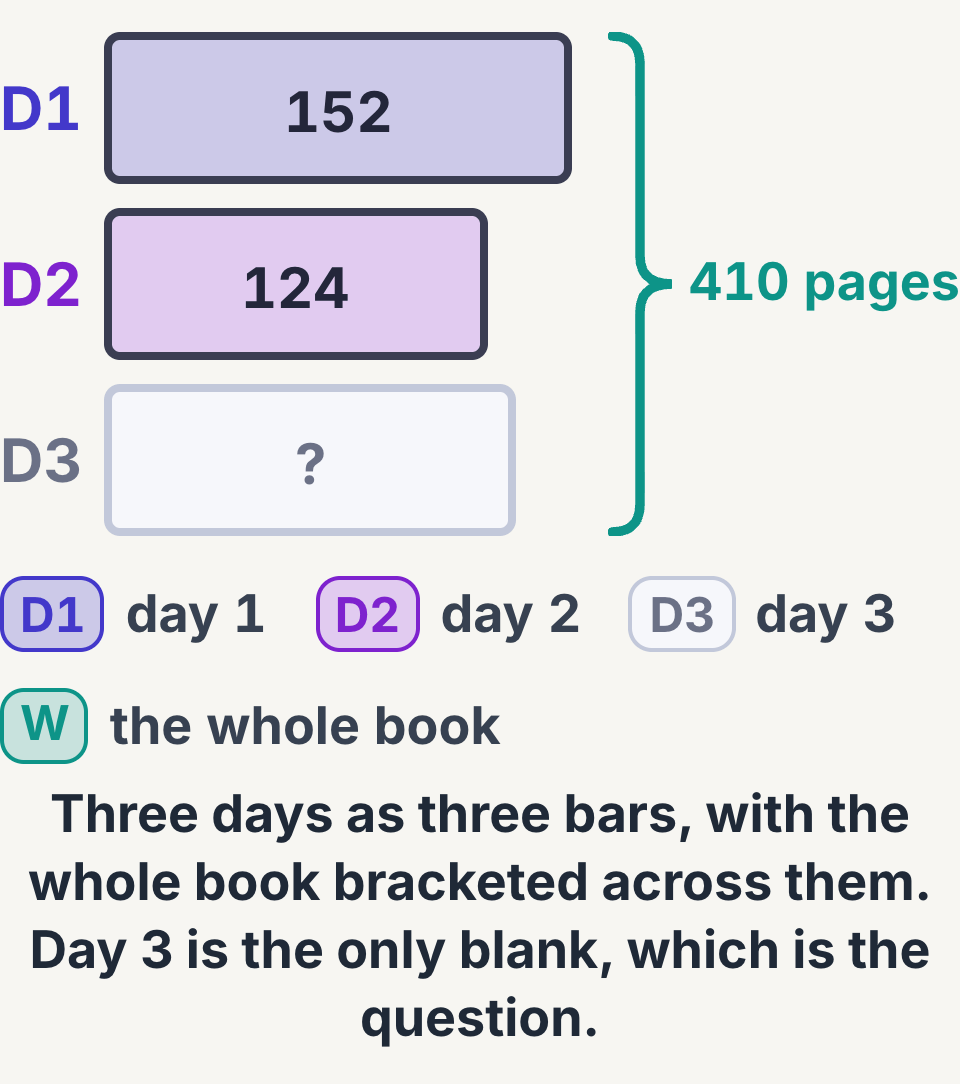
Ben read 152 pages on day one and 28 fewer on day two. He finished his 410-page book on day three. How many pages did he read on day three?
- Ben read 28 fewer pages on day two: 152 − 28 = 124 pages.
- All three days together are 410 pages. Draw that as one bar model.
- Cut the bar into the three days. Day one is 152 pages and day two is 124 pages. Day three is not known yet.
- Days one and two add up to 152 + 124 = 276. Subtract to find day three: 410 − 276 = 134.
- So Ben read 134 pages on day three.
Every question in StudyLah comes with a walkthrough like this one.
Try it freeThe one it gets confused with
Every one of these still uses bars. What changes is what the bars are counting, and getting that wrong is more common than drawing them badly.
Does the question give amounts, or a ratio and a fraction? If nothing has a real value yet, count equal units instead of writing numbers in the bars.
Does something move or change partway through? Then one bar cannot hold it. You need a before picture and an after picture.
Does a fraction apply to what is left rather than to the whole? Then the bar splits twice, and the second split sits under the remainder only.
Bar model questions
Real questions from the years it is taught. Try one together, then tap to check.
P1 question
Kumar has 20 stickers. There are 10 star stickers and 3 heart stickers. The rest are moon stickers. How many moon stickers does Kumar have?
Show answer
Answer7. Draw one bar for all 20 and cut it into stars, hearts and moons. 10 + 3 = 13, so the moons are 20 − 13 = 7.
P4 question
Find the smaller of two numbers whose sum is 6294 and whose difference is 1350.
Show answer
Answer2472. Two bars lined up on the left, the longer 1350 more. Take that off: 6294 − 1350 = 4944 is two equal bars, and 4944 ÷ 2 = 2472.
P5 question
A shop had 90 fans in stock. It sold 80% of them during a sale. How many fans were sold?
Show answer
Answer72. Draw 90 as a bar of 10 equal units, 9 in each. 80% is 8 of the 10 units: 8 × 9 = 72.
Helping at home
How to tell it has clicked
Ask your child to draw the question before solving it, and then cover the numbers. If the shape of the drawing still tells the story, they have understood it.
A child who draws bars of roughly equal length whatever the question is copying a format they have seen. That holds up until the numbers move, and then it stops.
Try this tonight
Read a question together and stop at the first comparison word. Ask one thing: which one is bigger, and by how much?
Have them draw only that much, then stop. Getting the two bars the right way round is the whole skill, and it takes a minute to check.
Where your child will meet it
The topics it turns up in
Want the bigger picture on how these methods fit together? Maths heuristics: every method
See which methods your child reaches for
StudyLah names the method in every worked solution, so you can see whether the problem was the method or the arithmetic.