
Problem-solving method · Go through the process
Working backwards
Working backwards solves problem sums that give the end and ask for the start: begin with the last number and undo each step, last step first. Schools teach it as "work backwards", and it rescues a child who has no idea where to start.
- Taught
- P1 to P6
- Also called
- work backwards
- Spot it by
- Start from the end
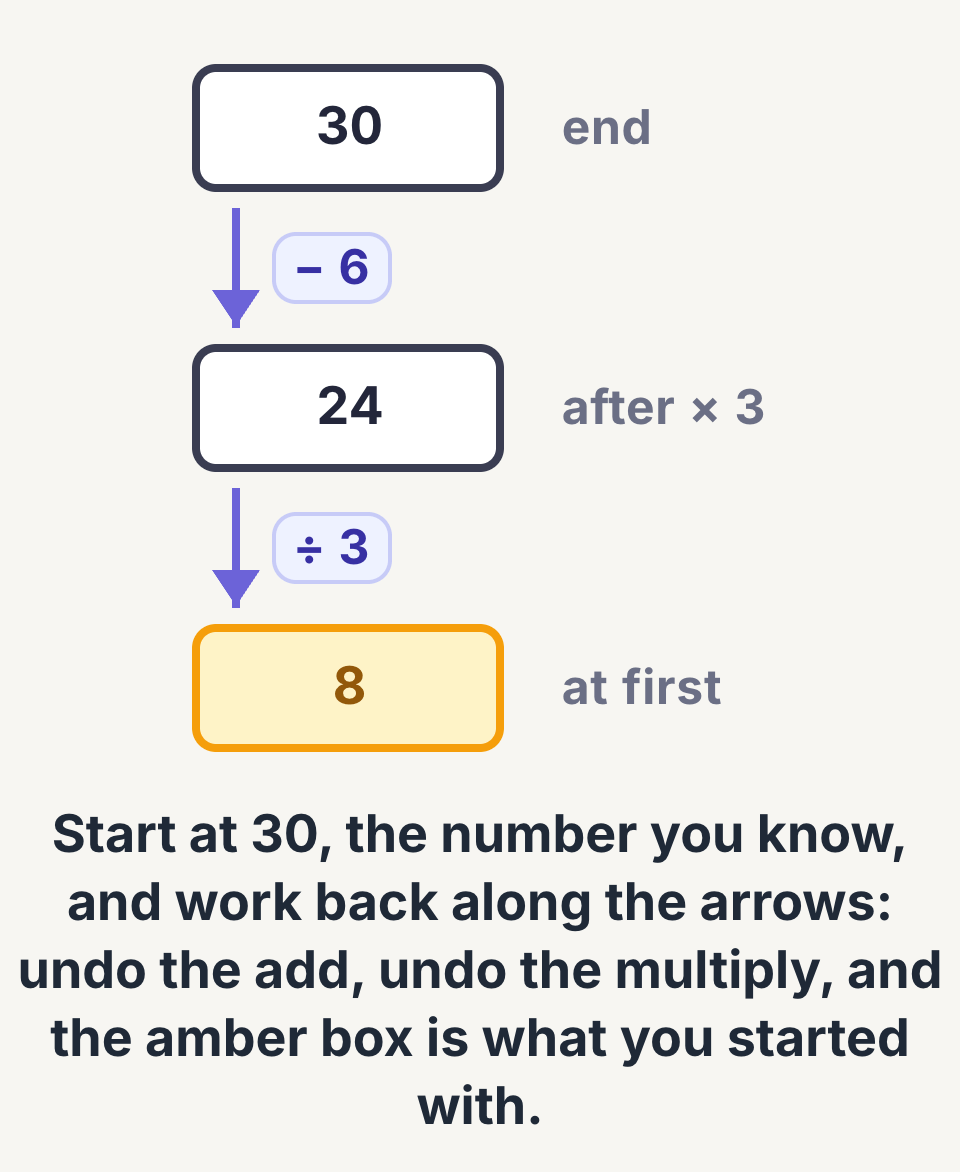
When to use working backwards
The words in a question that point at this method. You do not need to solve the question to spot them.
“How many did she have to begin with”
The question itself is pointing backwards.
“at first”
The classic. You are asked for the start and given the end.
“In the end, there were 2953 flags”
A final state, stated as a number. That is where the chain begins.
“The result is 4”
The same signal in a number puzzle. Start at the result and walk back.
“then she gave away half of what was left”
A chain of steps in order, which is exactly what you reverse.
Words to know
- Undo
- Reverse one step, so you are back where it started.
- Opposite step
- Add becomes subtract, times becomes divide, and the other way round.
- Last step first
- Undo the steps in the reverse of the order they happened.
- Check forwards
- Run the answer through the steps again and land on the end number.
How to do working backwards, step by step
A real question, the way Lah works every question in StudyLah: one step at a time, writing as she goes.
A school had some flags. It gave out 378 flags, then bought another 1386. In the end, there were 2953 flags. How many flags did the school have at first?
- Use working backwards. Start from the 2953 flags in the end and undo each change, last change first.
- The last change was buying 1386 flags, so take them away: 2953 − 1386 = 1567.
- Before that, the school gave out 378 flags, so add them back: 1567 + 378 = 1945.
- Check forwards: 1945 − 378 = 1567, and 1567 + 1386 = 2953. That lands on the end number.
- So there were 1945 flags at first.
Every question in StudyLah comes with a walkthrough like this one.
Try it freeThe one it gets confused with
All three deal with something that changed. The difference is the shape of the change, and it is usually visible in the question.
Is it two states, or a chain of steps? Two states get two pictures. A chain gets reversed one step at a time.
Do you actually know the end value? If you do, do not guess. Guessing is for when nothing in the question is pinned down.
Is "what was left" a fraction of something? Then draw it. Bars handle a fraction in the chain better than arrows do.
Working backwards questions
Real questions from the years it is taught. Try one together, then tap to check.
P1 question
A number has 9 added to it. Then 15 is taken away. The result is 4. Find the number.
Show answer
Answer10. Start at 4 and undo each step, last first: 4 + 15 = 19, then 19 − 9 = 10.
P4 question
Raj, Siti and Wei Ming had 840 marbles. Raj gave away 60 and Siti bought 30 more. Then all three had the same. How many did Raj have at first?
Show answer
Answer330. The end total is 840 − 60 + 30 = 810, so each has 270. Undo Raj's step: 270 + 60 = 330.
P6 question
A notebook costs as much as a folder. A pen costs as much as the notebook. The pen costs $2.40. Find the cost of the folder.
Show answer
Answer$7.20. The notebook is 2 × $2.40 = $4.80, which is 2 thirds of the folder. So a third is $4.80 ÷ 2 = $2.40, and 3 thirds are $7.20.
Helping at home
How to tell it has clicked
Ask which number in the question they are most sure about. A child with the method says the last one, without hesitating. It is the fastest check on this page.
Then watch for the forwards check. A child who does it unprompted has understood that reversing is error-prone, and that is the real lesson here.
Try this tonight
Do it out loud with something ordinary. We need to leave at 8. Getting there takes 20 minutes, and you need 15 to get ready. When do we start?
Most children can do that in their head long before they will do it on paper. Naming it as the same thing they meet in maths is the whole intervention.
Where your child will meet it
The topics it turns up in
Want the bigger picture on how these methods fit together? Maths heuristics: every method
See which methods your child reaches for
StudyLah names the method in every worked solution, so you can see whether the problem was the method or the arithmetic.