
Problem-solving method · Make a calculated guess
Guess and check
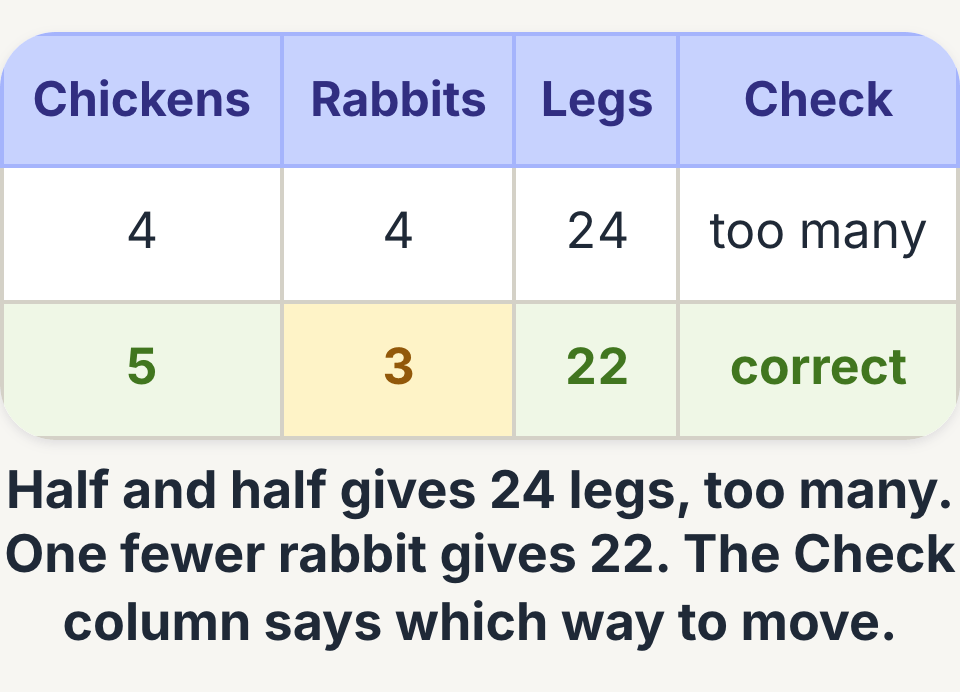
Guess and check means trying a sensible answer, checking it against the question, and using how far off it was to choose the next try. Some schools call it guess and verify. The rows that miss are part of the working, not a sign your child gave up.
- Taught
- P3 to P6
- Also called
- guess and verify
- Spot it by
- Small numbers, two kinds
When to use guess and check
The words in a question that point at this method. You do not need to solve the question to spot them.
“made up of five-dollar notes and ten-dollar notes”
Two kinds of thing and one total. The numbers are small, so a table of two or three tries gets there.
“has the same number of stickers and cards”
Two amounts that must come out equal. Guess the count, work out both, and check whether they match.
“What is the smallest number of turns”
Build up one try at a time and stop at the first that works. The smallest answer is the first one the table finds.
“How many of each”
You need two numbers that trade off against each other. One more of one kind means one fewer of the other.
“fewer than 40 in all”
A limit to test each guess against. A guess that breaks it is crossed out, and the next row starts from there.
Words to know
- Sensible guess
- A first try with a reason behind it, often half of each.
- Check column
- The last column of the table, where each try is marked.
- Too many
- What the check says when a guess overshoots (with money, too much). Go down next.
- Adjust
- Change the next guess using what the last check said.
How to do guess and check, step by step
A real question, the way Lah works every question in StudyLah: one step at a time, writing as she goes.
There are 16 notes in a wallet, made up of five-dollar notes and ten-dollar notes. The total value is $105. Find the number of ten-dollar notes.
- Use guess and check. Start with half of each: 16 ÷ 2 = 8 ten-dollar notes and 8 five-dollar notes.
- Count the money. 8 ten-dollar notes make $80 and 8 five-dollar notes make $40: $80 + $40 = $120. That is over $105, so it is too much.
- Too much means too many ten-dollar notes. Try 6 of them and 16 − 6 = 10 five-dollar notes: $60 + $50 = $110. Still too much.
- Try 5 ten-dollar notes and 16 − 5 = 11 five-dollar notes: $50 + $55 = $105. That is correct.
- So there are 5 ten-dollar notes.
Every question in StudyLah comes with a walkthrough like this one.
Try it freeThe one it gets confused with
Two of these look like guess and check on the page. The difference is what makes you stop writing rows.
Are the numbers big? The assumption method gets there in one calculation instead of several rows, and it is the faster road once a child trusts it.
Are you hunting for the one that fits, or counting every possibility? This stops when it finds. A list stops when it is complete.
Does the question hand you the final result? Then undo the steps, because there is nothing left to guess at.
Guess and check questions
Real questions from the years it is taught. Try one together, then tap to check.
P4 question
Aisha has the same number of stickers and cards. She gives each friend 2 cards and has 14 left, or 4 stickers and has 4 left. How many friends?
Show answer
Answer5. Guess the friends and check both totals. 3 friends gives 20 cards but 16 stickers, not equal. 5 friends gives 24 of each.
P5 question
A box of 6 pencils costs $5.40 and a box of 4 erasers $2.80. Raj bought 10 more pencils than erasers, fewer than 40 in all. What did he spend?
Show answer
Answer$21.80. Guess the pencils in 6s and check the gap: 18 pencils and 8 erasers differ by 10. That is 3 boxes and 2 boxes.
P6 question
Jar A has 5 marbles and Jar B has 17. A turn adds 9 to A or 5 to B. What is the fewest turns to make them equal?
Show answer
Answer6. Check each total Jar B reaches: 17, 22 and 27 fail, but 32 works. That is 3 turns for Jar A and 3 for Jar B.
Helping at home
How to tell it has clicked
Look at whether the wrong rows survived. A child who rubs out each failed try has understood the guessing and missed the checking, and loses the marks that were sitting in the rows they erased.
The other tell is the Check column. Too many and too few, written as words, mean your child is reading which way they were off rather than starting fresh each time.
Try this tonight
If they are stuck and the numbers are small, give them permission to write a wrong answer down. That is usually the unlock.
The first row is meant to be wrong. Its job is to say which way to move. A child who will not write anything until it is right cannot start this method at all.
Where your child will meet it
The topics it turns up in
Want the bigger picture on how these methods fit together? Maths heuristics: every method
See which methods your child reaches for
StudyLah names the method in every worked solution, so you can see whether the problem was the method or the arithmetic.