
Problem-solving method · Make a calculated guess
The assumption method (supposition method)
The assumption method solves "how many of each" problem sums by pretending everything is one kind, then correcting the total. One line of working replaces a page of guessing.
- Taught
- P4 to P6
- Also called
- supposition method
- Spot it by
- Two kinds, two totals
When to use the assumption method
The words in a question that point at this method. You do not need to solve the question to spot them.
“8 heads and 22 legs”
Two kinds of thing with two totals. This is the shape the method was built for.
“scored 3 points for each correct answer and lost 1 for each wrong”
A gain and penalty question. Assume every answer was correct, then trade down until the score matches.
“some $2 notes and some $5 notes”
Two denominations and one total value. Assume all of the cheaper kind and work up from the shortfall.
“the last task took 30 minutes longer”
An odd one out. Assume every task took the same time, then account for the extra separately.
“How many of each kind”
The answer is a split between two kinds, and supposition finds it without hunting for it.
Words to know
- Assume
- Pretend every item is the same kind, knowing it is not true.
- Shortfall
- How far the pretend total is from the real total.
- One swap
- What the total gains when one item changes to the other kind.
- ATEDO
- A memory aid some schools use for the five beats of the method.
How to do the assumption method, step by step
A real question, the way Lah works every question in StudyLah: one step at a time, writing as she goes.
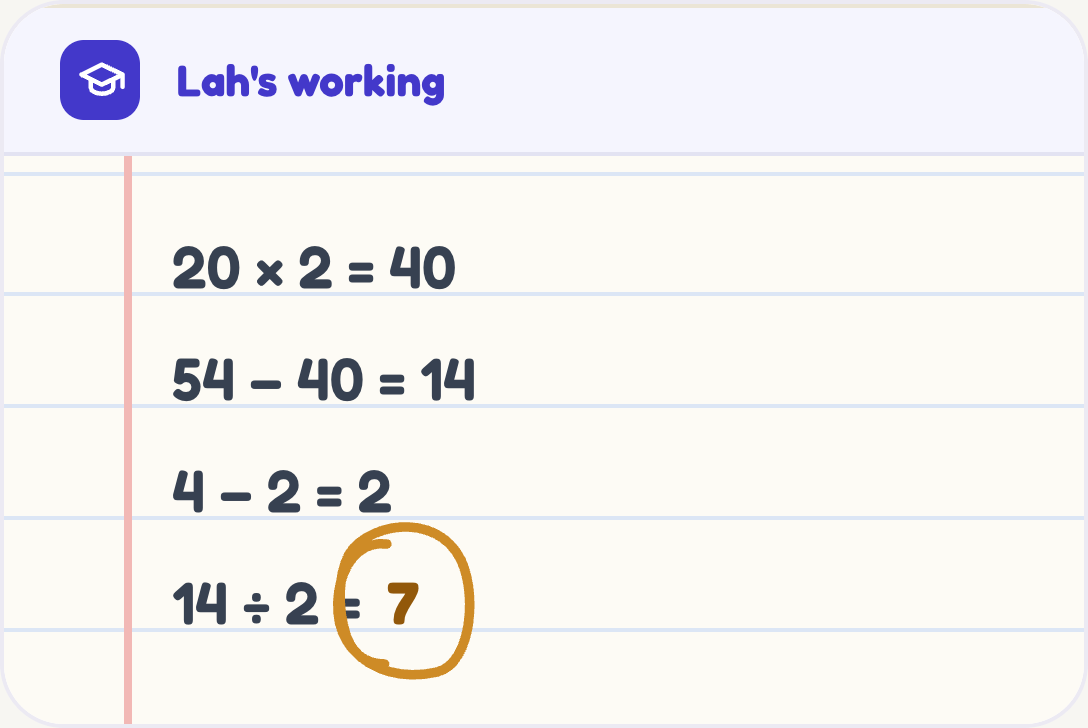
The chickens and rabbits on a farm have 54 legs altogether. There are 20 animals. A chicken has 2 legs and a rabbit has 4. Find the number of rabbits.
- This word problem mixes two kinds. Use the assumption method: suppose all 20 are chickens. That gives 20 × 2 = 40 legs.
- There are really 54 legs, so the guess is short by 54 − 40 = 14.
- Each time a chicken becomes a rabbit, the legs go up by 4 − 2 = 2.
- Divide to count the swaps: 14 ÷ 2 = 7. Each swap is one rabbit.
- So there are 7 rabbits.
Every question in StudyLah comes with a walkthrough like this one.
Try it freeThe one it gets confused with
The first of these solves the very same questions, which is why knowing when to switch matters more here than anywhere else on this page.
Are the numbers small? Then a two-row table is quicker and just as valid. This method earns its keep when guessing would take many rows.
Is it really two kinds of thing being counted? If the question compares amounts rather than counting two types, draw it instead.
Assumption method questions
Real questions from the years it is taught. Try one together, then tap to check.
P4 question
Sara has 28 coins, all 20-cent or 50-cent coins. Their total value is $9.80. How many 50-cent coins does she have?
Show answer
Answer14. Two kinds and one total: assume. All 20-cent coins make $5.60, short by $4.20. Each swap adds 30¢, and $4.20 ÷ 30¢ = 14.
P5 question
A courier delivered 200 jars. He earned $40 for each safe jar and paid $20 for each broken jar. He received $7100. How many jars were broken?
Show answer
Answer15. Assume all were safe: $8000, which is $900 too much. Each broken jar costs $40 + $20 = $60, and $900 ÷ $60 = 15.
P6 question
A factory makes 900 bicycles and tricycles with 2140 wheels in all. A bicycle has 2 wheels and a tricycle has 3. How many tricycles are there?
Show answer
Answer340. Assume all are bicycles: 1800 wheels, 340 short. Each tricycle adds 1 wheel, so there are 340 tricycles.
Helping at home
How to tell it has clicked
Ask what they assumed and why. A child with the method names the assumption in one sentence and knows it is false. A child without one describes the arithmetic they did and cannot say where the first number came from.
Watch for a table appearing. It means guess and check has been reached for instead, and while that may still get the answer, it is the slower road on the questions this method is set for.
Try this tonight
Ask what if they were all chickens? and let them tell you what goes wrong.
The answer they give, that there would not be enough legs, is the method. Everything after it is arithmetic, and the hard part is already done.
Where your child will meet it
The topics it turns up in
Want the bigger picture on how these methods fit together? Maths heuristics: every method
See which methods your child reaches for
StudyLah names the method in every worked solution, so you can see whether the problem was the method or the arithmetic.