
Problem-solving method · Give a representation
Systematic list
A systematic list counts every possibility in a fixed order, so your child can see that none is missing. Schools teach it as "make a systematic list", the method for problem sums that ask how many different ways.
- Taught
- P1 to P6
- Also called
- systematic listing
- Spot it by
- How many different ways
When to use a systematic list
The words in a question that point at this method. You do not need to solve the question to spot them.
“How many different ways”
The answer is a count of possibilities, so the possibilities have to be on paper first.
“shakes hands with every other friend once”
Every pair counts once. Fix one person, count only the pairs that are new, then move on.
“Each digit can be used only once”
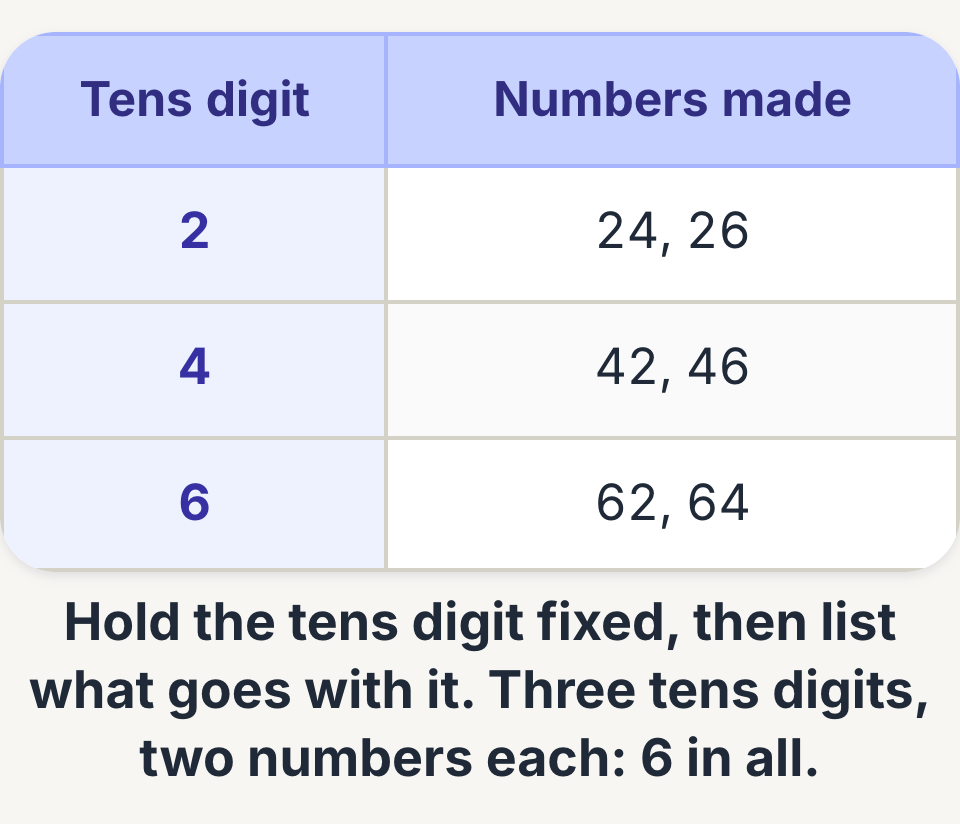
A small set to arrange. Hold one place fixed and list what can go with it.
“List all of them”
Completeness is being asked for, not an example. Work up from 1 so nothing is skipped.
“in how many ways can she pay”
Coins and notes. Fix the biggest one first, work down, and the order takes care of itself.
Words to know
- Hold it fixed
- Keep one choice the same while you list everything that goes with it.
- In order
- Smallest to largest, so a gap is easy to spot.
- One row each
- Every possibility gets its own line, so you can count them.
- New pairs only
- When pairing things up, count only the pairs not already listed.
How to do a systematic list, step by step
A real question, the way Lah works every question in StudyLah: one step at a time, writing as she goes.
There are 6 friends in a room. Each friend shakes hands with every other friend once. How many handshakes are there in total?
- Use a systematic list and start with the 1st friend. They shake hands with everyone else: 6 − 1 = 5 handshakes.
- The 2nd friend has already shaken hands with the 1st. So only 5 − 1 = 4 of their handshakes are new.
- Keep going: the 3rd friend adds 3 new ones, the 4th adds 2 and the 5th adds 1. The number pattern counts down by 1.
- Add the new handshakes: 5 + 4 + 3 + 2 + 1 = 15.
- So there are 15 handshakes in total.
Every question in StudyLah comes with a walkthrough like this one.
Try it freeThe one it gets confused with
Both of these also write things down as they go. What differs is what makes you stop writing.
Are you hunting for one answer that fits, or counting every possibility? Guess and check stops when it finds. A list stops when it is complete.
Does the question give you an end result? Then there is one answer to reverse to, not a set to list.
Systematic list questions
Real questions from the years it is taught. Try one together, then tap to check.
P3 question
Use the digits 7, 0, 4 and 3 once each. What is the greatest 4-digit even number you can make?
Show answer
Answer7430. Try each even digit last: 0 gives 7430 and 4 gives 7304. Listing both is how you know 7430 is the greatest.
P4 question
Which numbers are factors of both 12 and 20? List all of them.
Show answer
Answer1, 2, 4. Work up from 1 in factor pairs: 12 has 1, 2, 3, 4, 6, 12 and 20 has 1, 2, 4, 5, 10, 20.
P6 question
Mei Ling and Daniel had the same sum, under $35. She bought $7 notebooks with $2 left; he bought $5 folders with $1 left. How many folders?
Show answer
Answer3. List her possible sums in order: $9, $16, $23, $30. Only $16 leaves a whole number of folders: $15 ÷ $5 = 3.
Helping at home
How to tell it has clicked
Ask the only question that matters here: how do you know that is all of them? A child with the method points at the order. A child without one counts again and hopes for the same number.
Watch for a list written in the order the ideas arrived. It is often complete by luck, which hides the gap until a harder question turns up.
Try this tonight
Next time you order food, ask how many different combinations there are from two mains and three drinks.
Then ask the harder one: how do you know you got them all? If they cannot answer that, it is the thing to practise, not the counting.
Where your child will meet it
The topics it turns up in
In the PSLE's hardest questions
Want the bigger picture on how these methods fit together? Maths heuristics: every method
See which methods your child reaches for
StudyLah names the method in every worked solution, so you can see whether the problem was the method or the arithmetic.