
Problem-solving method
The grouping method
The grouping method solves problem sums where things come in fixed sets: work out what one group is worth, then how many groups there are. Tuition centres also call it the grouping concept, and it keeps every number whole.
- Taught
- P2 to P6
- Also called
- grouping concept
- Spot it by
- Sold in fixed sets
When to use the grouping method
The words in a question that point at this method. You do not need to solve the question to spot them.
“sold in packets of 8”
The question has already fixed the group for you. You cannot buy part of a packet, so whatever else happens, the answer has to come out in whole packets.
“an equal number of pencils and pens”
One of each is the group. Add the two prices together to get what a single set is worth, then divide the total by that.
“the least amount of money”
The last group will usually be a part group, and that is the whole question. Read carefully whether she has to buy it or can leave it behind.
“for every 4 pens bought, 1 free”
A deal, not a package. The group is five pens at the price of four, so you count in fives and pay in fours.
“the table shows the parking charges”
Tiered pricing. The first block nearly always costs something different from the rest, so the group is each extra half hour, not each hour.
Words to know
- Group
- One set the question fixes, like a packet of 8 or one of each.
- One set's value
- What one whole group costs or holds.
- How many groups
- The total divided by one group. Often not the final answer.
- Round up
- Count a part-group as a whole one when it must still be bought.
How to do the grouping method, step by step
A real question, the way Lah works every question in StudyLah: one step at a time, writing as she goes.
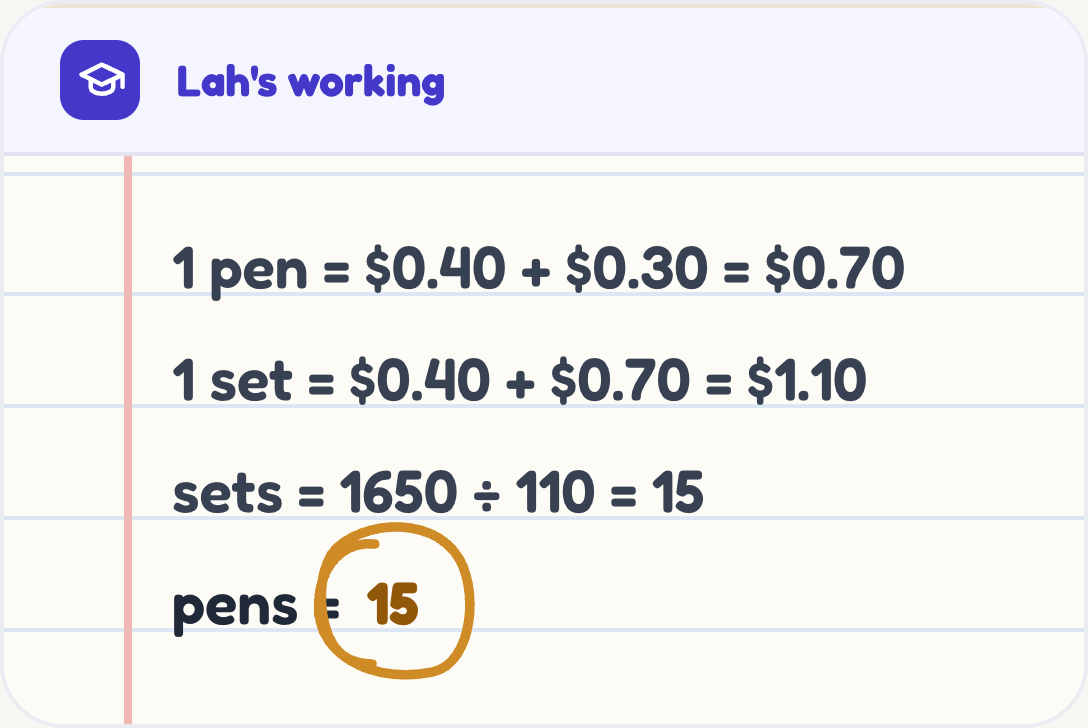
Lina bought an equal number of pencils and pens. A pencil costs $0.40 and a pen $0.30 more. She spent $16.50 in all. How many pens did she buy?
- Each pen costs $0.30 more than a pencil, so 1 pen is $0.40 + $0.30 = $0.70.
- She bought the same number of each, so group 1 pencil and 1 pen into one set: $0.40 + $0.70 = $1.10.
- Work in cents: $16.50 is 1650 cents and one set is 110 cents. Divide: 1650 ÷ 110 = 15 sets.
- The question asks for pens, not sets. Every set holds 1 pen.
- So Lina bought 15 pens.
Every question in StudyLah comes with a walkthrough like this one.
Try it freeThe one it gets confused with
All three of these show up in the same papers and look alike on the page. What separates them is one question you can ask before any arithmetic starts.
Do you know what things are actually worth, or only how they compare? Grouping works in real prices. Units and parts counts equal units when nothing has a value yet.
Can you work out what one group is worth directly? If you can, grouping gets there in a single division. Guessing is the fallback for when no group has a price you can find.
Are the two things bought in a fixed pairing, or in numbers nobody has told you? An equal number of each is a group. Chickens and rabbits sharing 94 legs is not.
Grouping method questions
Real questions from the years it is taught. Try one together, then tap to check.
P3 question
Eggs are sold in trays of 7. Mr Lee needs 60 eggs for his bakery. How many trays must Mr Lee buy at least?
Show answer
Answer9. One group is a tray of 7. 60 ÷ 7 = 8 R 4, and the 4 extra eggs still need a tray, so round up.
P4 question
Devi mixed 16.4 ℓ of white paint and 5.2 ℓ of blue paint, then poured it all into identical 6 ℓ tins. Find the least number of tins needed.
Show answer
Answer4. The paint is 16.4 + 5.2 = 21.6 ℓ, and one group is a 6 ℓ tin. 21.6 ÷ 6 = 3.6, so round up to 4.
P6 question
Farah had 3 times as many $2 notes as $5 notes, with $176 in total. How many $5 notes did she have?
Show answer
Answer16. One set is three $2 notes and one $5 note, so $11. $176 ÷ $11 = 16 sets, and each set holds one $5 note.
Helping at home
How to tell it has clicked
Ask one question before they start: what is one group here? If they can answer that in a sentence, the rest is arithmetic they can already do. If they cannot, more practice questions will not help until that part is fixed.
Watch what happens when the division does not come out even. A child who has understood stops and asks whether the leftover means one more packet or one fewer. A child who has memorised writes down the decimal and carries on.
Try this tonight
Do it in the supermarket aisle, on anything sold in a multipack. These come in packs of 6 and we need 20. How many packs?
Then ask the part that is actually the skill: we will have some left over, so do we round up or down? That is the same decision the exam question is testing, with the shopping still in your hands.
Where your child will meet it
The topics it turns up in
Want the bigger picture on how these methods fit together? Maths heuristics: every method
See which methods your child reaches for
StudyLah names the method in every worked solution, so you can see whether the problem was the method or the arithmetic.