
Problem-solving method · Go through the process
The equal stage method
The equal stage method is for problem sums that end with "and then they had the same": draw that moment first, call each side 1 unit, then work back. That one sentence is where the drawing begins.
- Taught
- P5 to P6
- Family
- Go through the process
- Spot it by
- They end up equal
When to use the equal stage method
The words in a question that point at this method. You do not need to solve the question to spot them.
“In the end they each had the same amount”
The one length in the question you are given for free. Draw it before anything else and make each person 1 unit.
“until all three bottles contained equal amounts”
The same signal with three quantities and no money in sight. What matters is that one named moment makes them level.
“spent half of his money”
A fraction of that person's OWN amount, so what is left is the unit. Halved means their starting bar is 2 units, not 1.
“had $280 altogether”
The total belongs to the START. You can only use it once both starting amounts are written in units, which is the step children skip.
Words to know
- The equal moment
- The point in the story where the two amounts match.
- 1 unit each
- What each side is called at that moment.
- Work back
- Undo each change to find the starting amounts in units.
- What is left
- After spending a fraction, the part kept. That part is the unit.
How to do the equal stage method, step by step
A real question, the way Lah works every question in StudyLah: one step at a time, writing as she goes.
Mei and Raju had $280 altogether. Mei got $50 from her aunt and Raju spent half his money. Then they had the same. How much did Raju have at first?
- This is a before and after problem. They end with the same amount, so draw a bar model and let each end with 1 unit.
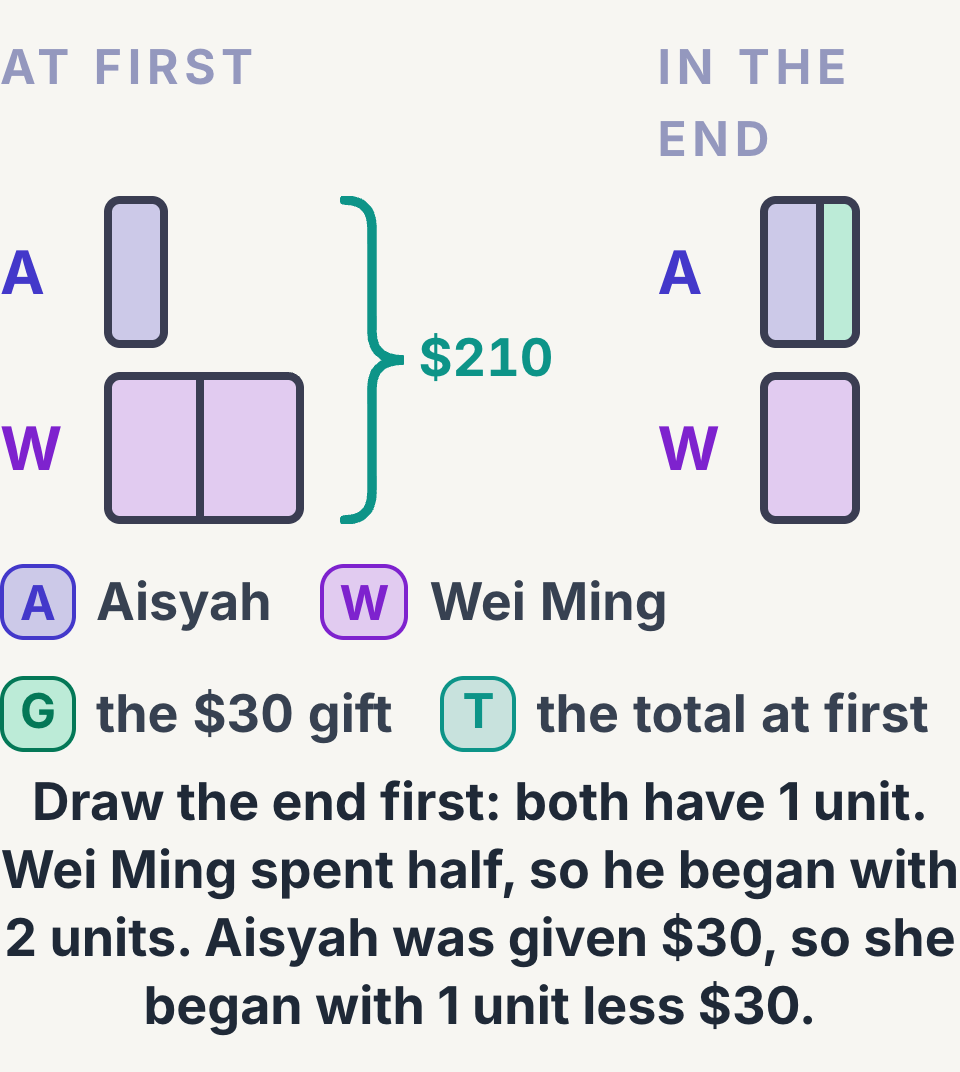
- Raju spent half and kept half, so at first he had 2 units. Mei got $50 from her aunt, so her own money at first was 1 unit less the $50.
- At first they had $280 altogether: 3 units − $50 = $280. So 3 units = $280 + $50 = $330.
- Divide to find 1 unit: $330 ÷ 3 = $110. Raju had 2 units, so 2 × $110 = $220.
- So Raju had $220 at first.
Every question in StudyLah comes with a walkthrough like this one.
Try it freeThe one it gets confused with
Three methods sit close to this one, and the question that separates them is always about what the question actually told you.
Does the question name a moment where the two are LEVEL? If it only says something changed, you still need two pictures, but there is no equal length to anchor them to.
Constant total and constant difference
Is something unchanged the whole way through? Those methods anchor on the thing that never moved. This one anchors on a moment the two MATCH, which is not the same idea.
Units and parts is how you turn the equal moment into numbers once you have it. Equal stage is the earlier decision about where the 1 unit belongs in the first place.
Equal stage method questions
Real questions from the years it is taught. Try one together, then tap to check.
P5 question
Lily and Ben had $234 at first. Lily was given $36, and Ben spent half of his money. Then they had equal amounts. How much did Ben have at first?
Show answer
Answer$180. End with 1 unit each, so Ben began with 2 units and Lily with 1 unit less $36. 3 units = $270, so 1 unit is $90.
P6 question
Bottle D is full of oil; same-size bottles E and F are each full. Oil from D is poured until all three match. What fraction of D was poured?
Show answer
Answer. Altogether there is of a bottle, so each ends with . D pours out 1 − .
P6 question
Tank X is full; same-size tanks Y and Z are each full. Water from X is shared until all three match. What fraction of X was moved?
Show answer
Answer. There is of a tank in all, so each ends with . X gives out 1 − .
Helping at home
How to tell it has clicked
Give them a question ending in "and then they had the same" and watch where the pencil lands. A child who draws the END has the method. One who writes "at first" and stops is trying to work forwards through the unknowns.
The sharper test: ask which person is 2 units. With a reason, "the one who spent half, because the half left is the unit", they have it. With a shrug, they copied the shape from a similar question.
Try this tonight
One question, before any drawing: which sentence tells you the two are the same? Have them underline it. In most of these questions it is the second to last line, and it is the line that gets skimmed.
Then one more: so how many units is each of them at the start? That is where the method actually lives. Everything after it is arithmetic they can already do.
Where your child will meet it
The topics it turns up in
Want the bigger picture on how these methods fit together? Maths heuristics: every method
See which methods your child reaches for
StudyLah names the method in every worked solution, so you can see whether the problem was the method or the arithmetic.